 English
 Español
 русский
 中文简体
中文简体NTF Fixed Lifting and Tilting Transfer Machine
The NTF Fixed Lifting and Tilting Transfer Machine is designed for the tran.....

Content
Efficient material transfer is one of the most important requirements in pharmaceutical solid dosage production. Granules, powders, milled products, and other solid materials must move from one processing stage to the next without unnecessary exposure, dust release, cross-contamination, or loss of product quality. At the same time, the transfer system must be flexible enough to connect equipment installed at different elevations and reliable enough to support repeated industrial operation.
The NTF Fixed Lifting and Tilting Transfer Machine is designed to address these requirements. It provides an enclosed method for lifting, positioning, rotating, and discharging conical bins used in pharmaceutical, chemical, food, and related processing applications. By combining a fixed lifting structure with a controlled tilting mechanism, the machine enables material transfer between equipment such as fluid bed granulators, fluid bed dryers, and milling units.
Unlike simple manual handling methods or open transfer arrangements, the machine is designed around controlled docking and enclosed discharge. The conical bin can be raised to the required height, rotated toward the receiving machine, lowered into position, and discharged through a butterfly valve. This sequence helps improve process continuity while supporting hygienic production and reducing the possibility of dust escaping into the working environment.
The equipment is manufactured and supplied by Changzhou Zhiyang Machinery Equipment Co., Ltd., a China-based manufacturer specializing in powder processing, oral solid dosage, and process-integrated equipment. Since its establishment in 2010, the company has developed equipment for laboratory, pilot-scale, and full-scale production. Its product portfolio includes laboratory equipment, mixing systems, granulation equipment, drying equipment, coating equipment, auxiliary processing equipment, and transfer and conveying systems.
This article examines the working principle, construction, operating sequence, hygienic design, safety features, application value, manufacturing strengths, and technical parameters of the NTF Fixed Lifting and Tilting Transfer Machine. It also explains how the machine compares with conventional material transfer methods and why it can be integrated into modern pharmaceutical production lines.
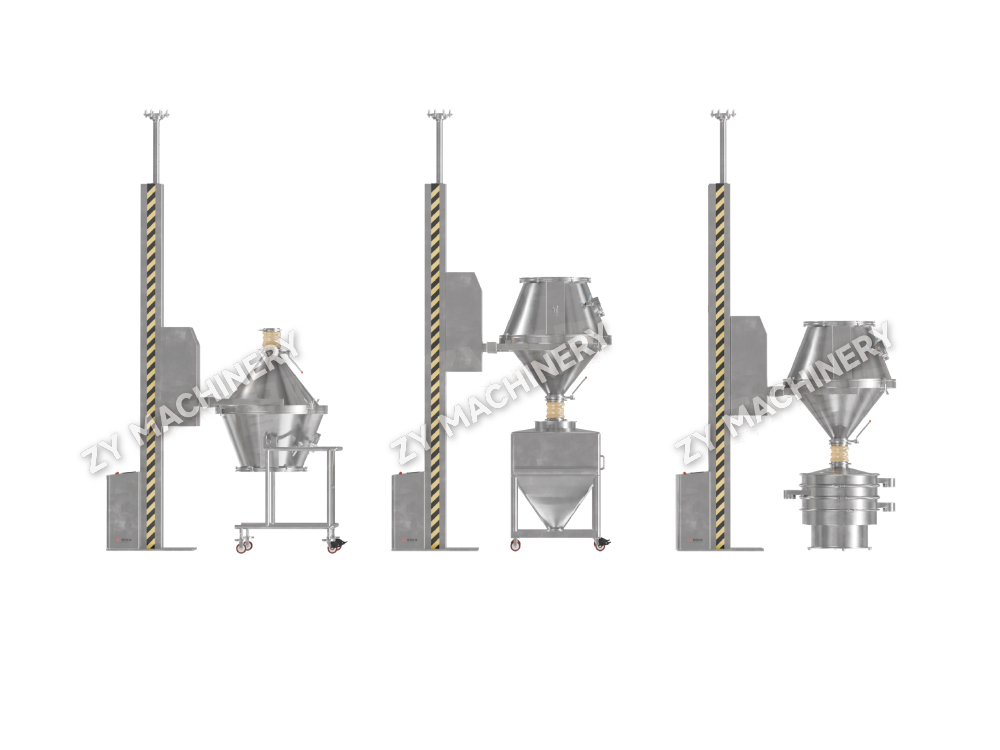
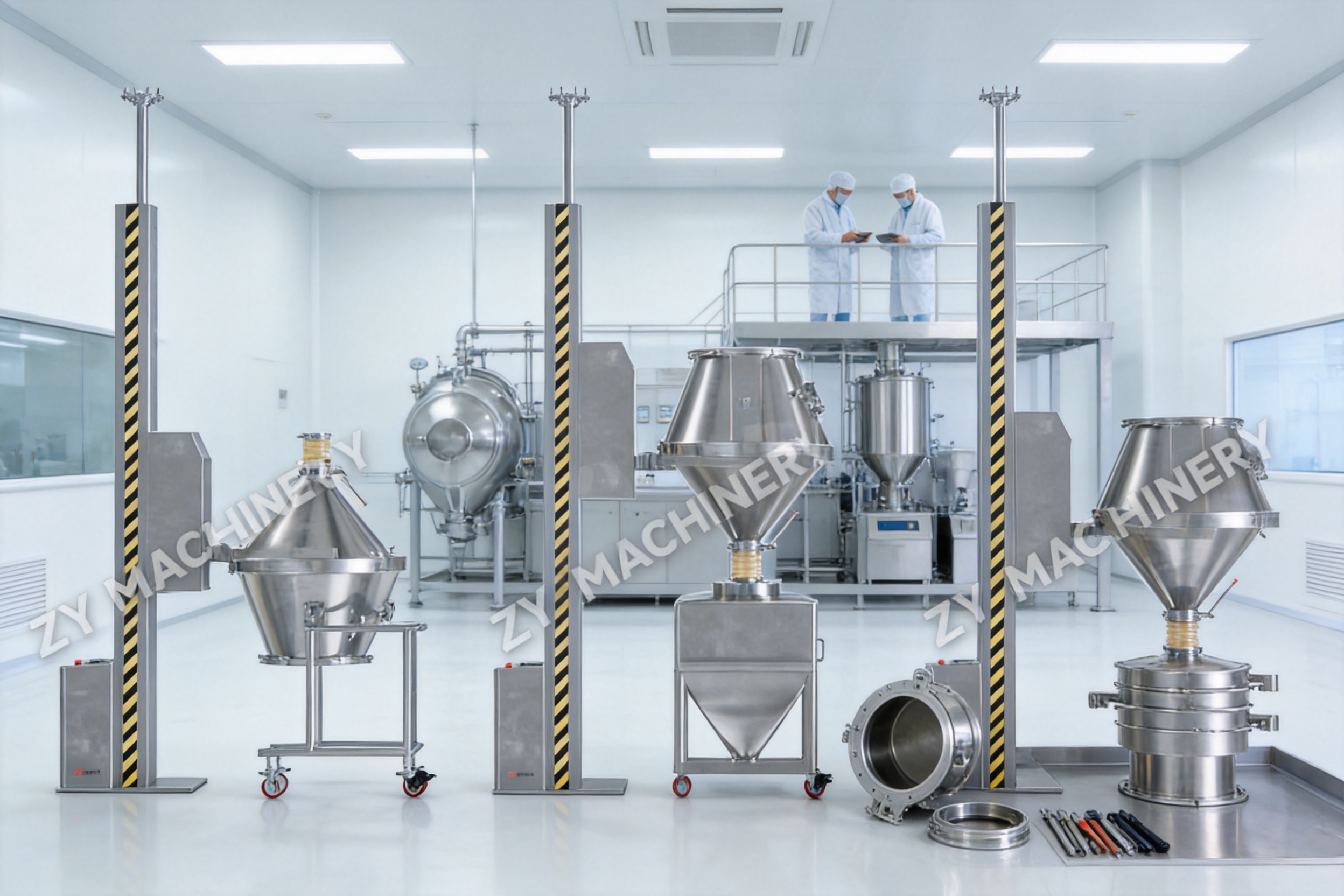
NTF Fixed Lifting and Tilting Transfer Machine
In a solid dosage manufacturing process, material quality can be affected at every transfer point. After blending, granulation, drying, milling, or another operation, the product must be moved without changing its physical characteristics or exposing it to contamination. A transfer step that appears simple from a mechanical perspective can create major process risks when the material is dusty, cohesive, moisture-sensitive, or sensitive to handling damage.
Open transfer may allow dust to enter the production area and may expose the product to environmental contaminants. Manual lifting and repositioning can create ergonomic risks and may introduce variation in the way material is discharged. Fixed-height equipment can also make process integration difficult when the outlet of one machine does not align with the inlet of another machine.
These challenges become more significant in facilities that operate several production batches each day. A transfer system must be sufficiently repeatable to support stable operation over time. It must also be easy to clean, inspect, and maintain because residues from one product can affect the next batch. For pharmaceutical manufacturers, the transfer method should support the principles of good manufacturing practice, including control of contamination, clear operating procedures, and effective cleaning.
The NTF machine responds to these needs by treating material transfer as an integrated process rather than as a simple movement from one location to another. Its lifting mechanism manages elevation, its tilting system manages discharge orientation, and its rotating column helps align the bin with downstream equipment. These functions allow the transfer operation to be coordinated with the layout and height of the production line.
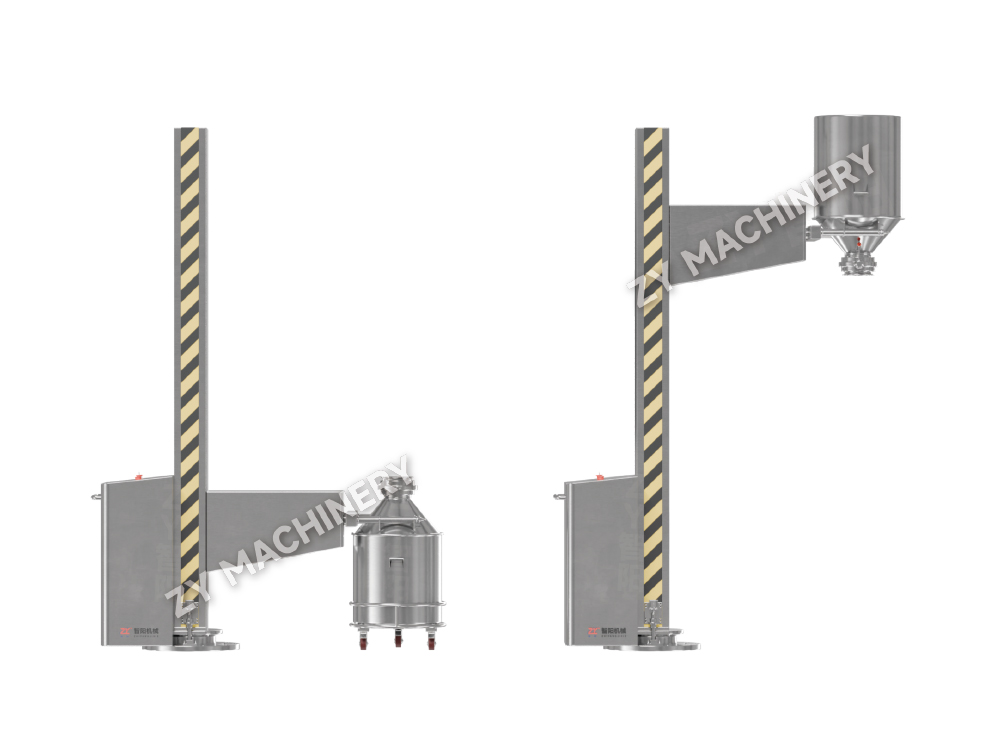
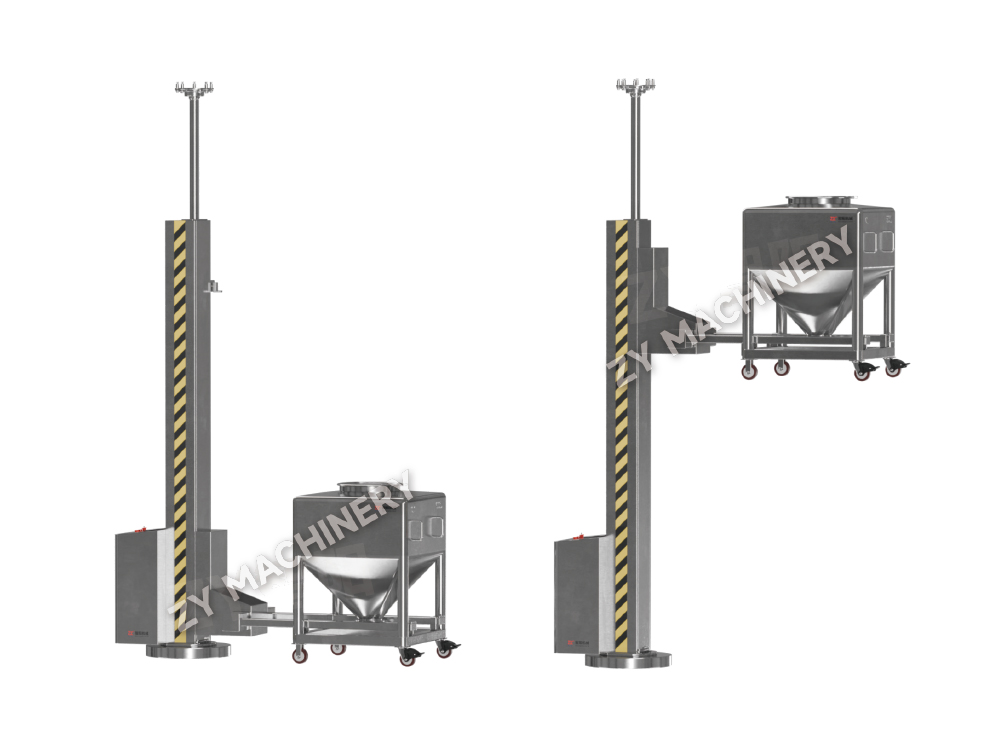
The NTF Fixed Lifting and Tilting Transfer Machine is a stationary lifting and conveying system for solid materials. Its principal purpose is to transfer material contained in a conical bin from one process stage to another. The machine is particularly suitable for use with fluid bed granulators, fluid bed dryers, and milling units, although the same operating concept can be applied to other compatible processing equipment.
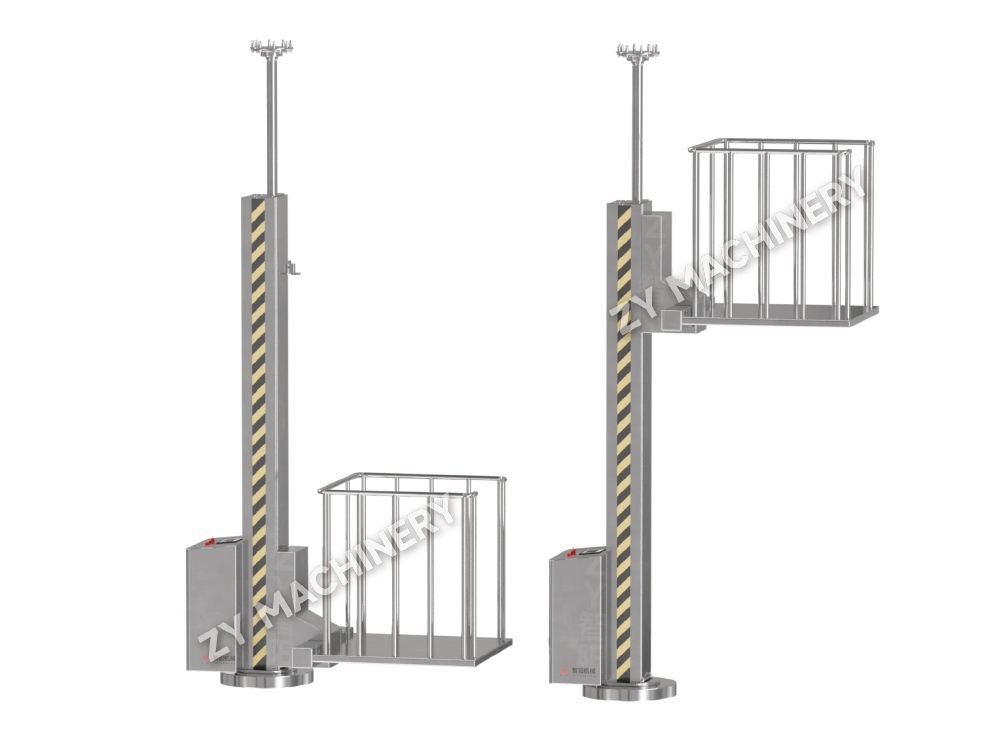
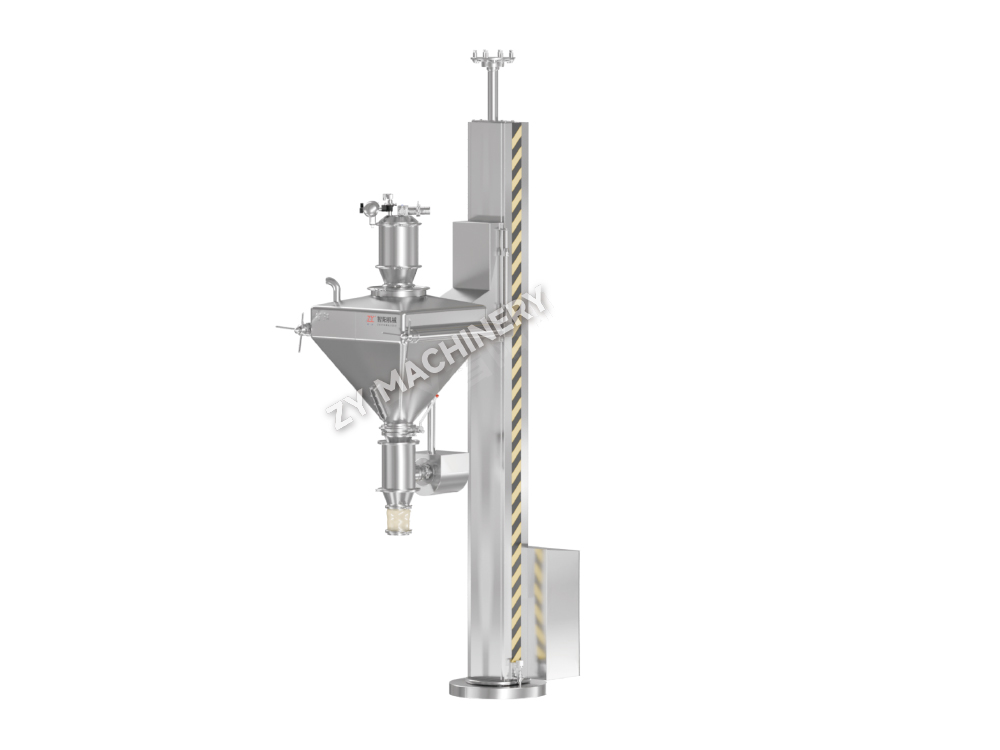
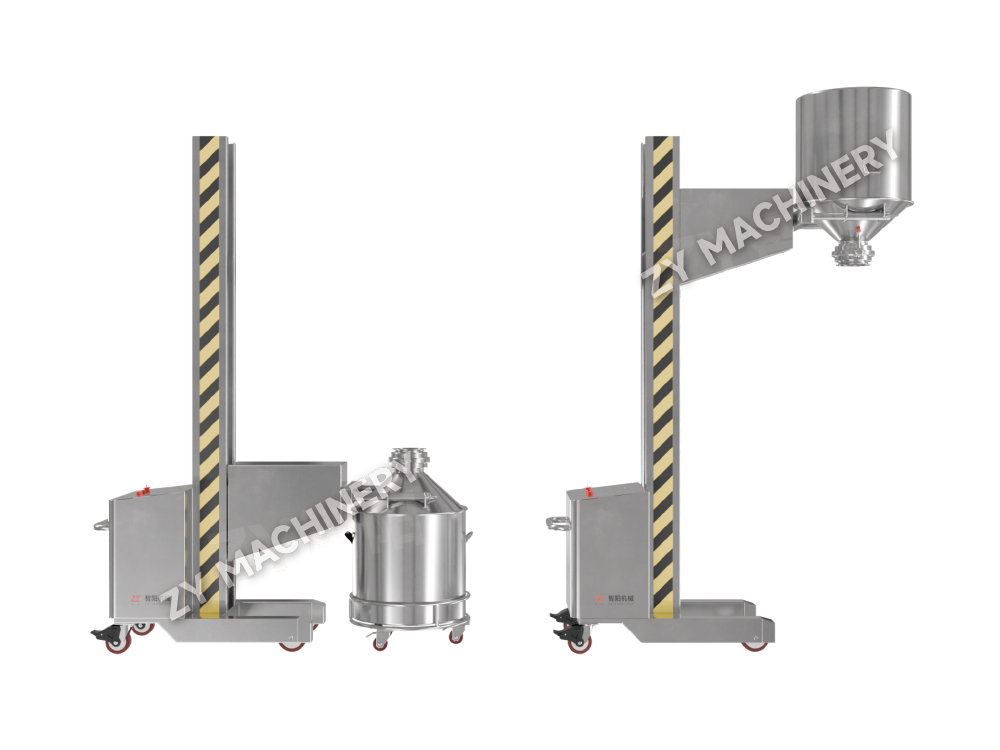
The machine consists of a base frame, a vertical column, a lifting mechanism, and a tilting system. Together, these components provide controlled movement in the vertical and rotational directions. The fixed structure gives the machine a stable operating foundation, while the lifting and tilting functions allow the bin to reach different process positions.
During operation, the conical bin is docked with the inlet of the receiving equipment. The lifting system raises the bin to the designated elevation. The tilting mechanism then rotates the bin by up to 180 degrees to prepare it for discharge. After the brake is released, the column can be rotated horizontally so that the bin aligns with the downstream process. The bin is lowered to the required working height, and the butterfly valve is opened to transfer the material under enclosed conditions.
The machine is not limited to one type of production scale. The NTF series includes models from NTF-200 through NTF-1000. This range allows users to select a configuration according to their process volume, layout, and equipment interface requirements.
The transfer cycle begins when the conical bin is positioned and docked with the inlet of a fluid bed granulator, fluid bed dryer, milling unit, or other compatible process machine. Proper docking establishes a controlled connection between the bin and the receiving equipment. This connection is important because it helps limit material exposure during transfer and supports a more consistent process route.
The docking arrangement also allows the transfer machine to function as part of a larger production system. Instead of requiring operators to manually empty the bin into a separate container, the machine positions the bin directly in relation to the next process stage. This can reduce intermediate handling and make the material flow easier to manage.
Once the bin is correctly positioned, the lifting mechanism raises it to the designated height. The vertical column provides the structural support for this movement. Lifting allows the machine to accommodate differences in elevation between the bin and the receiving equipment.
This function is particularly useful in production facilities where process machines have different inlet heights. Rather than redesigning the complete production line or relying on temporary platforms, the transfer machine can adjust the position of the bin within its operating range. The result is a more adaptable connection between upstream and downstream equipment.
After reaching the required elevation, the tilting system rotates the bin by up to 180 degrees. This movement prepares the material container for discharge. The machine can then rotate horizontally after the brake is released, allowing the operator to align the bin with the next process stage.
The combination of vertical lifting, tilting, and horizontal rotation gives the machine three-dimensional positioning capability. This is one of its main practical advantages over simple fixed conveyors or manually operated lifting devices. The transfer route can be adjusted according to the layout of the facility and the location of the receiving equipment.
After the bin is aligned, it is lowered to the required working position. Lowering the bin into the correct location supports stable docking and helps ensure that the discharge valve is properly positioned above the receiving inlet.
A controlled lowering sequence is important for protecting equipment interfaces and reducing the likelihood of sudden impact. It also provides a repeatable operating method that can be included in standard operating procedures.
When the bin is in the correct position, the butterfly valve is opened to allow material to move into the next processing stage. The discharge takes place through the enclosed connection between the bin and the receiving equipment. This arrangement helps reduce dust generation compared with open manual transfer.
The butterfly valve includes a misoperation prevention design. This feature helps reduce the chance of opening the valve at an incorrect stage of the transfer cycle. The valve can also be dismantled for cleaning, which supports maintenance and sanitation requirements.
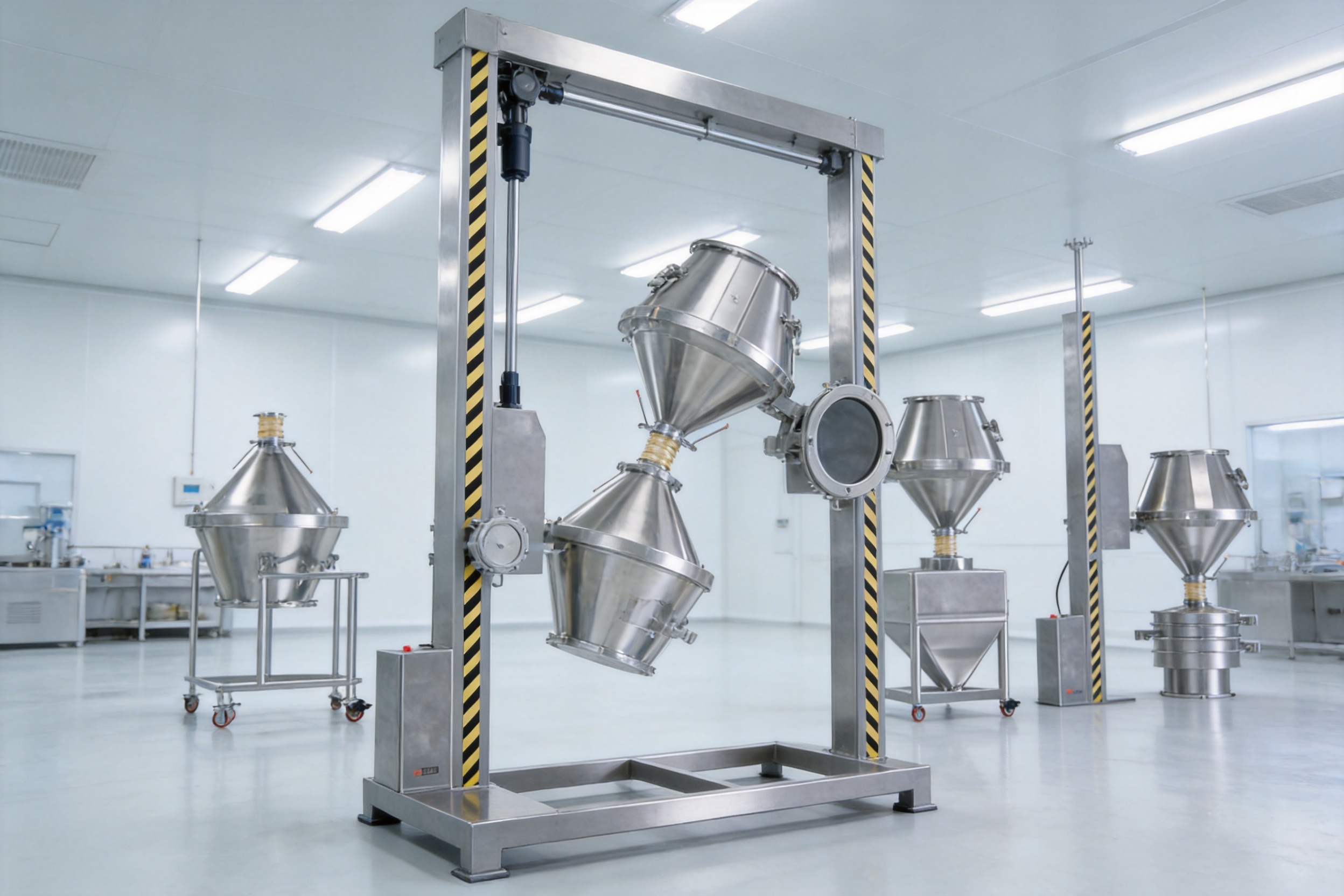
The base frame supports the complete machine and provides a stable foundation for lifting, tilting, and rotational movement. A rigid base is essential because the machine must handle the weight of the bin and its contents while maintaining alignment with process equipment.
The fixed installation format is suitable for production areas where the transfer point is part of a defined process layout. It avoids the instability that may occur when heavy material containers are moved manually or supported on temporary structures.
The vertical column provides the main structural path for lifting operations. It connects the base structure with the lifting mechanism and supports the movement of the bin through different working elevations.
Because the column also participates in horizontal rotation, it contributes to the machine’s ability to align the bin with downstream equipment. This integrated design allows the transfer system to perform positioning functions without requiring multiple separate machines.
The lifting mechanism raises and lowers the bin according to the requirements of the production process. Its purpose is not only to move the bin but also to help match the elevation of the container outlet with the receiving inlet.
Height adjustment can be valuable when a granulator, dryer, or mill has a different working level from the equipment used earlier in the process. The lifting mechanism provides a practical solution for these differences and can help reduce the need for extensive civil or layout changes.
The tilting system rotates the conical bin by up to 180 degrees. This movement supports discharge preparation and allows the bin to be oriented according to the process arrangement.
Tilting is especially useful when the material must be discharged from a container into a machine located at a different orientation. Instead of relying solely on gravity through a fixed outlet, the system allows the bin position to be actively adjusted.
The butterfly valve controls the material outlet. It is designed with a misoperation prevention arrangement to support safer operation. Its removable construction makes it easier to dismantle, inspect, and clean.
Since the valve is directly involved in product discharge, cleanability is a major consideration. A valve that can be removed without excessive difficulty can simplify sanitation work and help operators inspect contact surfaces more effectively.
Pharmaceutical manufacturing requires equipment surfaces and transfer routes that can be cleaned effectively. Residual powder may accumulate in corners, gaps, or poorly designed joints. If residues are not removed, they may contribute to cross-contamination, microbial risk, or batch-to-batch quality concerns.
The NTF machine is designed with contact surfaces that avoid dead corners and exposed fasteners. This design approach supports more effective cleaning and reduces locations where powder can accumulate. Smooth and accessible contact areas also make visual inspection easier for operators and maintenance personnel.
The removable butterfly valve is another important hygienic feature. Because the valve can be dismantled for cleaning, operators can access relevant product-contact areas rather than relying only on external wiping or limited in-place access.
Enclosed transfer is also valuable in powder handling. When material moves from a bin to a downstream machine through a controlled connection, the product is less exposed to the surrounding environment. At the same time, the production area is less likely to receive airborne dust from the transfer operation.
Reduced dust release can improve housekeeping and help create a more comfortable working environment. It can also reduce the risk that powder from one product will settle on nearby equipment or surfaces. For facilities handling multiple products, this reduction in uncontrolled material movement can support more effective contamination control.
These features do not replace a complete cleaning validation, containment assessment, or GMP program. However, they provide a machine design that is compatible with the practical objectives of pharmaceutical hygiene management.
One of the clearest advantages of the NTF system is its ability to transfer material through a controlled and enclosed route. Conventional manual handling may require operators to open a container, lift or tip it, and pour the material into another machine. This approach can increase dust release and may create inconsistent discharge conditions.
The NTF system positions the bin and opens the discharge valve only after the equipment is correctly aligned. This provides a more organized transfer sequence and helps reduce unnecessary product exposure.
A fixed-height transfer point may work only when the upstream and downstream machines have compatible elevations. If equipment is changed or the production layout is modified, the fixed transfer arrangement may become inconvenient.
The lifting mechanism of the NTF machine allows the bin to be raised or lowered to the required position. This adaptability can simplify process integration and help manufacturers use the machine with different types of equipment.
Manual transfer may require several steps to orient the bin, move it to the correct location, and prepare it for discharge. Each additional handling step can increase labor requirements and create more opportunities for error.
The NTF machine combines vertical lifting, tilting, and horizontal rotation in one coordinated system. This integrated motion can reduce the need for separate lifting aids, temporary supports, or repeated manual repositioning.
Equipment with exposed fasteners, inaccessible corners, and permanent valves can be difficult to clean thoroughly. The NTF design focuses on contact surfaces without dead corners and includes a detachable butterfly valve.
Compared with less hygienically designed transfer devices, this arrangement can make cleaning and inspection more straightforward. Easier cleaning may also reduce the time required between batches, depending on the validated cleaning procedure and the material being processed.
The machine is designed to operate with fluid bed granulators, fluid bed dryers, and milling units. This makes it suitable for process routes where material passes through multiple stages and must remain within a controlled container during transfer.
A transfer machine that can work across several process stages may reduce the need to use different handling methods at each point. Standardizing the transfer approach can help simplify training, maintenance, and operating procedures.
The misoperation prevention design of the butterfly valve provides an additional operational safeguard. While operator training and written procedures remain essential, mechanical prevention features can help reduce the possibility of opening the valve at an unsuitable time.
This is particularly important when the bin is being moved, when the receiving equipment is not ready, or when the bin has not reached its correct docking position. A controlled valve arrangement supports more disciplined operation.
An important feature of the configuration is that the granulating or milling unit can be lifted synchronously with the conical bin. This capability helps match different process heights and supports sealed docking with downstream equipment.
Production equipment is not always installed at the same elevation. In some facilities, the available floor space, ceiling height, process sequence, or equipment design creates differences between the bin outlet and the next machine inlet. Synchronized lifting provides a way to compensate for these variations.
Sealed docking is valuable because it supports the continuity of the material path. When the bin and receiving unit are correctly connected, the transfer can take place with less opportunity for dust to escape or external particles to enter. This can be especially useful when processing fine powders or dry granules.
The synchronized configuration may also reduce the need for additional transfer accessories. Instead of adding multiple flexible connections, platforms, or manual lifting arrangements, the machine can provide the necessary positioning function within the process equipment system.
For engineering teams, this flexibility can simplify equipment planning. The final configuration must still be designed according to the specific equipment dimensions, load requirements, room height, and process validation requirements, but the machine provides a practical foundation for integrated installation.
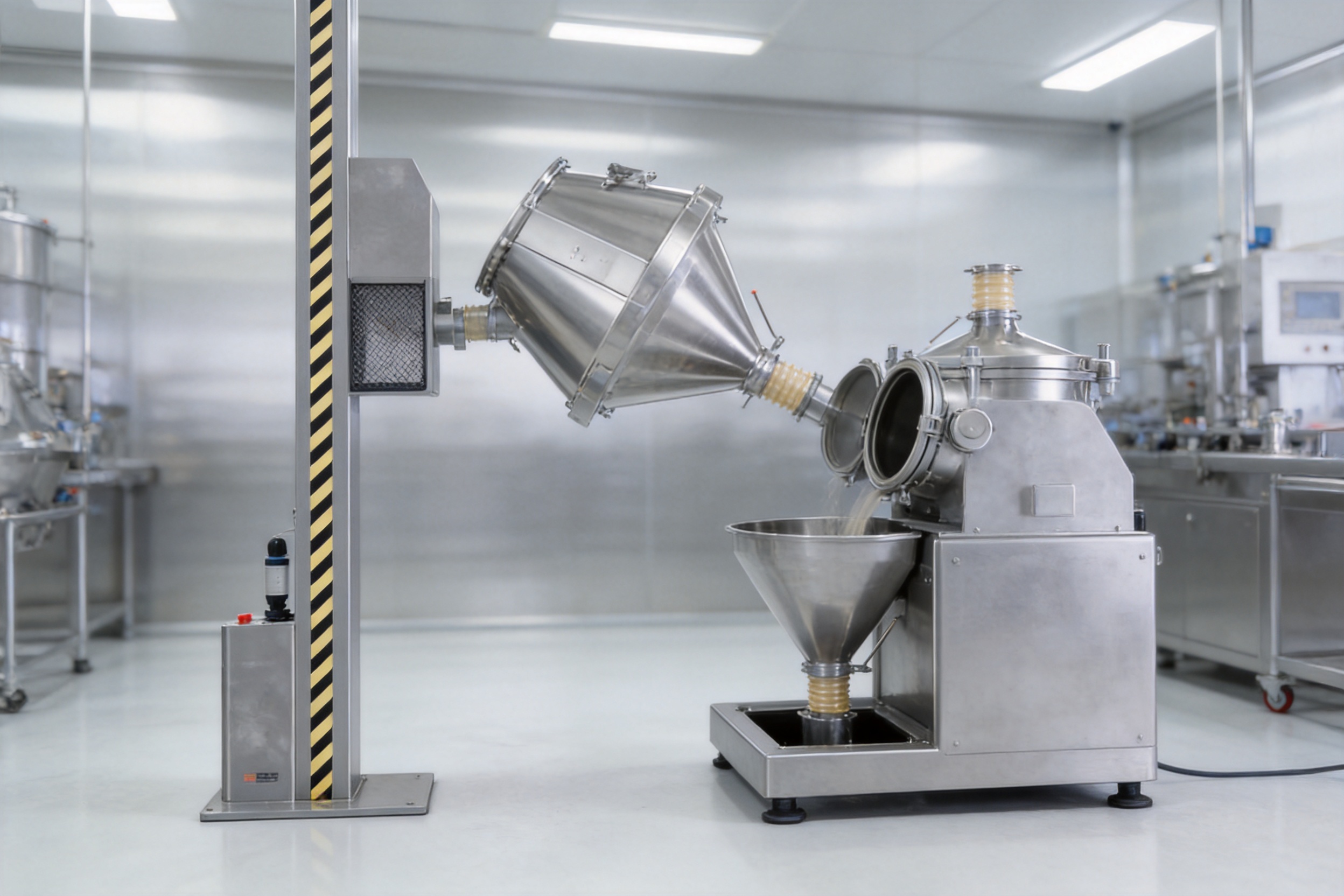
The primary application of the NTF machine is pharmaceutical solid dosage production. It can be used in process routes involving granulation, drying, milling, and transfer of intermediate materials.
In a typical route, wet or dry granules may be processed in a granulator, dried in a fluid bed dryer, reduced in size through a milling unit, and then moved to the next operation. The transfer machine can help connect these stages while keeping the material in a conical bin and reducing unnecessary manual intervention.
The enclosed transfer concept is suitable for manufacturers seeking to improve dust control, cleaning access, and process consistency. It can be used in facilities producing tablets, capsules, granules, and other oral solid dosage forms, subject to the final process design.
Chemical manufacturers may also use the machine for powders, granules, additives, and other solid materials. In chemical applications, the appropriate material of construction, sealing arrangement, and safety configuration must be selected according to the characteristics of the product.
The lifting and tilting functions can help transfer material between process machines where the products are difficult to handle manually or where open transfer is undesirable.
Food manufacturers may require hygienic transfer for ingredients, premixes, powders, and granulated products. The machine’s cleanable contact surfaces and enclosed discharge concept can support controlled handling in suitable food-processing environments.
As with pharmaceutical use, the final design should consider the product’s flowability, moisture content, particle size, cleaning requirements, and applicable hygiene regulations.
Nutraceutical, veterinary, biotechnology, and additives manufacturers often handle materials using process steps similar to pharmaceutical production. These may include blending, granulation, drying, milling, and controlled transfer.
The NTF system can be considered where a facility requires a repeatable method for moving solid materials between machines while maintaining a clean and organized production route.
The NTF series is available in five principal models. The following data presents the listed power ratings and reference installation dimensions.
| Item | Unit | NTF-200 | NTF-300 | NTF-500 | NTF-800 | NTF-1000 |
| Power | kW | 1.3 | 1.65 | 2.75 | 2.75 | 2.55 |
| Reference installation dimension L1 | mm | 2200 | 2440 | 2940 | 3170 | 3370 |
| Reference installation dimension L2 | mm | 1075 | 1200 | 1600 | 1730 | 1830 |
| Reference installation dimension W1 | mm | 700 | 700 | 700 | 700 | 700 |
| Reference installation dimension W2 | mm | 1080 | 1280 | 1480 | 1680 | 1880 |
| Reference installation dimension H1 | mm | 2000 | 2000 | 2000 | 2000 | 2000 |
| Reference installation dimension H2 | mm | 3550 | 3700 | 3950 | 4050 | 4400 |
| Reference installation dimension H3 | mm | 3700 | 3800 | 4100 | 4200 | 4500 |
These dimensions are provided for installation reference. Actual equipment selection and final layout should be confirmed according to the conical bin, receiving machine, building height, material load, working clearance, cleaning access, and process requirements.
Successful installation begins with a detailed review of the process route. The engineering team should identify the upstream equipment, downstream equipment, bin size, required lifting height, discharge orientation, available floor area, and available ceiling height.
The reference values for H2 and H3 indicate that vertical clearance is an important planning factor. Larger models require greater installation height. Before installation, the facility should verify that the machine can complete its full lifting and tilting movement without interfering with beams, ducts, lighting, sprinklers, air-handling equipment, or other production systems.
Floor loading and foundation conditions should also be checked. The fixed base frame must be installed on a suitable support structure capable of handling the operating load and movement forces. The final anchoring method should be determined during the engineering stage.
The connection between the machine and the receiving process equipment should be designed to maintain proper alignment. Incorrect alignment may affect docking, valve operation, sealing, or material flow. The interface should also allow operators to access the relevant components for inspection and cleaning.
Room layout is another important consideration. Adequate space should be provided around the machine for bin docking, rotation, maintenance, valve removal, and sanitation. A compact layout may save floor area, but insufficient clearance can make routine operation more difficult.
Electrical power requirements should be reviewed according to the selected model. The listed power ratings range from 1.3 kW to 2.75 kW. Electrical installation, control configuration, grounding, and safety interlocks should be confirmed for the individual project.
Changzhou Zhiyang Machinery Equipment Co., Ltd. focuses on the design, manufacture, and integration of powder processing and oral solid dosage equipment. This specialization is valuable because a transfer machine is most effective when it is designed in relation to the equipment around it.
A company that understands granulation, drying, mixing, coating, milling, and conveying can evaluate the transfer point as part of the complete process rather than treating it as an isolated machine. This process-oriented approach helps identify practical issues such as material flow, equipment elevation, bin compatibility, discharge conditions, cleaning access, and production sequencing.
ZY Machinery provides standalone machines, modular systems, and complete production lines for pharmaceutical, biopharmaceutical, biotechnology, nutraceutical, veterinary, additives, and related industries. This range allows customers to source a single transfer machine or develop a broader integrated process solution.
The company states that its solutions are designed according to material characteristics, capacity requirements, and site conditions. This is important because powders and granules do not all behave in the same way. Particle size, bulk density, moisture content, cohesion, flowability, and sensitivity to handling can influence the selection of transfer equipment and operating method.
Site conditions also affect the equipment design. Ceiling height, room size, floor arrangement, equipment interface, cleaning route, and utility availability must be considered before a machine is finalized. Engineering based on actual site conditions can reduce installation difficulties and improve the practicality of the final system.
The company has expanded its product portfolio and strengthened its research and development capabilities over time. It has also developed patented technologies and obtained quality system certification according to the supplied company information.
For transfer equipment, continuous development may involve improvements to mechanical positioning, safety arrangements, cleanability, equipment interfaces, and integration with different process machines. These areas are directly related to the reliability and usability of the final system.
Reliable material handling equipment depends on the quality of its structural components, lifting system, rotation mechanism, valves, contact surfaces, and control elements. Manufacturing quality must be maintained across the full equipment lifecycle, from design and fabrication to assembly, inspection, testing, and delivery.
ZY Machinery emphasizes product quality, customer reputation, responsive service, research, and innovation. These priorities support a manufacturing model in which equipment performance is considered together with engineering support and long-term customer use.
The company’s process-driven approach means that it aims to provide practical process routes and engineering implementation plans rather than simply supplying individual machines. For a fixed lifting and tilting transfer system, this may include reviewing the bin arrangement, equipment elevations, material flow path, and relationship between transfer and downstream processing.
This type of support can be especially useful for overseas customers and for facilities expanding from a single machine to a modular production line. The company reports that its equipment and engineering solutions have been delivered to customers in multiple countries and regions, supported by overseas service capabilities.
A well-designed transfer machine can improve the daily work of operators. Instead of manually lifting and tipping a heavy bin, operators can follow a defined sequence involving docking, lifting, rotation, alignment, lowering, and valve opening.
Standardized movement can make training easier because the transfer operation is based on a repeatable procedure. It can also make deviations easier to identify. If the bin is not at the correct height or the receiving equipment is not ready, the operating sequence can be stopped before discharge.
Reducing manual handling may also improve ergonomics. Heavy containers and large batches can be difficult to move safely without mechanical assistance. A fixed machine provides a dedicated handling solution for the process area.
The enclosed transfer path can help reduce cleaning work in the surrounding room by limiting the release of powder during discharge. Less airborne or spilled material may contribute to more efficient housekeeping, although the overall result depends on the product, sealing condition, operating practice, and cleaning program.
Maintenance teams may benefit from the accessible design of the butterfly valve and the absence of exposed fasteners on product-contact surfaces. Components that can be inspected and removed in a practical manner may reduce the difficulty of routine service.
Cleaning procedures should be established according to the processed materials and the facility’s validated requirements. Operators should follow approved instructions for isolating the machine, removing the bin or valve components where applicable, cleaning product-contact surfaces, inspecting the equipment, and restoring it to service.
The design without dead corners helps reduce powder accumulation, but all surfaces should still be inspected after cleaning. Areas around the discharge valve, docking interface, bin connection, and moving components should receive particular attention.
The butterfly valve can be dismantled for cleaning. Operators should ensure that the valve is safely isolated before removal and that all seals and components are correctly reassembled. Damaged or worn sealing parts should be replaced according to the maintenance schedule.
The lifting and tilting mechanisms should be checked regularly for abnormal noise, excessive vibration, uneven movement, or signs of wear. Braking and positioning functions should also be inspected because safe operation depends on the machine maintaining the bin in the intended position.
A preventive maintenance program should include mechanical inspection, electrical inspection, fastener checks, lubrication where applicable, safety device checks, and functional testing. The exact schedule should be based on operating frequency, load, environment, and manufacturer recommendations.
Safe operation requires more than the presence of a misoperation prevention design. Operators should be trained in bin docking, lifting, rotation, lowering, valve operation, emergency procedures, and cleaning isolation.
The operating area should remain clear during movement. Personnel should not stand beneath a lifted bin or enter hazardous movement zones while the machine is operating. The machine should be used only within its specified load and operating limits.
The receiving equipment should be ready before the butterfly valve is opened. Communication between upstream and downstream operators may be required when the transfer machine is part of a multi-stage production line.
From a GMP perspective, transfer procedures should be documented and controlled. Batch records may include confirmation of equipment status, cleaning status, bin identification, connection condition, and material transfer completion. The equipment should be included in the facility’s qualification and validation strategy as appropriate.
Risk assessment should consider material properties, dust potential, operator access, moving parts, pinch points, electrical systems, and emergency stopping arrangements. The final safety configuration should be confirmed during project engineering and commissioning.
Model selection should begin with the required bin size and process capacity. The NTF series includes models identified as NTF-200, NTF-300, NTF-500, NTF-800, and NTF-1000. The appropriate model should be selected according to the actual process load rather than nominal capacity alone.
The facility should also consider the required lifting height and available vertical clearance. Larger models have greater reference installation dimensions, particularly in H2 and H3. These dimensions should be checked against the building structure and equipment layout.
Power requirements are another selection factor. The listed power values vary among the models, so the facility’s electrical supply should be reviewed before final ordering.
Material characteristics should be discussed during technical specification. A free-flowing granule may discharge differently from a cohesive powder. Moisture-sensitive, abrasive, or temperature-sensitive materials may require additional process considerations. The bin, valve, sealing, and receiving equipment should be evaluated as a complete transfer interface.
Cleaning and changeover requirements should also influence the decision. Facilities producing multiple products may require an especially clear cleaning strategy for the bin connection and discharge valve. The design should allow operators to access relevant surfaces without creating unnecessary dismantling work.
Modern solid dosage facilities increasingly seek shorter and more controlled material paths. Every additional open handling point may increase the risk of dust, loss, contamination, and operator exposure. A dedicated lifting and tilting transfer system helps connect process stages in a more organized way.
The machine can serve as part of a modular production system. It may be installed between a granulator and dryer, between a dryer and mill, or at another transfer point where a bin must be lifted and positioned. Its role can be adapted as the production route changes, provided the equipment interfaces and load requirements remain suitable.
Process integration also supports better use of floor space. Instead of arranging every machine at the same level or building extensive fixed platforms, the facility can use controlled lifting to accommodate process elevation differences. This may provide greater flexibility during layout planning.
The machine’s fixed design is appropriate for a defined transfer station. It provides a stable base and a dedicated operating zone. In comparison with mobile handling equipment, a fixed station may offer more consistent positioning and easier integration with permanently installed process machines.
At the same time, the tilting and rotation functions provide flexibility within the fixed installation. The machine does not need to be moved across the room to reach the downstream process; instead, the bin can be repositioned by the integrated movement system.
The value of a transfer machine should be evaluated beyond its purchase price. Important factors include ease of installation, operating consistency, cleaning time, maintenance access, integration with existing equipment, operator safety, and the ability to support future process requirements.
The NTF machine can provide value by combining several handling functions in one system. Lifting, tilting, horizontal rotation, lowering, docking, and discharge are coordinated within the same equipment concept. This can reduce reliance on separate handling devices and simplify the material route.
Its hygienic design can also contribute to lower operational burden. Contact surfaces without dead corners and a removable butterfly valve are practical features for facilities that need regular cleaning and inspection.
Another source of value is engineering support. A machine selected and designed according to material characteristics, capacity, and site conditions is more likely to perform effectively than a standard device installed without sufficient process review.
ZY Machinery’s product range allows customers to coordinate the transfer machine with other equipment from the same process-oriented supplier. This may simplify communication when a project includes mixing, granulation, drying, coating, conveying, and auxiliary processing systems.
The machine is used to lift, position, rotate, and discharge conical bins containing solid materials. It is mainly applied to transfer material between pharmaceutical process machines such as fluid bed granulators, fluid bed dryers, and milling units.
Yes. The machine is also suitable for selected chemical and food-processing applications where hygienic and enclosed transfer of powders or granules is required. The final configuration should be selected according to the material and industry requirements.
The tilting mechanism can rotate the bin by up to 180 degrees. This movement prepares the bin for discharge and helps orient it toward the receiving process equipment.
Yes. After releasing the brake, the column can be rotated horizontally to align the bin with the downstream process. This allows the transfer route to accommodate different equipment orientations.
The bin is docked with the receiving equipment before the butterfly valve is opened. Material therefore moves through an enclosed connection instead of being manually poured through an open transfer point. This arrangement helps reduce dust generation and uncontrolled material release.
The butterfly valve is designed to be dismantled for cleaning. Its misoperation prevention design also supports safer operation. Cleaning and reassembly should be performed according to approved site procedures.
The machine includes product-contact surfaces designed without dead corners or exposed fasteners, an enclosed transfer route, a removable discharge valve, and controlled positioning functions. These features support cleaning, contamination control, and repeatable operation. They should be used as part of a complete GMP, qualification, and validation program.
Yes. The lifting mechanism raises or lowers the bin to the required working position. The granulating or milling unit can also be lifted synchronously with the conical bin in the relevant configuration to support sealed docking at different process heights.
The listed series includes NTF-200, NTF-300, NTF-500, NTF-800, and NTF-1000. Selection should be based on bin size, process load, installation dimensions, lifting requirements, and the layout of the receiving equipment.
Customers should provide the material type, bulk density, batch size, expected throughput, bin dimensions, process equipment models, inlet and outlet elevations, available room dimensions, cleaning requirements, electrical conditions, and any special safety or containment requirements.
It can be considered as a standalone transfer machine or as part of a modular or complete production line. The supplier also provides other powder processing and oral solid dosage equipment, allowing the transfer system to be coordinated with mixing, granulation, drying, coating, and conveying processes.
The NTF Fixed Lifting and Tilting Transfer Machine provides a practical solution for controlled movement of solid materials in pharmaceutical and related industries. Its fixed base, vertical lifting mechanism, tilting system, horizontal column rotation, controlled lowering, and butterfly valve discharge work together to create a structured transfer sequence.
Compared with open manual handling, fixed-height transfer, or separate handling devices, the machine offers several practical advantages. It supports enclosed material movement, adjustable equipment alignment, reduced operator intervention, easier valve cleaning, and improved compatibility with fluid bed granulators, fluid bed dryers, and milling units.
Its hygienic design is particularly relevant to pharmaceutical production. Contact surfaces without dead corners or exposed fasteners can facilitate cleaning, while the removable butterfly valve improves access to an important product-contact component. The misoperation prevention design contributes an additional layer of operational control.
The machine’s value is strengthened by the process engineering capabilities of Changzhou Zhiyang Machinery Equipment Co., Ltd. The company combines equipment manufacturing with process integration and provides solutions for laboratory, pilot-scale, and full-scale production. Its experience across powder processing, oral solid dosage, granulation, drying, coating, mixing, and conveying enables it to evaluate transfer equipment as part of a complete manufacturing route.
For manufacturers seeking a cleaner, safer, and more adaptable method of transferring powders and granules, the NTF series offers a strong platform for process integration. Final model selection and installation should be based on the material, bin, equipment interfaces, room dimensions, load requirements, cleaning strategy, and applicable regulatory expectations.
1. Supplied technical information for the NTF Fixed Lifting and Tilting Transfer Machine.
2. Supplied product parameter schedule for NTF-200, NTF-300, NTF-500, NTF-800, and NTF-1000 models.
3. General principles of good manufacturing practice for pharmaceutical production and contamination control.
4. General engineering principles for powder processing, granulation, drying, milling, and enclosed material transfer.
5. Manufacturer-provided company information concerning process integration, equipment manufacturing, research and development, quality systems, and overseas service capabilities.
6. General equipment-cleaning and preventive-maintenance principles for hygienic powder and solid material handling systems.
Want to stay up to date?
Contact us via the email address below.
Don't worry about spam. We hate it too!
Mobile Client

Video Account
Phone:+86-15161130178
Tel:+86-519-88674267
Email:czzy188@163.com
Phone:+86-15161132798
Email:zy@zy-drying.com

WeChat ID

Copyright 2026 Changzhou Zhiyang Machinery Equipment Co., Ltd. All Rights Reserved  Oral Solid Dosage Equipment Manufacturer