 English
 Español
 русский
 中文简体

NTZS Fixed Lifting Vacuum Feeding Granulator
The NTZS Fixed Lifting Vacuum Feeding Granulator is designed for the transf.....

Content
In modern pharmaceutical manufacturing, the movement of powders, granules, and other solid materials between process stages is just as important as mixing, granulation, drying, coating, or tablet compression. A material transfer step that is poorly designed can create dust, product loss, cross-contamination, operator exposure, cleaning difficulties, and inconsistent production performance. For this reason, pharmaceutical manufacturers increasingly require enclosed, reliable, and flexible transfer systems that can connect different machines while maintaining hygienic production conditions.
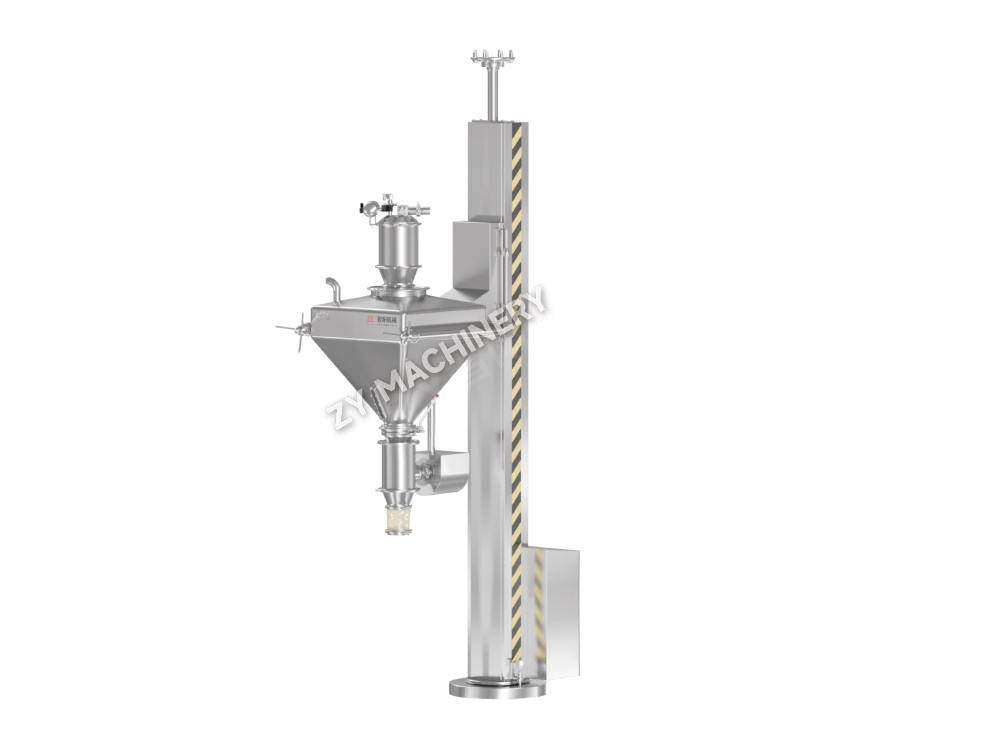
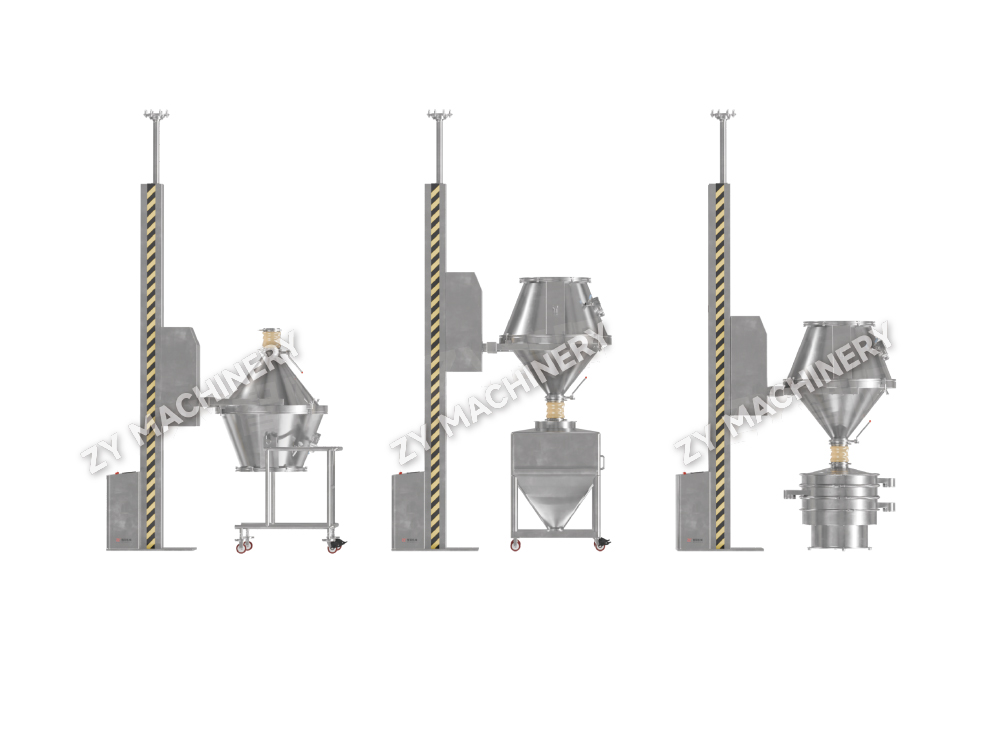
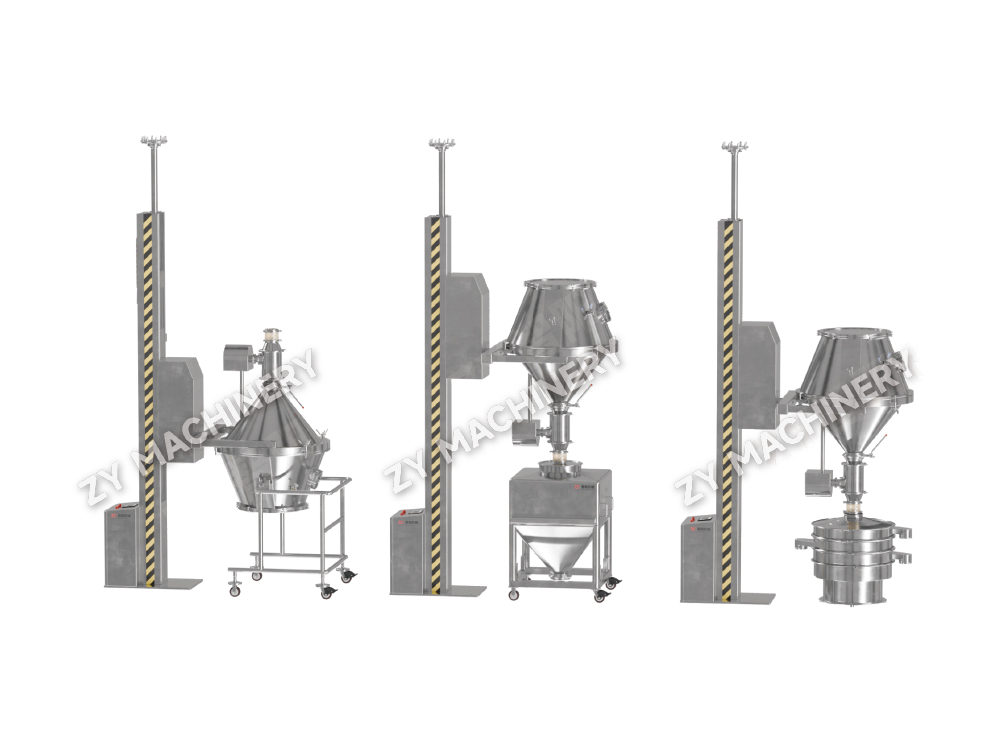
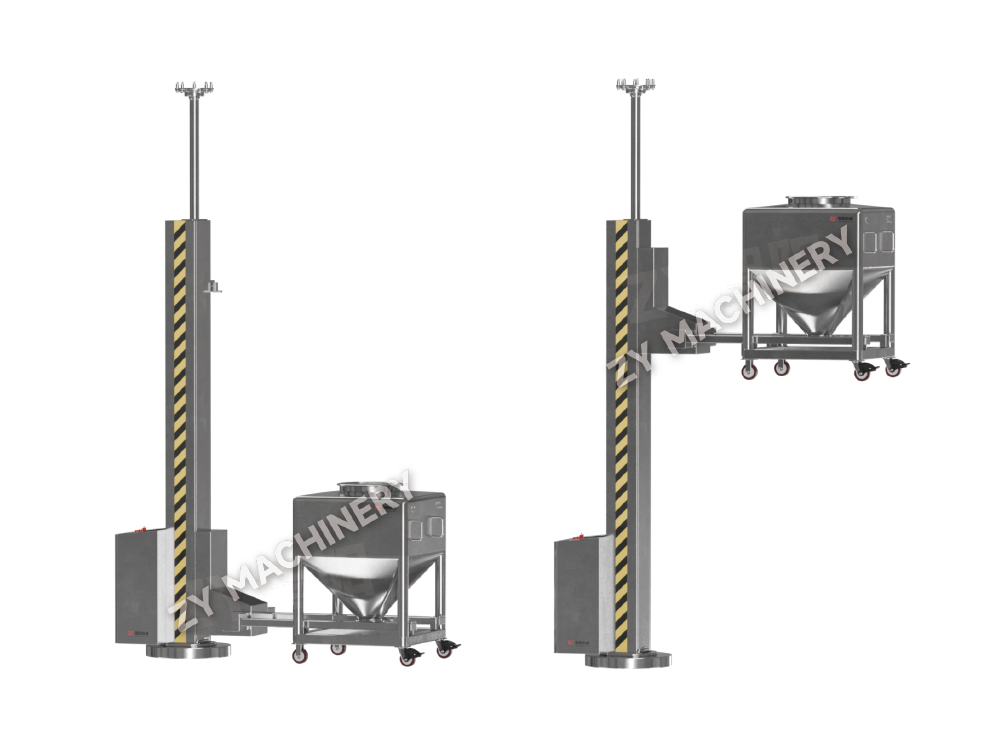
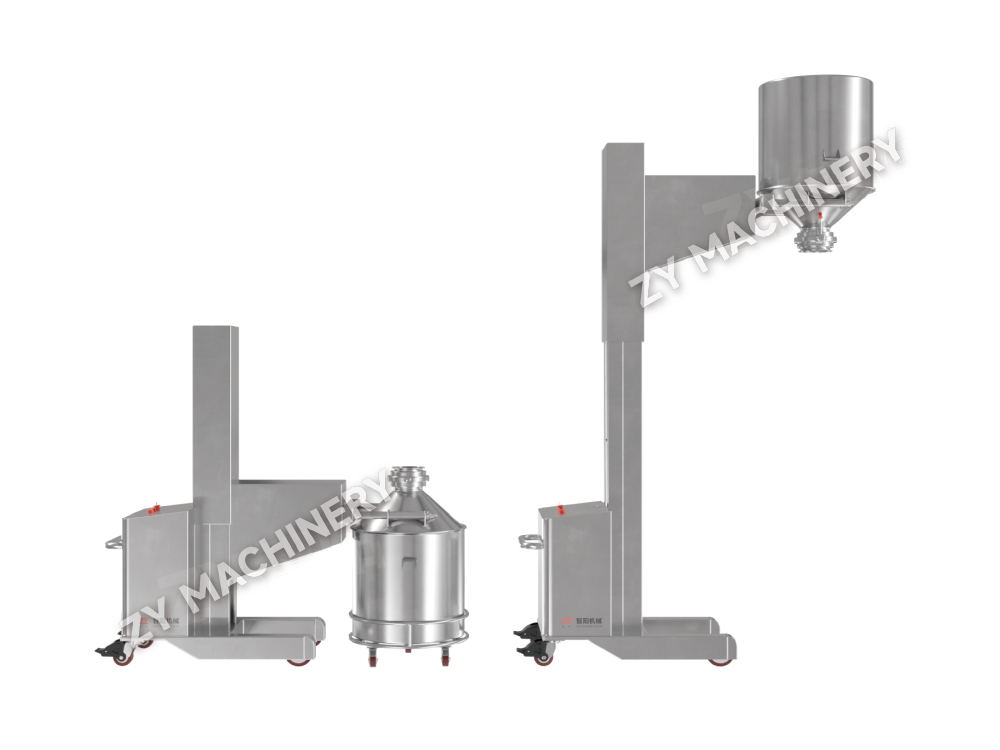
The NTG Series Fixed Lifting Feeding Machine is designed to address these requirements. It is a fixed lifting and conveying system for solid materials used in pharmaceutical solid dosage production and related industries. The machine lifts a conical bin or material container, rotates it into position, and docks it with the inlet of downstream processing equipment. Once the connection is completed, the discharge valve can be opened so that material moves into the next machine through an enclosed route.
This configuration allows the feeding machine to support closed material handling between mixers, granulators, tablet presses, coating machines, capsule filling machines, and other production equipment. It can also be used in chemical, food, nutraceutical, veterinary, and additive manufacturing applications where clean, controlled, and efficient material transfer is required.
Unlike simple hoists or open conveying arrangements, the NTG Series combines lifting, positioning, rotation, docking, and discharge control in one coordinated system. This integrated approach helps reduce manual handling, supports dust control, improves process continuity, and makes it easier for manufacturers to develop a practical material-transfer route around their existing production equipment.
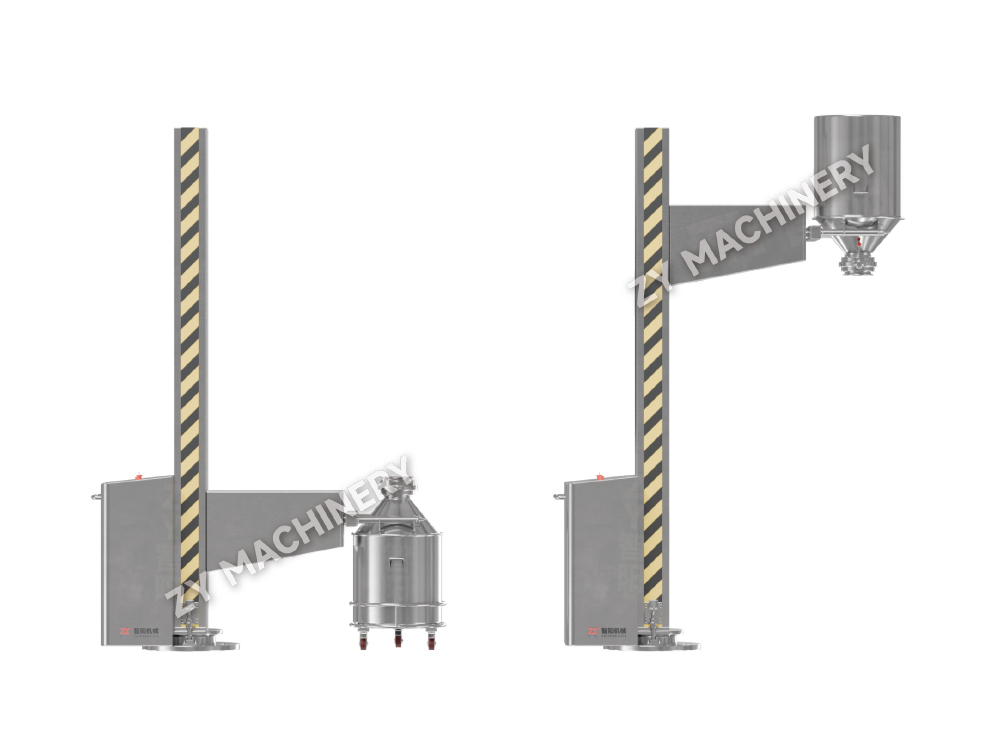
NTG Series Fixed Lifting Feeding Machine
Solid dosage production normally involves a sequence of operations. Raw materials may first be weighed and premixed before being granulated, dried, milled, blended, lubricated, compressed, coated, or filled into capsules. At each stage, the material must be transferred from one machine to another. These transfer steps may appear simple, but they have a direct effect on product quality, production efficiency, occupational safety, and cleaning validation.
Traditional transfer methods often rely on manual lifting, open containers, flexible bags, or separate hoisting equipment. Such methods can be acceptable for small-scale operations, but they may become inefficient or unsuitable when production volumes increase or when the material is dusty, potent, hygroscopic, or sensitive to contamination. Manual transfer can also expose operators to repetitive physical work and increase the chance of spillage.
A closed lifting feeding machine offers a more controlled alternative. The material remains in a dedicated container during transportation, and the container is lifted and connected directly to the next processing machine. This can reduce the number of open handling steps and make the material route easier to manage. It also helps manufacturers organize production areas with greater attention to hygiene and process separation.
The NTG Series is especially relevant to pharmaceutical plants that use mobile or detachable conical bins as intermediate material containers. A bin can be loaded at one stage, moved to the feeding machine, lifted to the necessary level, and connected with the receiving equipment. This arrangement supports a flexible production concept without requiring every processing machine to be installed at exactly the same height.
In addition to improving transfer efficiency, the equipment supports the broader objective of process integration. A mixer, granulator, dryer, or other unit does not need to be treated as an isolated machine. The lifting system can help coordinate the physical relationship between processing equipment, containers, discharge valves, and downstream inlets.
The operating cycle begins when the conical bin is securely connected to the material container or discharge assembly. The connection must be stable before lifting begins. This provides a controlled interface between the container and the lifting mechanism and helps ensure that the bin is supported throughout the transfer cycle.
After activation, the lifting mechanism raises the container to the designated height. The vertical column provides the main structural support for this movement, while the base frame supplies stability to the complete unit. The lifting height can be selected according to the layout and inlet elevation of the downstream machine.
Once the bin reaches the required position, the tilting mechanism rotates the container by 180 degrees. This rotation changes the orientation of the container so that its discharge side can be positioned above the receiving inlet. The movement is coordinated with the machine structure to support accurate positioning during docking.
The column can then rotate the container into alignment with the feeding inlet of the downstream equipment. This is an important function because processing machines may be arranged at different positions within a production room. The ability to rotate the lifted container provides greater layout flexibility than a system that can only move vertically.
After alignment, the container is docked and sealed with the feeding inlet. This connection creates an enclosed route for discharge. When the docking process has been completed and the operating conditions have been confirmed, the discharge butterfly valve is opened. Material then moves from the conical bin into the next processing stage.
The sequence can be summarized as follows:
1. Connect the conical bin to the material container or discharge assembly.
2. Confirm that the container is properly secured.
3. Raise the container to the required process height.
4. Tilt and rotate the container by 180 degrees.
5. Align the discharge outlet with the downstream feeding inlet.
6. Complete the sealed docking connection.
7. Open the discharge butterfly valve.
8. Transfer the material to the next process under enclosed conditions.
This sequence combines mechanical handling and process connection in a single operating concept. It reduces the need for separate lifting devices, manual repositioning, or open transfer between individual machines.
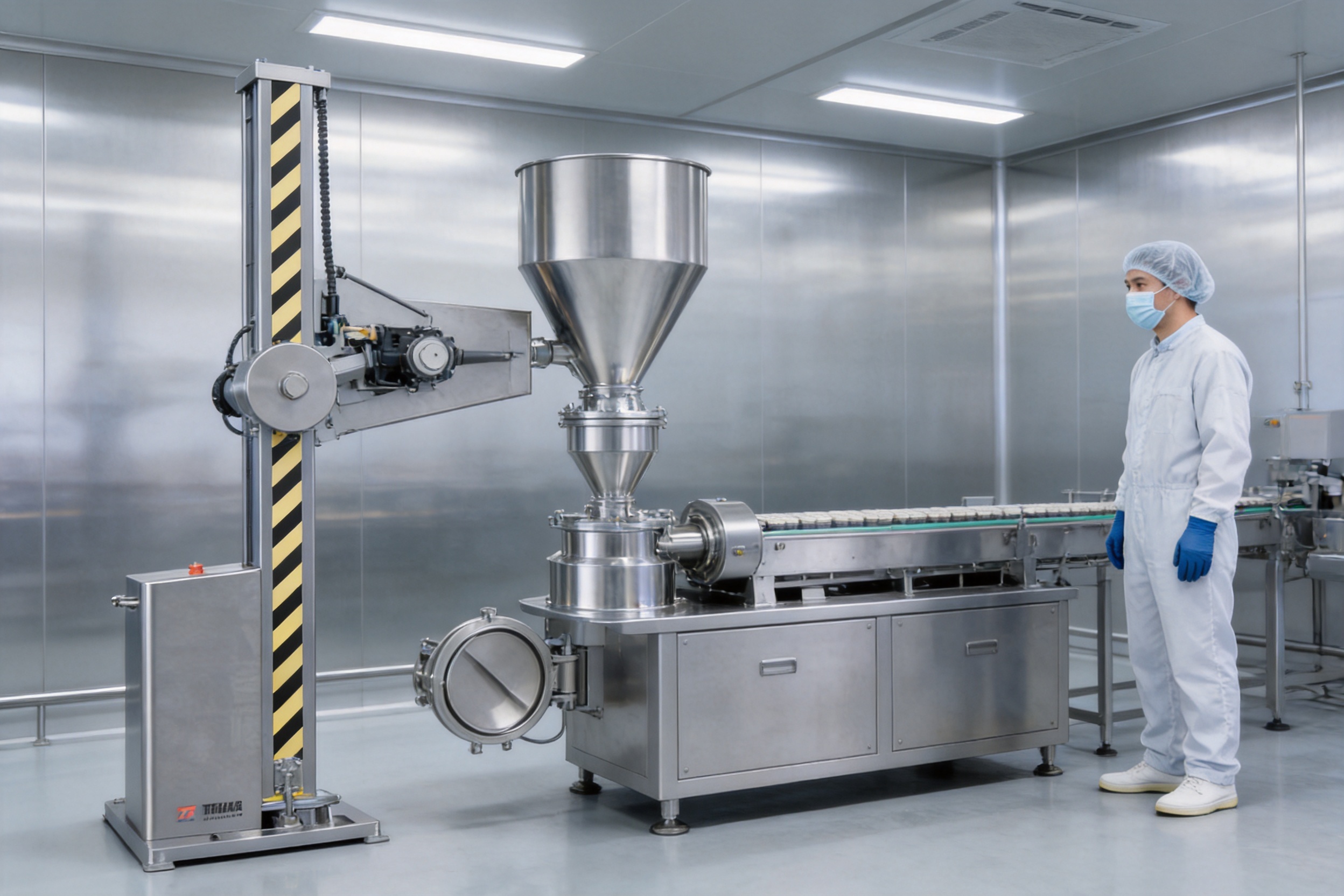
The base frame supports the vertical column and lifting assembly. Because the container may hold a significant quantity of solid material, the frame must provide sufficient rigidity and stability during lifting, rotation, and docking. A stable base is also important for reducing vibration and maintaining accurate alignment with downstream equipment.
The fixed structure gives the system a defined installation position within the production area. Compared with a completely mobile lifting arrangement, a fixed machine can be integrated into a planned production line and positioned according to the operating height, room layout, and process sequence.
The vertical column guides the lifting movement and serves as the main support for the container during elevation. It also enables the rotation and positioning functions required for docking. The column arrangement helps the machine reach different process heights while keeping the transfer route organized.
For facilities with several connected production stages, this adaptability is valuable. Processing machines may not have identical inlet heights, and room layouts may require the material container to turn before connection. The rotating column helps accommodate these differences without relying entirely on custom conveyors or additional transfer equipment.
The lifting mechanism raises the conical bin and associated material container to the designated height. Its purpose is not simply to elevate material, but to place the container in a position where it can be safely connected to the next machine. A controlled lifting movement supports repeatable operation and reduces the need for manual handling at elevated locations.
The available height dimensions can be selected or configured according to the production line. The stated product parameters include different reference heights for the NTG-100, NTG-150, and NTD-200 models. These dimensions provide a basis for installation planning, although the final arrangement should be confirmed against the customer’s container size, equipment inlet elevation, building height, and process requirements.
The tilting assembly changes the orientation of the container by 180 degrees. This allows the discharge outlet to face the receiving machine after the container has been lifted. The rotating column then provides directional positioning for docking.
This combination of vertical lifting, tilting, and horizontal positioning is a major difference between the NTG Series and basic lifting equipment. A standard hoist may raise a container, but it may not be able to align it with a machine inlet or create a repeatable enclosed connection. The integrated movement sequence is therefore an important part of the machine’s process value.
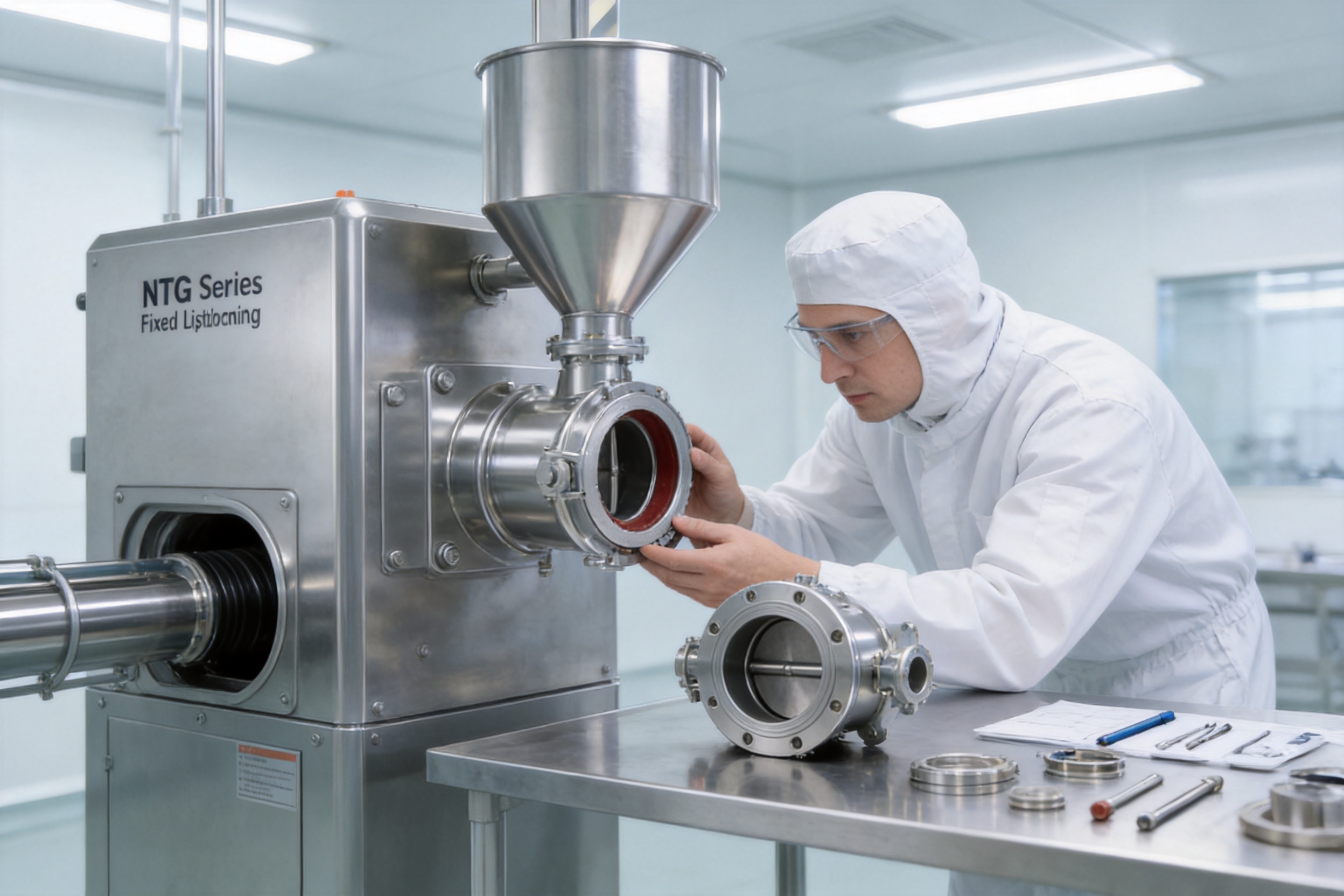
The discharge butterfly valve controls the release of material from the container. It is equipped with a misoperation prevention design to help reduce the possibility of unintended opening during handling or docking. This feature is particularly useful in pharmaceutical production, where unplanned discharge can result in product loss, contamination, or difficult cleaning work.
The valve can also be easily disassembled. This supports cleaning, inspection, maintenance, and component replacement. In hygienic production, the accessibility of product-contact and discharge components is important because retained powder may affect the next batch or complicate cleaning verification.
Pharmaceutical equipment must be designed with more than mechanical performance in mind. Surfaces, joints, fasteners, access points, and discharge components all influence the ability of operators to clean and maintain the machine. The NTG Series uses smooth surfaces, a compact structure, and a design intended to minimize dead corners.
The absence of exposed fasteners helps reduce areas where powder may accumulate. Exposed bolts, recessed joints, and difficult-to-reach pockets can increase cleaning time and create concerns about residual material. A smoother exterior also supports visual inspection and makes routine wipe-down procedures more efficient.
Dead-corner reduction is especially important when the machine is used for multiple products. Powders and granules can become trapped in small spaces and may later be released during another production cycle. By simplifying the external structure and providing access to removable parts such as the butterfly valve, the equipment supports more practical cleaning and changeover work.
The enclosed docking arrangement provides an additional hygienic benefit. Material is not required to fall through a large open gap between the container and the receiving equipment. Instead, the container is aligned and sealed with the downstream inlet before the valve is opened. This helps reduce uncontrolled dust release and limits exposure of the product to the surrounding environment.
It is important to understand that a machine alone does not guarantee compliance with every GMP requirement. Facility design, cleaning procedures, validation, operator training, material characteristics, containment strategy, and documentation are also essential. However, the structural features of the NTG Series support a GMP-oriented production environment by helping manufacturers establish a more controlled and cleanable transfer process.
For operations involving potent powders, additional containment and safety measures may be required. These may include suitable seals, extraction systems, pressure control, personal protective equipment, and validated operating procedures. The feeding machine can form part of this strategy, but the final containment concept should be developed according to the specific material hazard and facility requirements.
Manual lifting and tipping can be physically demanding, especially when containers are filled with dense powders or granules. Repetitive handling also increases the possibility of operator injury, spillage, and inconsistent positioning. The NTG Series uses a mechanical lifting structure to perform the main elevation and orientation steps.
Operators can focus on connection, inspection, control, and process monitoring instead of repeatedly moving heavy containers by hand. This can improve workplace ergonomics and make the transfer operation more repeatable.
Open transfer can release dust into the production room. Apart from creating housekeeping problems, airborne powder may create cross-contamination risks and expose employees to the material. The NTG Series is designed to complete the connection with the receiving machine before discharge begins.
Because the discharge occurs through a docked route, the amount of uncontrolled material exposure can be reduced compared with open tipping or manual dumping. Actual dust performance depends on the material, seals, receiving equipment, air balance, and extraction design, but the enclosed transfer principle provides a strong foundation for dust management.
Processing lines often contain machines with different inlet and outlet elevations. A fixed lifting feeding machine can compensate for these differences by raising the container to the required height. This may reduce the need to construct complex platforms or install separate elevators for every machine.
The ability to match different process heights also supports future line expansion. When a customer adds a new tablet press, coating machine, or capsule filling machine, the existing transfer concept may be adapted more easily than an arrangement based entirely on fixed open conveyors.
Connecting a container to a machine inlet manually can require multiple adjustments. Misalignment may damage seals, delay production, or result in an incomplete connection. The lifting, tilting, and rotating functions of the NTG Series are intended to make alignment more systematic.
Repeatable positioning is particularly important when the same container must be used in several production cycles. A stable docking method helps reduce operator variability and supports a consistent material route from one batch to the next.
Changeover time has a direct effect on equipment utilization. A machine with smooth surfaces, few accumulation points, and removable discharge components can be easier to clean between products. The butterfly valve’s disassembly design is useful for inspection and cleaning of a key product-contact area.
Cleaning procedures still need to be developed and validated for the specific formulation. Nevertheless, equipment that is designed with hygienic access in mind can help reduce unnecessary cleaning effort and support more reliable changeover execution.
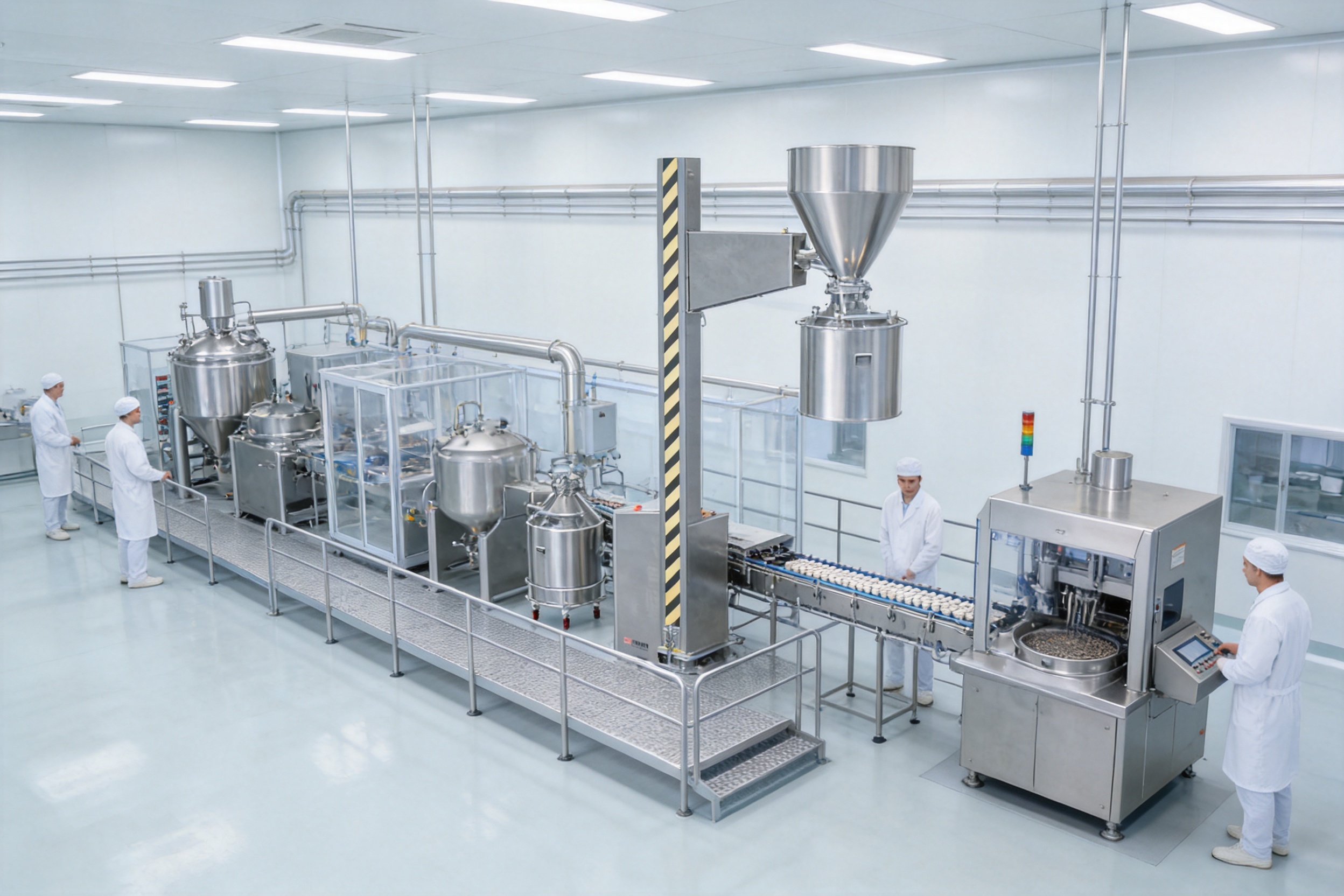
The NTG Series can be used with mixers, granulators, tablet presses, coating machines, and capsule filling machines. This broad compatibility allows the same basic transfer concept to be applied across several stages of an oral solid dosage line.
By supporting integration rather than functioning as an isolated hoist, the machine can contribute to a more unified production system. It may be installed between an intermediate bin and a high-level tablet press, between a granulator and a dryer, or between a final blending stage and a capsule filling machine, depending on the process configuration.
The following reference information is provided for the listed models:
| Item | Unit | NTG-100 | NTG-150 | NTD-200 |
| Total power | kW | 1.87 | 1.87 | 1.87 |
| Installation length L | mm | 1850 | 1920 | 1920 |
| Installation length L1 | mm | 1100 | 1100 | 1100 |
| Installation width W | mm | 550 | 550 | 550 |
| Reference height H1 | mm | 2200 | 2200 | 2200 |
| Reference height H2 | mm | 3050 | 3150 | 3310 |
| Reference height H3 | mm | 2800 | 2800 | 2800 |
The supplied technical table identifies the third model as NTD-200, while the product is presented as the NTG Series. This model designation should be confirmed during technical clarification and quotation. The dimensions should also be treated as installation references rather than a substitute for a project-specific layout drawing.
Before installation, the customer should verify the available floor area, ceiling clearance, container dimensions, full-load weight, downstream inlet position, service access, electrical requirements, and cleaning space. The raised container may require additional clearance above the machine, particularly when the equipment is installed below a ceiling, pipe rack, air duct, or maintenance platform.
The width of the machine is listed as 550 mm for all three reference models, while the overall length varies between 1850 mm and 1920 mm. These compact dimensions may help the equipment fit into production areas where floor space is limited. However, operators still require sufficient clearance for container connection, valve removal, inspection, cleaning, and safe movement around the machine.
Total power is listed as 1.87 kW for each model. Final electrical specifications should be confirmed according to the intended country, plant power supply, control configuration, motor requirements, and customer standards. The machine should be installed on a suitable foundation capable of supporting the equipment and its maximum operating load.
After preblending or wet mixing, material may need to move into a granulation unit. The feeding machine can lift the material container and position it above the granulator inlet. The enclosed docking route helps limit powder release during the transfer.
Granulated material often requires controlled movement to a drying system. By raising and orienting the bin, the machine can support connection to a dryer or related processing unit at a different elevation. This can be useful in lines where gravity-assisted feeding is preferred.
Dried granules may be transferred to a final blending or lubrication stage. A closed bin-based route can help protect the material from unnecessary environmental exposure while also reducing manual movement between rooms or machines.
Tablet presses are often installed with feed inlets at a height that is inconvenient for direct manual loading. The lifting feeding machine can elevate a conical bin and dock it with the press inlet. This arrangement may provide a more stable supply route and reduce the need for repeated bag or container lifting.
Coating processes require a consistent supply of tablets or related solid materials. The machine can be used to position the container at the appropriate height for a coating machine, supporting enclosed transfer where the line layout permits.
Capsule filling lines may also benefit from controlled bin lifting and sealed docking. Depending on the formulation and machine design, the transfer system can help move blended powders toward the capsule filling stage while reducing open handling.
Although the NTG Series is designed with pharmaceutical solid dosage manufacturing in mind, the same operating principle can be useful in other industries. Chemical plants may use the machine to handle powders, granules, additives, or intermediate products. Food manufacturers may apply it to hygienic transfer of dry ingredients where dust control and cleaning are important.
Nutraceutical and dietary supplement production is another relevant field. These facilities often process powders, granules, vitamins, minerals, and botanical ingredients using equipment similar to pharmaceutical production systems. The ability to transfer material in a closed and organized manner can support product protection and efficient batch handling.
Veterinary medicines, feed additives, specialty chemicals, and biotechnology-related dry materials may also require controlled transfer. In each case, the suitability of the equipment depends on bulk density, flowability, particle size, moisture content, temperature, dust characteristics, container capacity, and required containment level.
The machine should not be selected solely by nominal model size. A proper technical evaluation should consider whether the material flows freely through the discharge outlet, whether bridging may occur, whether the container needs vibration or agitation, and whether the receiving machine can accept the expected feed rate. These factors can influence the final configuration and operating procedure.
The manufacturer specializes in powder processing and oral solid dosage equipment, with experience in standalone machines, modular systems, and complete production lines. This product range provides an important advantage when a customer needs more than a single lifting unit. The feeding machine can be considered as part of a wider process route involving laboratory equipment, mixers, granulators, dryers, coaters, auxiliary systems, and conveying equipment.
A process-oriented manufacturer can evaluate the relationship between the material, equipment capacity, plant layout, and production objective. This is different from supplying a standard machine without considering how it will connect to the rest of the line. Practical engineering decisions may include container volume, lifting height, discharge arrangement, docking position, cleaning access, control integration, and future expansion.
The company’s manufacturing and development activities are based in Changzhou, China, and began in 2010. Its stated service scope covers pharmaceutical, biopharmaceutical, biotechnology, nutraceutical, veterinary, additives, and related industries. This broad sector experience can help the engineering team understand that equipment requirements vary considerably according to the application.
For example, a laboratory installation may prioritize flexibility, small-batch handling, and rapid changeover. A pilot plant may require scalable process development and multiple product trials. A full-scale production line may prioritize output, automation, cleaning validation, reliability, and integration with plant utilities. A supplier capable of working across these scales can help customers maintain greater consistency as their process develops.
The company also emphasizes research and development, patented technologies, quality system certification, and overseas service capability. These strengths are relevant to international customers that require more than fabrication. Documentation, commissioning support, spare parts planning, process consultation, and after-sales response can all influence the long-term value of a material handling system.
Another advantage is the ability to provide modular solutions. A customer may initially purchase a feeding machine for one processing stage and later expand to additional transfer points, granulation systems, or complete production lines. Modular engineering can help reduce the risk of designing each machine as an isolated unit.
Reliability in a lifting feeding machine includes more than motor operation. The structure must remain stable under repeated load cycles, the lifting movement must remain controlled, the rotation mechanism must maintain alignment, and the discharge valve must operate consistently. Regular inspection and preventive maintenance are necessary to preserve these functions.
Quality manufacturing begins with suitable material selection, accurate fabrication, controlled welding, surface treatment, dimensional inspection, and assembly verification. Hygienic equipment also requires attention to weld smoothness, surface finish, accessible joints, sealing interfaces, and the removal of fabrication residues. These details can influence both cleaning performance and service life.
A professional factory should evaluate the machine through assembly checks and functional testing before delivery. Such checks may include lifting movement, rotation range, valve operation, safety interlocks, connection accuracy, electrical control, abnormal noise, and load-related performance. The exact inspection program depends on the agreed technical specification.
For customers purchasing equipment internationally, documentation is also important. Typical project documentation may include general arrangement drawings, installation requirements, electrical information, operating instructions, maintenance recommendations, spare parts lists, material certificates, inspection records, and factory test information where applicable.
After installation, commissioning should confirm that the equipment works correctly with the customer’s actual container, downstream machine, material properties, and production procedure. A machine may operate correctly during factory testing but still require adjustment when installed in a new facility. Site conditions, inlet positions, floor levels, electrical standards, and plant ventilation can affect final performance.
Overseas service capability can shorten the response time for installation guidance, troubleshooting, operator training, and replacement parts. This is particularly valuable for pharmaceutical factories that operate under strict production schedules and cannot tolerate long interruptions caused by unresolved equipment issues.
Because the equipment lifts and rotates loaded containers, safety must be addressed through both mechanical design and operating procedure. Operators should confirm that the container is correctly connected before starting the lift. The working area should remain clear during elevation, tilting, rotation, and docking.
The misoperation prevention design on the discharge butterfly valve helps reduce accidental opening, but operators should still follow a defined sequence. The valve should remain closed during movement and should only be opened after the container is fully aligned, securely docked, and ready for discharge.
Safety controls may include position confirmation, lifting limits, emergency stop functions, overload protection, access restrictions, and interlocks. The final safety package should be confirmed according to the machine configuration, local regulations, customer standards, and risk assessment.
Operators should receive training in container connection, machine start-up, normal discharge, emergency stopping, cleaning, inspection, and fault reporting. Training should also cover the risks associated with the material itself, including dust inhalation, combustible dust, potent compounds, allergenic ingredients, and cross-contamination.
Routine inspections should include the lifting assembly, structural fasteners, rotating components, valve seals, docking surfaces, electrical controls, and safety devices. Any unusual vibration, noise, movement, leakage, or difficulty in alignment should be reported before continued production.
The appropriate model should be selected after reviewing the complete process rather than only the required lifting height. Important questions include:
What is the maximum loaded weight of the container?
What are the container diameter, discharge size, and connection type?
What is the inlet height and position of the downstream machine?
Does the container need to rotate through a full 180 degrees?
What is the required discharge rate?
What are the powder flow and cohesion characteristics?
What cleaning method and validation standard will be used?
Does the product require containment, inerting, or dust extraction?
What are the available ceiling height, floor area, and service clearances?
What electrical and control standards apply at the installation site?
Customers should provide drawings or dimensional information for the existing processing equipment whenever possible. A complete layout review can identify potential conflicts before fabrication. It can also confirm whether the machine should be installed beside, between, or in front of the receiving equipment.
Material testing may be advisable when the powder has poor flowability, high cohesion, strong electrostatic behavior, or a tendency to bridge. In these situations, the outlet design and discharge procedure may require particular attention. The feeding machine is intended for solid material transfer, but reliable discharge always depends on the interaction between the container geometry and the material properties.
The value of the NTG Series should be considered over the equipment life cycle. Initial purchase price is only one factor. Reduced manual handling, shorter transfer time, lower product loss, easier cleaning, and improved process consistency may contribute to lower operating costs.
Closed transfer may also reduce the frequency of housekeeping caused by spilled powder. A cleaner production environment can support better worker comfort and reduce the time spent cleaning surfaces that were contaminated during open transfer. In regulated manufacturing, improved control may also simplify the development of standard operating procedures and cleaning records.
Process integration can improve equipment utilization. When the transfer route is designed correctly, the material container can be moved between stages with fewer manual interventions. This may reduce waiting time between batches and support more predictable production scheduling.
The compact structure can be beneficial in facilities where floor space is expensive or limited. A fixed lifting machine may occupy less room than a combination of temporary hoists, platforms, open conveyors, and manual handling zones. The actual space saving depends on the layout, but integrated functions generally simplify the material route.
Long-term value also depends on maintainability. A machine with accessible components, removable valves, and a clear operating structure can be easier for maintenance teams to inspect and repair. This may reduce downtime and improve the availability of the transfer point.
Its primary purpose is to lift, rotate, align, and feed solid materials from a conical bin or material container into downstream pharmaceutical processing equipment. It supports enclosed transfer between operations such as mixing, granulation, drying, compression, coating, and capsule filling.
The main application is pharmaceutical solid dosage manufacturing. It can also be used in chemical, food, nutraceutical, veterinary, additive, and related industries where hygienic handling of powders or granules is required.
The container is aligned and sealed with the downstream feeding inlet before the discharge butterfly valve is opened. This allows material to move through an enclosed connection instead of being manually dumped through an open gap. Dust performance also depends on seals, ventilation, extraction, material properties, and the receiving machine.
Yes. The equipment can be integrated with mixers, granulators, tablet presses, coating machines, capsule filling machines, and other downstream units. The exact connection arrangement must be confirmed according to the inlet dimensions and process layout.
Yes. The operating principle includes a 180-degree tilting movement followed by column rotation to align the container with the downstream feeding inlet.
Its smooth surfaces, compact structure, reduced dead corners, limited exposed fasteners, removable butterfly valve, and enclosed docking concept support GMP-oriented production. However, overall GMP compliance also requires suitable facility design, validated cleaning, documented procedures, operator training, and appropriate quality management.
The discharge butterfly valve is designed for easy disassembly. This supports cleaning, inspection, maintenance, and replacement of relevant components.
Customers should confirm container size and weight, material characteristics, discharge rate, lifting height, downstream inlet dimensions, floor and ceiling clearance, electrical requirements, cleaning procedures, containment needs, and the required control and safety functions.
It may form part of a containment strategy, but additional measures may be necessary. These can include specialized seals, extraction, pressure control, closed connections, protective equipment, and a material-specific risk assessment. The final design must be agreed according to the hazard classification and facility requirements.
An integrated lifting feeder combines elevation, tilting, rotation, alignment, docking, and discharge control. A basic hoist may only lift a container and may not provide repeatable connection with a processing machine or support an enclosed discharge route.
The same transfer concept can be adapted to laboratory, pilot, and full-scale production environments, provided the container size, load, process height, and installation arrangement are suitable. The required configuration should be evaluated according to the scale and flexibility of the operation.
The supplied parameter table identifies the third model as NTD-200. Because the product is described as the NTG Series, the model designation should be confirmed in the final technical offer and project documentation.
The NTG Series Fixed Lifting Feeding Machine provides a practical solution for controlled solid material transfer in pharmaceutical and related manufacturing. By combining lifting, tilting, rotation, positioning, sealed docking, and butterfly-valve discharge, it addresses several weaknesses associated with open or heavily manual handling methods.
Its compact fixed structure supports stable installation, while smooth surfaces, reduced dead corners, limited exposed fasteners, and a removable valve support hygienic operation and cleaning. The enclosed transfer route can help reduce dust emission and cross-contamination risk, while the ability to match different process heights provides greater flexibility when connecting mixers, granulators, tablet presses, coating machines, and capsule filling machines.
The manufacturer’s broader expertise in powder processing, oral solid dosage equipment, modular systems, and complete production lines adds value beyond the individual machine. Customers can work with a supplier that understands the relationship between material properties, production capacity, plant layout, equipment integration, and long-term service.
For the best result, the feeding machine should be selected as part of a complete process evaluation. Container dimensions, material flow, lifting load, inlet height, cleaning requirements, dust control, safety functions, and future expansion should all be considered before final design. When properly specified and integrated, the NTG Series can support cleaner, safer, more efficient, and more repeatable material handling across modern solid dosage production.
1. Product technical information for the NTG Series Fixed Lifting Feeding Machine, including operating principle, structural features, and reference dimensions.
2. Pharmaceutical manufacturing good practice principles concerning hygienic equipment design, cleaning, contamination control, and material handling.
3. General engineering practices for powder processing equipment, enclosed transfer systems, bulk material handling, and industrial machine safety.
4. Technical guidance on oral solid dosage manufacturing processes, including mixing, granulation, drying, tablet compression, coating, and capsule filling.
5. Manufacturer-provided corporate information concerning powder processing equipment, oral solid dosage systems, research and development, quality management, and international service.
Want to stay up to date?
Contact us via the email address below.
Don't worry about spam. We hate it too!
Mobile Client
Video Account
Phone:+86-15161130178
Tel:+86-519-88674267
Email:czzy188@163.com
Phone:+86-15161132798
Email:zy@zy-drying.com

WeChat ID

Copyright 2026 Changzhou Zhiyang Machinery Equipment Co., Ltd. All Rights Reserved  Oral Solid Dosage Equipment Manufacturer