 English
 Español
 русский
 中文简体
中文简体
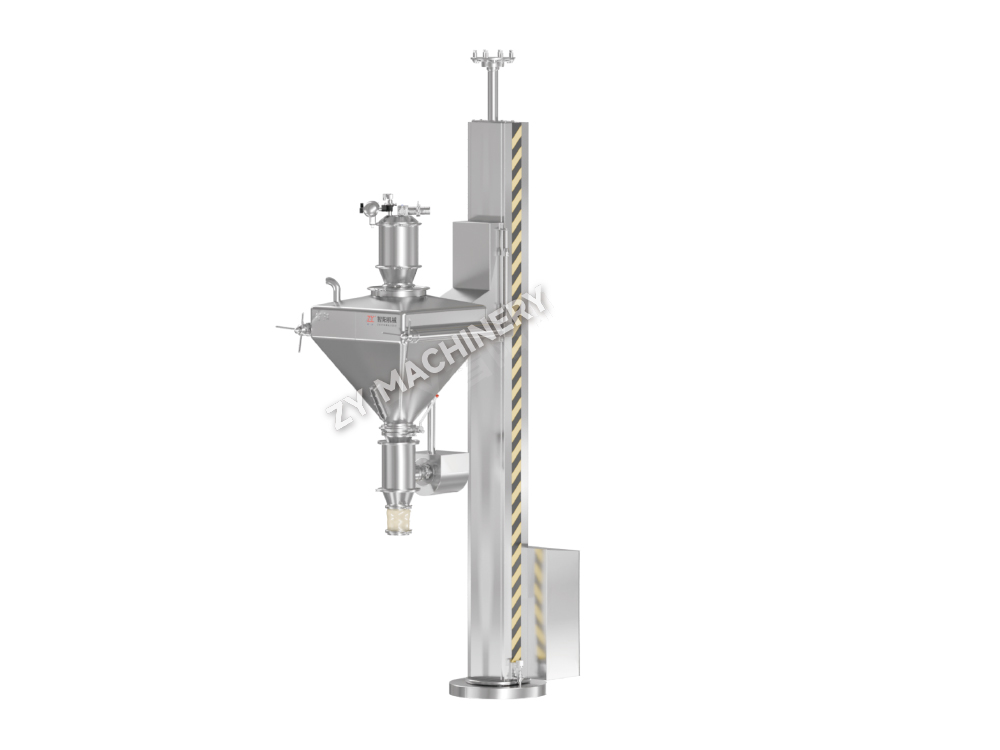
NTF Fixed Lifting and Tilting Transfer Machine
The NTF Fixed Lifting and Tilting Transfer Machine is designed for the tran.....

Content
In pharmaceutical manufacturing, the transfer of powders, granules, and other solid materials is not a secondary activity. It is an essential part of process control. Every handover between granulation, drying, milling, blending, and downstream operations can affect product quality, operator safety, dust control, production efficiency, and compliance with good manufacturing practice requirements. An unsuitable transfer method may expose the material to the environment, create dust, increase manual handling, introduce cross-contamination risks, or make it difficult to maintain a consistent production sequence.
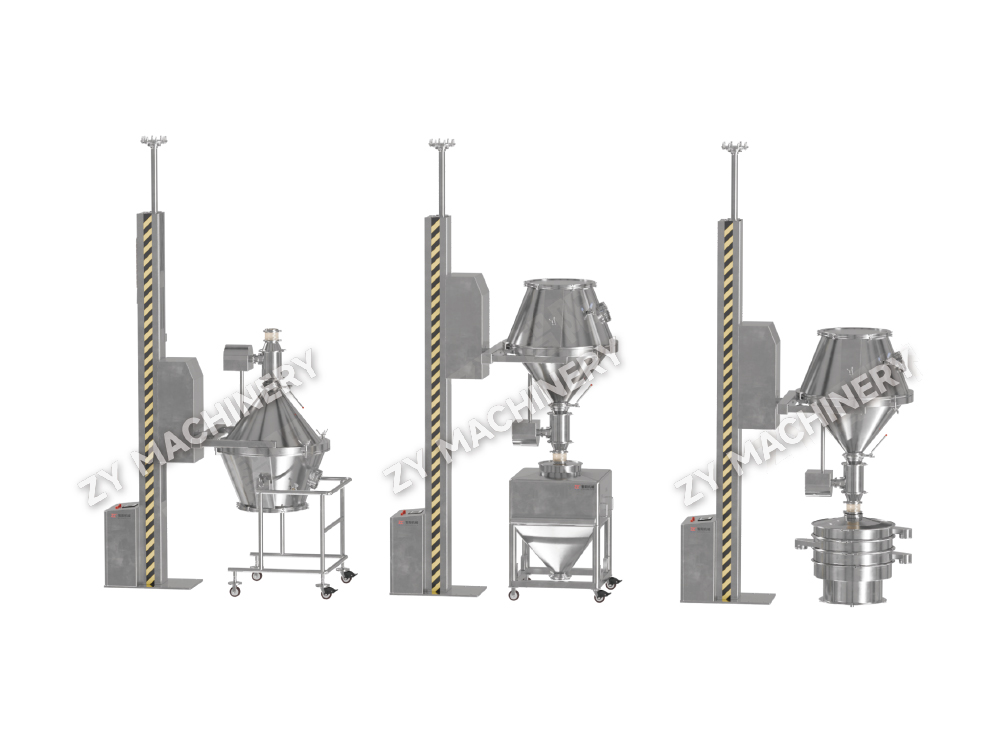
The NTF Fixed Lifting and Tilting Transfer Machine is developed to address these challenges. It is designed for the controlled transfer and feeding of solid materials in pharmaceutical oral solid dosage production. By combining a fixed lifting structure, a vertical column, a lifting mechanism, a tilting system, and a detachable butterfly valve, the equipment enables enclosed material transfer between process units. It is especially suitable for use with fluid bed granulators, fluid bed dryers, milling machines, and other equipment that requires accurate alignment between a mobile conical bin and a process inlet.
In addition to pharmaceutical applications, the machine can be used in chemical, food, nutraceutical, veterinary, additives, and related industries. Its enclosed design, hygienic contact surfaces, flexible positioning, and controlled discharge make it suitable for production environments in which material protection and process repeatability are important.
The equipment is manufactured and supplied by Changzhou Zhiyang Machinery Equipment Co., Ltd., a China-based engineering company specializing in powder processing, oral solid dosage equipment, and integrated production solutions. Through process-oriented design, equipment customization, quality management, and project support, the company provides machinery for laboratory, pilot-scale, and full-scale applications.
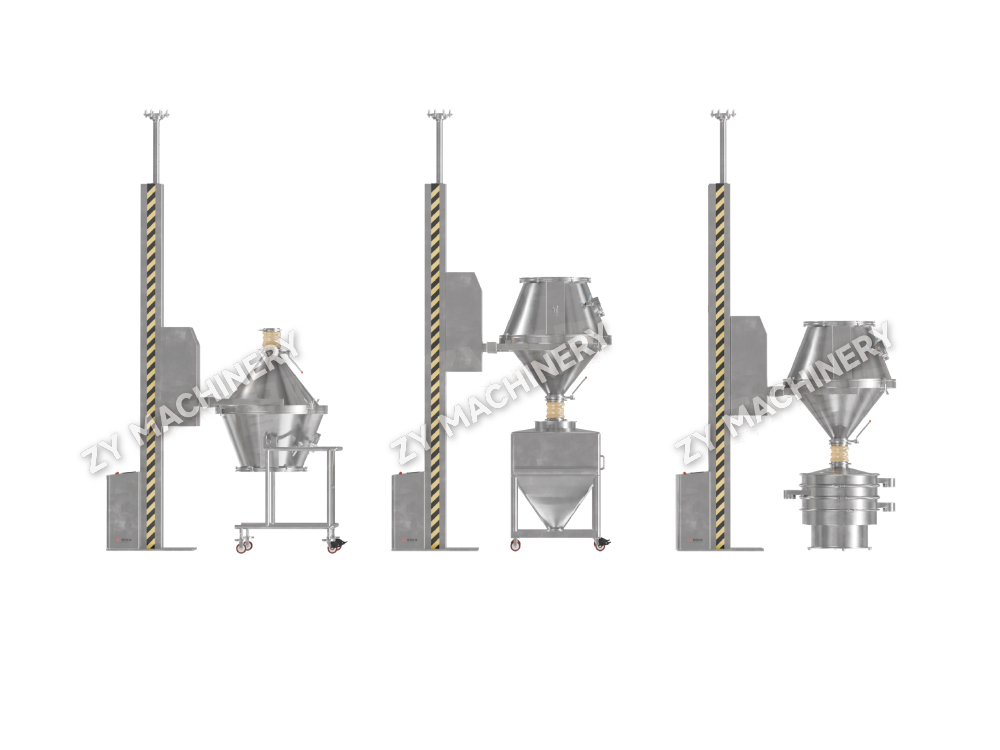
NTF Fixed Lifting and Tilting Transfer Machine
Solid dosage production usually involves several interconnected stages. A typical process may include material weighing, mixing, wet or dry granulation, drying, milling, lubrication, compression, coating, and packaging. The physical properties of the material can change from one stage to the next. A wet granulate may need to be dried without exposure to uncontrolled humidity. A dry powder may need to be conveyed without segregation. A milled material may need to be discharged into a downstream vessel without generating excessive airborne dust.
Manual transfer can be acceptable for limited laboratory operations, but it becomes inefficient and risky as production scale increases. Operators may need to lift or move heavy bins, open containers, position vessels at different heights, and manually control discharge points. These activities increase the possibility of spillage, ergonomic injury, dust release, material loss, and operator contact with the product.
Conventional conveying systems may reduce some of these problems, but they are not always suitable for every formulation or process route. Pneumatic conveying can influence particle size distribution, cause attrition, or require complex air-handling systems. Fixed chutes may not accommodate different equipment layouts. Forklift handling may introduce open transfer steps and may not provide the positioning accuracy needed for sealed docking. A dedicated lifting and tilting transfer machine offers another approach: it moves the process bin itself, aligns it with the receiving equipment, and controls discharge through a dedicated valve.
The NTF machine is therefore more than a lifting device. It is a process connection system. Its purpose is to coordinate the position, height, orientation, and discharge of a conical bin so that material can move from one stage to another with fewer open handling steps.
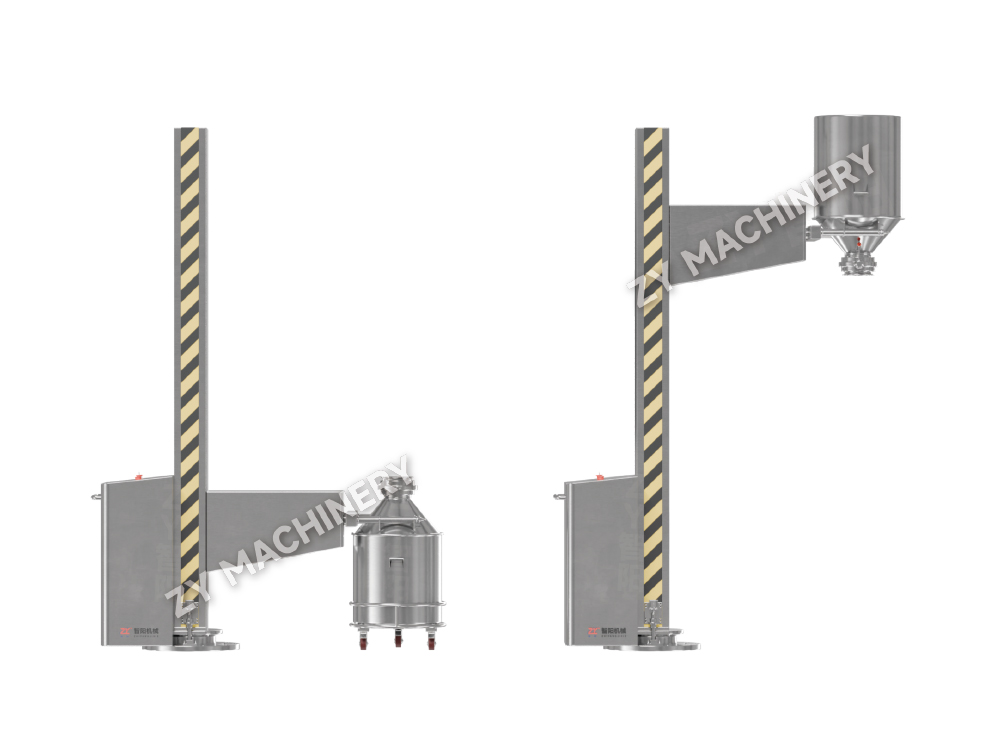
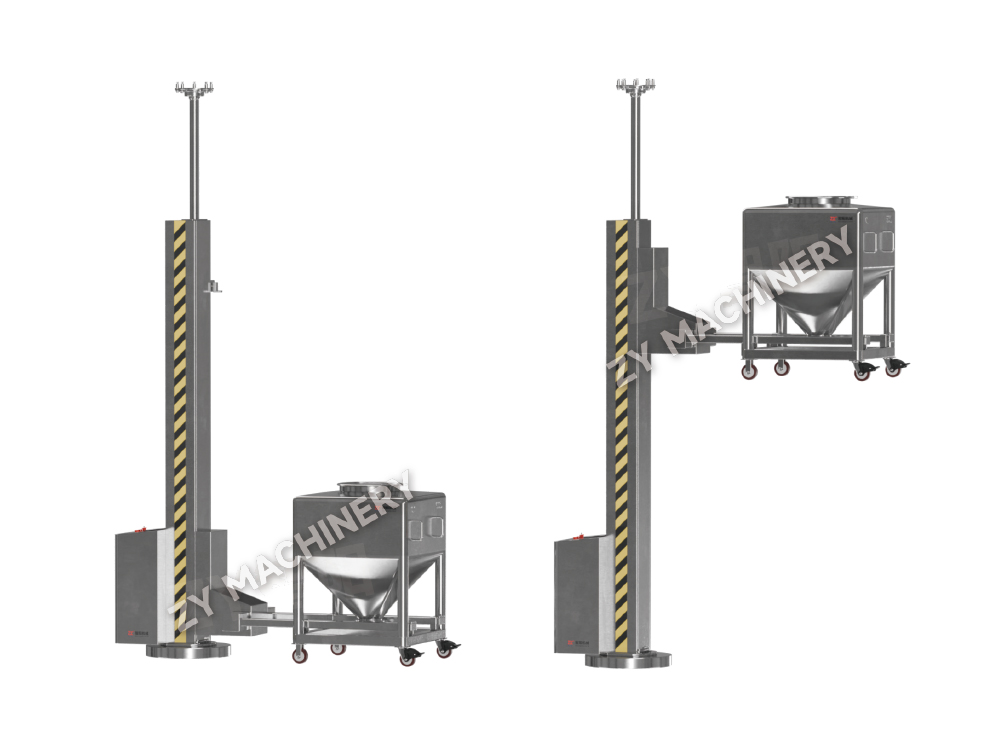
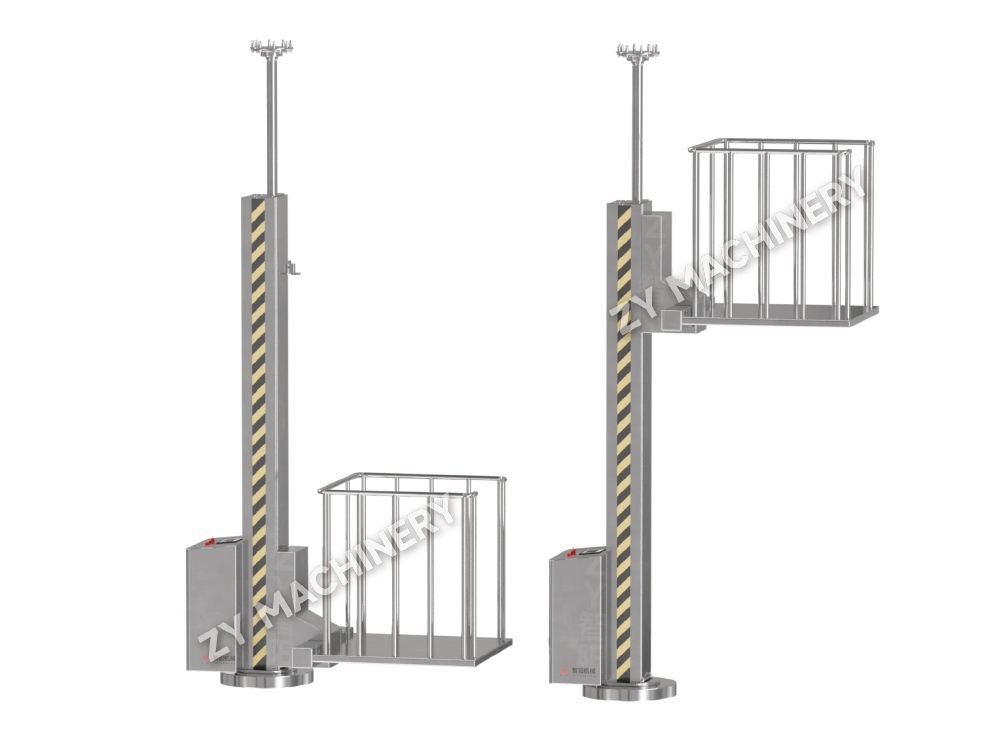
The NTF is a fixed lifting and tilting transfer machine intended for solid material handling. Its principal assemblies include a base frame, a vertical column, a lifting mechanism, a tilting mechanism, and a material discharge arrangement. During operation, a conical bin is docked with the inlet of a fluid bed granulator, fluid bed dryer, milling unit, or another compatible process machine.
After the equipment is activated, the lifting mechanism raises the bin to the required position. The tilting mechanism can rotate the bin by up to 180 degrees, allowing the outlet of the bin to be oriented toward the receiving process. When horizontal alignment is required, the column can be rotated after the brake is released. The bin is then lowered to the appropriate working height. Once the connection and position have been confirmed, the butterfly valve is opened so that the material can enter the next process stage under enclosed conditions.
This sequence allows the operator to complete a material transfer operation through controlled mechanical movement rather than repeated manual lifting, repositioning, and emptying of the bin. The fixed structure also provides a stable reference point within the production area. Compared with loosely positioned mobile handling methods, a fixed machine can help maintain a predictable transfer route and simplify the arrangement of associated equipment.
The base frame supports the machine and provides a stable foundation for lifting and tilting operations. Its role is particularly important when a loaded conical bin is raised or rotated. A stable base helps reduce unwanted movement and provides a defined installation footprint for production planning.
The vertical column forms the primary structural support for the lifting and positioning system. It guides the vertical movement of the bin and provides the axis for horizontal rotation. The column arrangement allows the machine to serve more than one process position when the production layout requires alignment with adjacent equipment.
The lifting mechanism raises and lowers the conical bin. The lifting range is selected according to the process height and the dimensions of the associated equipment. This feature is useful where fluid bed granulators, dryers, and milling machines have different inlet elevations.
The tilting system rotates the bin up to 180 degrees. Tilting assists with positioning and discharge, especially when the outlet must be oriented toward a process inlet or when gravity is used to support material flow. The rotation range also helps the equipment adapt to different plant arrangements.
The butterfly valve controls the outlet of the bin. It is designed to support enclosed discharge and includes a misoperation prevention feature. The valve can be dismantled for cleaning, which is important in multiproduct manufacturing environments where product residue must be removed between batches.
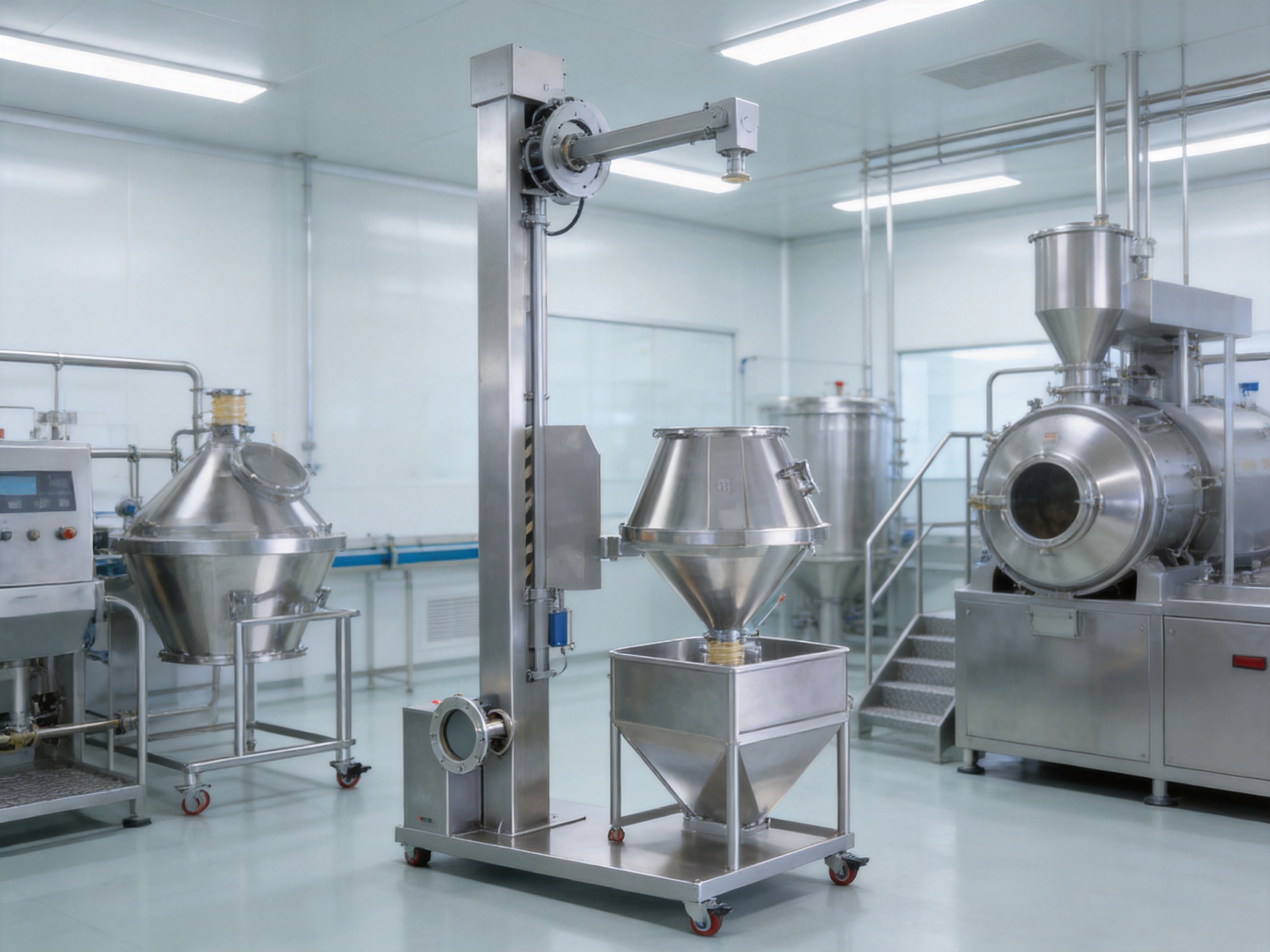
The operating cycle begins when the conical bin is positioned and docked with the inlet of the fluid bed granulator, fluid bed dryer, milling unit, or another receiving machine. Proper docking establishes the physical connection between the transfer vessel and the downstream process. In a pharmaceutical plant, docking must be planned with consideration for equipment clearance, cleaning access, operator access, and the required containment level.
The NTF design supports this connection by providing controlled movement of the bin. Instead of requiring the receiving equipment to be manually approached with uncertain positioning, the bin can be lifted and adjusted until it reaches the required process elevation.
Once the bin is in the correct starting position, the lifting system raises it to the designated height. Vertical lifting makes it possible to work with equipment that has elevated inlets. This is especially relevant to fluid bed granulators and fluid bed dryers, which may be installed at a height that allows discharge into a lower process unit or accommodates their internal airflow and processing configuration.
The lifting movement also allows the same transfer machine concept to be used across process lines with different height requirements. This flexibility can reduce the need for multiple fixed platforms or extensive manual adjustment. Where the granulating or milling unit is designed to lift synchronously with the conical bin, the system can help maintain a suitable relationship between the two components and support sealed docking.
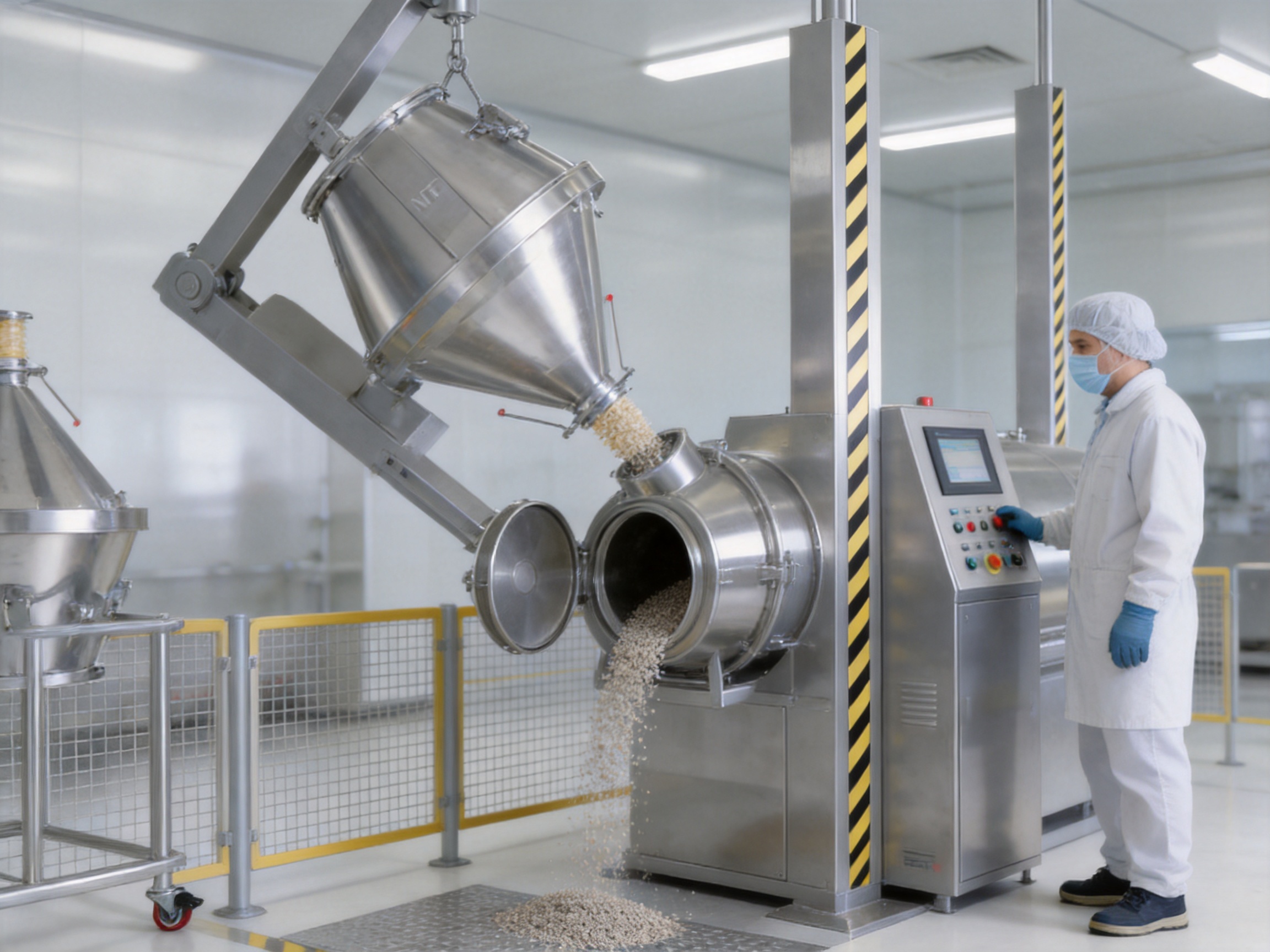
After the required height is reached, the tilting mechanism rotates the conical bin by up to 180 degrees. This movement prepares the bin for discharge and allows the outlet to face the receiving equipment. The ability to change the bin orientation is important where the inlet direction of the process machine does not match the initial position of the bin.
Tilting can also help use gravity more effectively during transfer. The conical geometry of the bin and its orientation influence how the material moves toward the outlet. The actual flow behavior will depend on powder cohesion, moisture content, particle size, bulk density, and formulation characteristics, so process trials and product-specific evaluation remain important. However, the mechanical ability to orient the vessel provides a valuable adjustment during operation.
When the bin must be aligned with another process position, the operator can release the brake and rotate the column horizontally. This allows the bin to move from one working direction to another without requiring a separate lifting device or manual repositioning of the loaded vessel.
Horizontal rotation is particularly useful in compact production layouts where several machines are arranged around a central transfer area. It can also help create a more logical process route, reducing unnecessary movement between operations. The rotation function should be used according to the plant’s operating procedures, safety controls, and approved equipment configuration.
After orientation is complete, the bin is lowered to the required working height. This step enables the outlet and receiving inlet to be positioned correctly for material discharge. Controlled lowering helps prevent impact between equipment interfaces and gives the operator a more predictable method for establishing the connection.
Once the bin is correctly positioned, the butterfly valve is opened to allow the material to enter the next processing stage. The enclosed transfer path helps reduce exposure of the product to the surrounding environment. It can also reduce dust generation compared with open manual dumping, although the final containment performance will depend on the design of the complete process line, seals, ventilation system, receiving equipment, and operating procedures.
The valve’s misoperation prevention design contributes to safe use by reducing the possibility of an unintended opening sequence. Its detachable construction supports cleaning, inspection, and maintenance. In pharmaceutical applications, these features are important because transfer equipment must be both functional and maintainable throughout repeated production cycles.
One of the principal advantages of the NTF machine is its ability to support enclosed material transfer. Open transfer methods can expose powders and granules to room air, operators, and nearby equipment. They may also allow dust to escape into the production area. By using a docked conical bin and controlled butterfly valve, the NTF helps create a more contained route between process stages.
Enclosure is valuable for both product protection and workplace control. It can reduce the opportunity for foreign matter to enter the material and can help limit the release of airborne particles. It also supports a cleaner production environment, particularly when the material is fine, dusty, potent, or sensitive to humidity.
Loaded bins can be heavy and difficult to position manually. Requiring operators to lift, tilt, or empty such vessels can create ergonomic challenges and increase the likelihood of spillage. The NTF transfers these movements to a dedicated mechanical system. Operators can control the lifting, rotation, lowering, and discharge sequence through the machine rather than relying on physical force.
Reduced manual handling may also improve batch-to-batch repeatability. A consistent mechanical sequence is easier to standardize in operating procedures than a process that depends heavily on individual operator technique.
The lifting, tilting, and horizontal rotation functions provide several axes of adjustment. This flexibility is an important distinction compared with fixed chutes, simple hoists, or basic bin tippers that may only provide one type of movement.
The NTF can be adapted to different inlet heights and process directions. This makes it suitable for production areas where fluid bed granulators, dryers, and milling units are arranged at different elevations or orientations. The machine can therefore support a broader range of plant configurations without requiring every process unit to be installed at exactly the same height.
The ability to raise the bin and align it with the receiving equipment supports sealed docking. This is particularly valuable in pharmaceutical production, where open transfer points can increase contamination risks and complicate environmental control.
Sealed docking also helps preserve the integrity of the process sequence. When the material moves directly from one vessel or process unit to another, there may be less opportunity for product loss, environmental exposure, or accidental mixing with another material. The final level of containment depends on the complete interface design, but the NTF provides the mechanical positioning needed to establish that interface.
The contact surfaces are designed without dead corners or exposed fasteners. These characteristics help reduce locations where material can accumulate and make routine cleaning more straightforward. In production environments that handle multiple products, cleanability is a major factor in equipment selection.
Dead corners can retain powder and create difficult-to-inspect areas. Exposed fasteners may also complicate cleaning and increase the possibility of residue accumulation. A smoother and more accessible contact-surface design can help maintenance personnel perform cleaning more efficiently and consistently.
The butterfly valve is a key part of the transfer process. It regulates the release of material and helps maintain an enclosed discharge route. Its detachable structure allows the valve to be removed for cleaning and inspection, which is an advantage over designs that leave critical contact parts permanently installed and difficult to access.
The misoperation prevention feature adds another layer of operational security. In a busy production area, the correct sequence of docking, positioning, and valve operation is important. A design that helps prevent improper operation can reduce the possibility of premature discharge or an unsafe handling condition.
A fixed transfer machine provides a defined installation point. Its lifting column and rotating structure can serve equipment in more than one direction, depending on the plant layout. This may help reduce the number of separate handling devices required in the production area.
Space efficiency should not be considered only in terms of floor area. A well-planned transfer system can also reduce the need for temporary pallets, mobile lifting equipment, open intermediate containers, and additional staging zones. The result can be a clearer material flow and easier separation between incoming materials, in-process materials, and finished batches.
Pharmaceutical equipment must be designed with cleaning, inspection, maintenance, and contamination control in mind. The NTF machine addresses these requirements through its contact-surface configuration, detachable valve, and enclosed transfer approach.
The absence of dead corners on product-contacting areas helps reduce the possibility of retained residue. Smooth, accessible surfaces are generally easier to inspect visually and clean using approved procedures. The lack of exposed fasteners on contact surfaces also helps simplify cleaning and reduce potential collection points.
Cleanability is particularly important when the same transfer machine is used for several products. Product residues may have different flow properties, colors, active ingredients, or cleaning requirements. The ability to dismantle the discharge butterfly valve gives the cleaning team improved access to a critical product-contact component.
Hygienic design does not replace a validated cleaning procedure. The cleaning method, detergent selection, rinse requirements, drying process, inspection standard, and verification approach must be established by the user according to the product and facility requirements. Nevertheless, a machine that is easier to dismantle and inspect provides a stronger foundation for effective sanitation.
The enclosed transfer route can also support environmental control. Powders may be sensitive to humidity, oxygen, or airborne contamination. Granules may generate dust when poured from one container to another. Keeping the material inside a connected transfer path can reduce these exposures and improve the overall cleanliness of the production room.
For GMP-oriented projects, the machine should be evaluated as part of the complete system. Important considerations include the materials of construction, surface finish, gasket materials, equipment identification, safety interlocks, documentation, cleaning validation strategy, and integration with the facility’s quality system. Changzhou Zhiyang Machinery Equipment Co., Ltd. can provide process and engineering support for customers who need equipment configured for pharmaceutical production environments.
During fluid bed granulation, powders are processed with controlled air movement and a binder or other liquid addition. After granulation, the material may need to be transferred to a dryer, mill, or intermediate container. The NTF can support the movement of a conical bin to the required inlet position and help reduce open handling between operations.
Because granules may be fragile or moisture-sensitive, the transfer route should be selected with care. The lifting and tilting arrangement allows the plant to establish a controlled discharge position, while the enclosed connection helps protect the material from unnecessary environmental exposure.
Fluid bed dryers often have elevated process inlets and require accurate alignment with the material container. The NTF’s lifting capability is suitable for this type of arrangement. Once the bin is raised and docked, the discharge valve can be opened under controlled conditions.
Drying processes may be sensitive to residual moisture, room humidity, and cross-contamination. A more enclosed transfer sequence can help maintain the intended process environment as material moves to the next stage.
Milling units may be installed at different heights and may require the material bin to be positioned above or beside the inlet. The NTF can raise, rotate, and lower the bin to align with the milling equipment. This can reduce dependence on manual feeding and help create a more repeatable material supply route.
Since milling can produce fine particles, enclosed transfer is particularly useful for dust management. The machine does not independently provide complete dust extraction or containment; these functions must be coordinated with the mill, ventilation system, and facility design. However, the NTF can serve as a mechanical interface within that overall containment strategy.
The machine can be applied to powder transfer, granule discharge, intermediate material handling, and feeding operations. Its use should be based on material flow testing and process requirements. Cohesive, electrostatic, sticky, or highly compressible materials may require additional evaluation to confirm suitable discharge performance.
Beyond pharmaceuticals, the NTF may be used for hygienic solid material handling in chemical and food industries. Chemical powders may require enclosed transfer to reduce operator exposure. Food ingredients may require cleanable surfaces and controlled material routes to protect product quality.
For each industry, the specific construction materials, surface finish, sealing system, electrical requirements, cleaning method, and safety features should be selected according to the application. The basic lifting and tilting concept remains useful wherever a process bin must be accurately positioned and discharged into another machine.
The NTF series is available in several models. The model selection should be based on bin size, process capacity, available installation height, required transfer position, and the layout of connected equipment. The following values are provided as reference installation parameters.
| Item | Unit | NTF-200 | NTF-300 | NTF-500 | NTF-800 | NTF-1000 |
| Power | kW | 1.3 | 1.65 | 2.75 | 2.75 | 2.55 |
| Reference installation dimension L1 | mm | 2200 | 2440 | 2940 | 3170 | 3370 |
| Reference installation dimension L2 | mm | 1075 | 1200 | 1600 | 1730 | 1830 |
| Reference installation dimension W1 | mm | 700 | 700 | 700 | 700 | 700 |
| Reference installation dimension W2 | mm | 1080 | 1280 | 1480 | 1680 | 1880 |
| Reference installation dimension H1 | mm | 2000 | 2000 | 2000 | 2000 | 2000 |
| Reference installation dimension H2 | mm | 3550 | 3700 | 3950 | 4050 | 4400 |
| Reference installation dimension H3 | mm | 3700 | 3800 | 4100 | 4200 | 4500 |
These dimensions are intended for installation reference and should not be treated as a substitute for a project-specific layout drawing. Before ordering, users should confirm the bin geometry, outlet height, receiving-equipment inlet, service clearances, floor loading, ceiling height, operator access, cleaning access, and movement envelope required during lifting and rotation.
Changzhou Zhiyang Machinery Equipment Co., Ltd. approaches equipment development from a process perspective. Instead of treating the machine as an isolated mechanical product, the company considers material characteristics, production capacity, equipment arrangement, and site conditions. This approach is valuable for transfer equipment because performance depends heavily on how the machine connects to upstream and downstream operations.
For example, a transfer system for a free-flowing granule may require different discharge considerations from one designed for a cohesive powder. A laboratory installation may prioritize compact dimensions and flexibility, while a commercial production line may prioritize throughput, containment, automation, and cleaning efficiency. Engineering decisions must reflect these differences.
The company’s product scope includes laboratory equipment, mixing equipment, granulation equipment, drying equipment, coating equipment, auxiliary processing equipment, and transfer and conveying systems. This broad range enables the NTF machine to be considered as part of a larger process route rather than as a disconnected lifting unit.
Integration knowledge can help users coordinate the transfer machine with fluid bed granulators, fluid bed dryers, milling systems, bins, valves, and other process equipment. It can also support the development of modular systems and complete production lines for pharmaceutical, biopharmaceutical, biotechnology, nutraceutical, veterinary, additives, chemical, and food applications.
Production facilities rarely share identical layouts. Ceiling height, column location, equipment spacing, floor level, material flow direction, and maintenance access can all influence the final design. The company provides engineering implementation plans based on site conditions and customer requirements.
For the NTF machine, customization may involve the relationship between the lifting range and the connected equipment, the installation footprint, the rotation path, the bin interface, the discharge valve arrangement, and the required process height. Such project-specific coordination helps reduce the risk of discovering dimensional conflicts after installation.
Reliable transfer equipment requires structural stability, accurate fabrication, proper alignment, dependable movement, and accessible maintenance points. A manufacturing process for this type of machine generally involves engineering review, material preparation, component fabrication, mechanical assembly, electrical integration where applicable, surface treatment, inspection, and final testing.
Quality control should cover both individual components and the assembled machine. Important checks may include dimensional verification, weld quality, alignment of moving parts, operation of the lifting and tilting mechanisms, brake function, valve operation, safety features, surface condition, and compatibility with the project drawings.
Changzhou Zhiyang Machinery Equipment Co., Ltd. emphasizes quality system development, patented technologies, research and development, and continuous product improvement. These capabilities support the manufacture of equipment intended for demanding powder-processing and oral solid dosage environments.
The company supplies equipment for laboratory, pilot, and full-scale production. This experience is useful because customers may begin with a small process-development unit and later expand to commercial production. A process-oriented supplier can help maintain continuity in equipment concepts while adapting dimensions, capacity, controls, and integration requirements to the new scale.
Scale-up is not simply a matter of making every component larger. Powder flow, residence time, load distribution, cleaning procedures, operator access, and material behavior may change with scale. Equipment selection should therefore consider the complete process route and the desired production objectives.
Before installation, the user should prepare a complete equipment layout showing the NTF machine, conical bin, receiving equipment, service connections, access routes, and maintenance zones. The lifting and rotation envelope must be checked carefully. The machine may require additional vertical clearance when the bin is raised to its highest position.
The floor should be capable of supporting the fixed structure and the dynamic loads associated with lifting and rotation. The installation area should be level and suitable for anchoring according to the approved engineering design. Any local requirements for drainage, room classification, electrical protection, grounding, and cleanroom compatibility should be reviewed before installation.
The transfer interface is equally important. The bin outlet, butterfly valve, receiving inlet, gasket, docking arrangement, and any required clamps or seals must be matched. If the receiving equipment is designed to move vertically or operate with a lifting mechanism, synchronization should be considered during the design stage.
Operators and maintenance personnel need sufficient space to inspect the valve, clean contact surfaces, access controls, and remove components. A machine that is technically functional but difficult to access may reduce the practical benefits of hygienic design.
Where the machine is connected to a fluid bed granulator or dryer, the process sequence should be reviewed from loading through discharge. The user should define the correct order for bin docking, lifting, tilting, rotation, lowering, valve opening, emptying, and disconnection. Written procedures and operator training help ensure that the mechanical functions are used consistently.
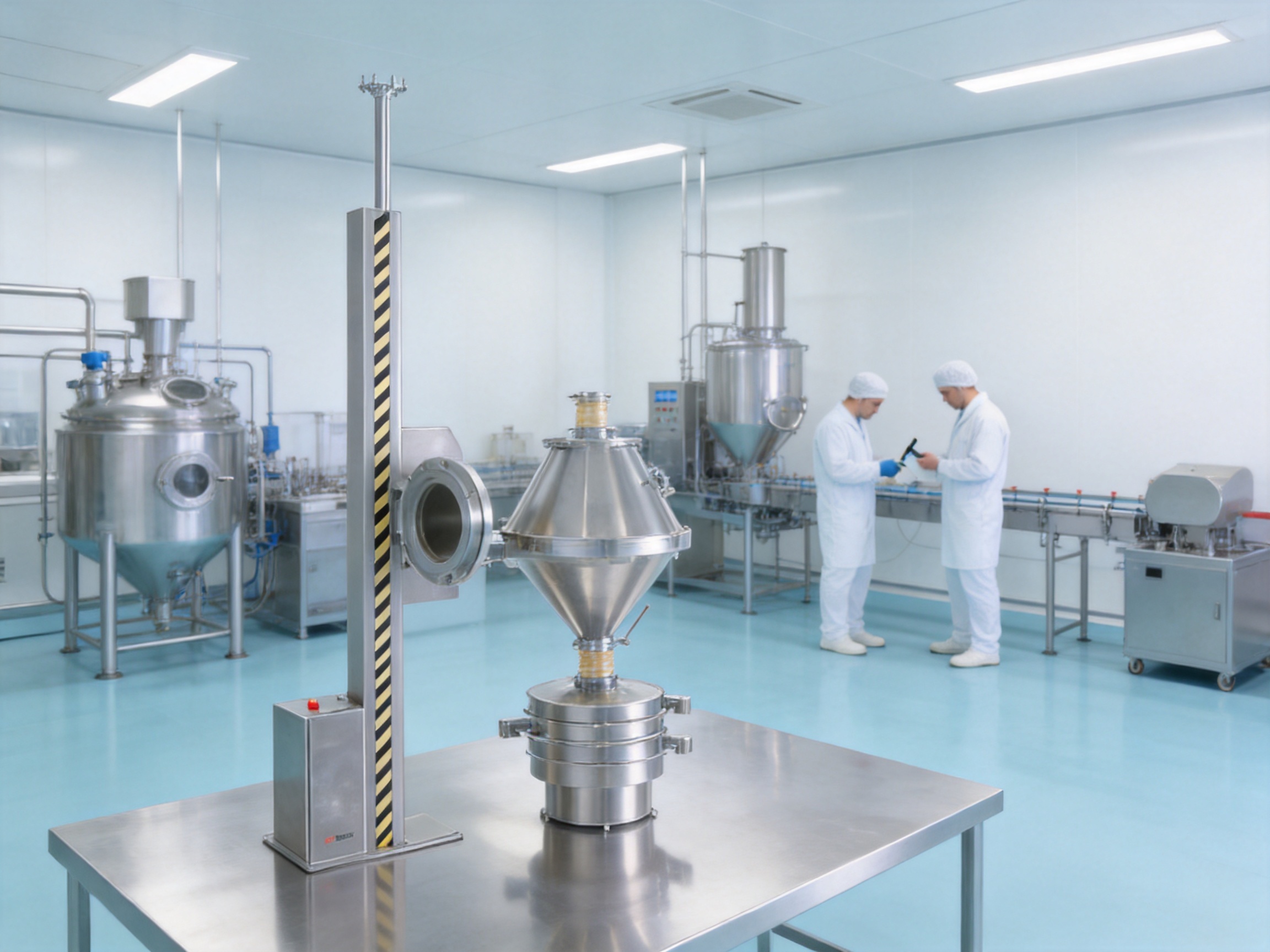
Cleaning should be planned as part of the equipment life cycle rather than treated as an activity performed only after a batch. Product-contacting surfaces should be inspected for residue, and the butterfly valve should be removed when required by the approved cleaning procedure. The absence of dead corners and exposed fasteners can make inspection easier, but all surfaces still need to be cleaned according to the product-specific procedure.
Maintenance personnel should regularly inspect the lifting mechanism, tilting system, rotating column, brake, structural connections, valve components, seals, and control elements. The inspection frequency should be based on operating hours, load conditions, production intensity, and the site’s preventive maintenance program.
Moving parts should be maintained according to the manufacturer’s instructions. Lubricants must be selected carefully so that they do not create a contamination risk. Any component located near the product path should be protected against leakage or accidental contact. Worn seals, damaged gaskets, loose connections, or abnormal movement should be corrected before continued operation.
Operational reliability also depends on correct loading and bin compatibility. The bin should remain within the specified mechanical limits, and the material should be loaded in a way that does not create an unstable center of gravity. Operators should not bypass safety features or attempt to move the machine outside its intended movement range.
A documented maintenance program may include daily visual checks, routine valve inspection, periodic structural inspection, functional testing of the brake, verification of lifting and tilting movement, and scheduled replacement of wear components. Records provide evidence that the machine is being maintained in a controlled manner.
Because the NTF machine lifts and rotates loaded vessels, safety must be addressed through equipment design, installation, procedures, and training. Operators should understand the permitted load, movement path, control functions, emergency procedures, and restrictions on access during operation.
The area around the machine should be kept clear while the bin is being lifted, tilted, rotated, or lowered. Personnel should not stand beneath a suspended load or enter a hazardous movement zone. The brake should be used according to the approved operating sequence, and the machine should not be moved if the bin is improperly docked or unsecured.
The misoperation prevention design on the butterfly valve helps reduce the possibility of an incorrect discharge action. However, valve protection is only one part of the safety system. The complete installation should include suitable guarding, emergency stop provisions, control logic, signage, operator training, and site-specific risk assessment.
Safety requirements can vary by country, industry, electrical classification, and facility type. Before commissioning, the customer should verify that the delivered configuration meets applicable local regulations and internal standards. If the material is combustible or explosive, the user must also assess dust explosion risks and determine whether additional electrical, ventilation, grounding, or protective measures are required.
Production efficiency is influenced by more than the speed of a single movement. It also depends on how easily the equipment can be cleaned, positioned, operated, inspected, and integrated into the process. The NTF machine contributes to efficiency through several coordinated functions.
First, mechanical lifting reduces the time and effort required to position a loaded bin. Second, horizontal rotation allows the same machine to serve different process directions where the layout permits. Third, the tilting function prepares the bin for discharge without a separate manual tipping operation. Fourth, the detachable butterfly valve can simplify cleaning and inspection between batches.
Enclosed transfer can also reduce product losses associated with open dumping. Less material may remain on temporary surfaces, and fewer manual transfer steps may be required. The actual improvement will depend on the product, batch size, operating method, and the design of the connected machines, but the equipment provides a practical foundation for a more organized process flow.
In a well-designed production line, the transfer machine can help establish a repeatable route from granulation to drying, from drying to milling, or from milling to another processing stage. Repeatability is particularly important in regulated manufacturing, where operators must follow defined procedures and production records must reflect controlled processing conditions.
When selecting an NTF model, buyers should begin with the material and process requirements. Important questions include the type of powder or granule, bulk density, moisture content, flowability, sensitivity to shear, batch size, discharge behavior, and required containment level.
The next step is to confirm the bin and process-equipment dimensions. The customer should provide the conical bin diameter, height, outlet arrangement, total loaded weight, connection type, and center-of-gravity information. The inlet dimensions and elevation of the fluid bed granulator, dryer, mill, or other receiving machine should also be documented.
Plant layout is another major consideration. The available length, width, and height should be compared with the reference dimensions of the selected model. The user must allow space for the complete rotational path, the highest lifting position, operator movement, cleaning, maintenance, and emergency access.
Customers should also clarify the required surface finish, materials of construction, sealing materials, electrical requirements, control method, cleaning procedure, and documentation package. If the machine will be used in a validated pharmaceutical process, project discussions should address design qualification, factory testing, site acceptance, manuals, drawings, certificates, and other quality documentation required by the customer.
It is also advisable to review how the machine will interact with upstream and downstream equipment. A transfer machine performs best when its lifting range, docking interface, valve arrangement, and control sequence are designed together with the connected process units.
Changzhou Zhiyang Machinery Equipment Co., Ltd. was founded in 2010 and is based in Changzhou, China. The company specializes in powder processing and oral solid dosage equipment, with products and engineering solutions serving pharmaceutical, biopharmaceutical, biotechnology, nutraceutical, veterinary, additives, chemical, food, and related industries.
Its product portfolio covers laboratory equipment, mixing equipment, granulation equipment, drying equipment, coating equipment, auxiliary processing equipment, and transfer and conveying systems. This range allows the company to support individual equipment purchases as well as modular systems and complete production lines.
The company’s engineering approach is based on the characteristics of the customer’s materials, the required capacity, the site conditions, and the intended process route. This approach can be beneficial for buyers who need more than a standard machine. A suitable transfer solution must fit the actual production environment, and the company’s process integration experience supports that objective.
Research and development, patented technologies, quality system certification, and overseas service capabilities form part of the company’s development strategy. Its equipment and engineering solutions have been supplied to customers in multiple countries and regions. International project experience can help support communication, documentation, installation coordination, and after-sales service for customers outside China.
The company emphasizes honesty, strength, quality, and specialty. These values are reflected in its focus on product reliability, customer reputation, responsive service, technical development, and practical engineering implementation. For a product such as the NTF machine, these strengths are relevant because successful operation depends on correct selection, accurate integration, and continued support after delivery.
The primary purpose is to lift, rotate, tilt, position, and discharge a conical bin containing solid materials. It is mainly used to transfer and feed powders or granules between pharmaceutical process units such as fluid bed granulators, fluid bed dryers, and milling machines.
Yes. The machine is also suitable for selected applications in the chemical and food industries. It may additionally be considered for nutraceutical, veterinary, additives, and related powder-processing operations where hygienic and enclosed transfer is required.
The tilting mechanism can rotate the bin by up to 180 degrees. The appropriate operating position depends on the receiving equipment, material characteristics, bin design, and approved process procedure.
Horizontal rotation allows the bin to align with a downstream process located in a different direction. This can improve layout flexibility and reduce the need for separate manual repositioning or additional handling equipment.
The NTF supports enclosed transfer and can help reduce dust generation compared with open manual handling. Complete dust-control performance depends on the full system, including seals, docking interfaces, receiving equipment, ventilation, extraction, material properties, and operating procedures. The machine should therefore be evaluated as part of the complete containment design.
Yes. The discharge butterfly valve is designed to be dismantled easily for cleaning and maintenance. Its misoperation prevention design also helps support safer operating procedures.
The machine supports GMP-oriented operation through enclosed material transfer, cleanable contact surfaces, a design without dead corners or exposed fasteners on relevant surfaces, and a detachable discharge valve. GMP compliance must be assessed for the complete equipment configuration and validated through the customer’s quality system and procedures.
Model selection should consider bin dimensions, loaded weight, material flow properties, required lifting height, installation footprint, receiving-equipment inlet position, rotation envelope, and process capacity. A project-specific engineering review is recommended before final selection.
Yes. The machine is specifically intended for use with fluid bed granulators and fluid bed dryers. It can also be coordinated with milling units and other compatible process machines. The bin interface and process heights must be confirmed during the design stage.
The NTF series includes models intended for different production requirements, while the company also provides laboratory and pilot-scale equipment. Suitability for a particular laboratory depends on bin size, available space, process height, required movement, and the scale of the material batch.
Customers should provide material characteristics, batch size, bin dimensions, total loaded weight, outlet details, connected equipment information, required discharge height, plant layout, available ceiling height, cleaning requirements, electrical standards, and any GMP, containment, or documentation requirements.
Maintenance should include inspection of the lifting mechanism, tilting system, rotating column, brake, structural connections, valve, seals, and controls. The exact schedule should be established according to operating conditions and the manufacturer’s instructions. Cleaning and maintenance records should be retained where required by the site quality system.
Yes. The manufacturer supplies standalone machines, modular systems, and complete production lines. The NTF can be incorporated into a broader process route that includes mixing, granulation, drying, milling, coating, and other powder-processing operations.
The NTF Fixed Lifting and Tilting Transfer Machine provides a controlled method for moving solid materials between pharmaceutical process stages. Its combination of vertical lifting, up to 180-degree tilting, horizontal column rotation, controlled lowering, and enclosed butterfly-valve discharge addresses several practical challenges associated with conventional manual transfer.
Its principal advantages include reduced manual handling, flexible process alignment, support for sealed docking, improved cleaning access, a hygienic contact-surface design, and compatibility with fluid bed granulators, fluid bed dryers, milling units, and other solid-processing equipment. These features make it a useful component in oral solid dosage manufacturing and in related chemical and food applications.
The equipment’s value is maximized when it is engineered as part of the complete process. Proper model selection, bin compatibility, site planning, safety assessment, cleaning strategy, and integration with receiving equipment are essential for reliable operation. Through process-driven design, equipment manufacturing, research and development, quality management, and engineering support, Changzhou Zhiyang Machinery Equipment Co., Ltd. provides a practical foundation for customers seeking dependable powder-processing and material-transfer solutions.
1. Changzhou Zhiyang Machinery Equipment Co., Ltd. Product information for the NTF Fixed Lifting and Tilting Transfer Machine.
2. Changzhou Zhiyang Machinery Equipment Co., Ltd. Product portfolio information covering powder processing, oral solid dosage, granulation, drying, coating, and conveying equipment.
3. Good Manufacturing Practice guidance for pharmaceutical production equipment, hygienic design, cleaning, contamination control, and process documentation.
4. General engineering principles for powder and granule handling, enclosed transfer, bin positioning, and equipment integration.
5. General safety and maintenance principles for lifting, tilting, rotating, and discharging equipment used in industrial production.
Want to stay up to date?
Contact us via the email address below.
Don't worry about spam. We hate it too!
Mobile Client

Video Account
Phone:+86-15161130178
Tel:+86-519-88674267
Email:czzy188@163.com
Phone:+86-15161132798
Email:zy@zy-drying.com

WeChat ID

Copyright 2026 Changzhou Zhiyang Machinery Equipment Co., Ltd. All Rights Reserved  Oral Solid Dosage Equipment Manufacturer