 English
 Español
 русский
 中文简体
中文简体
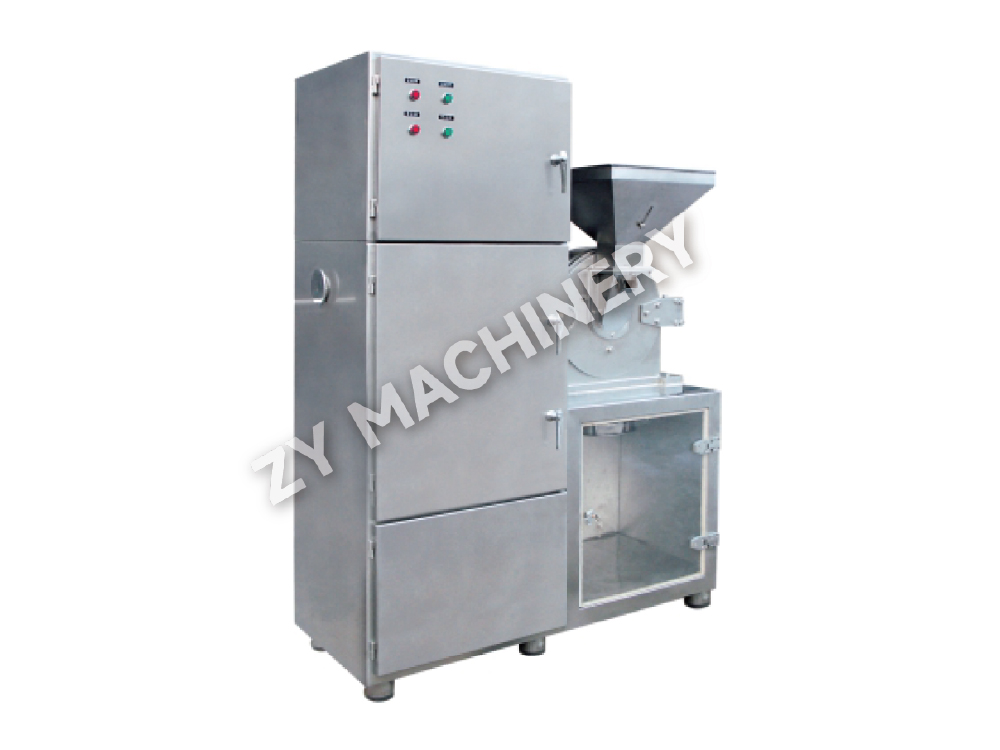
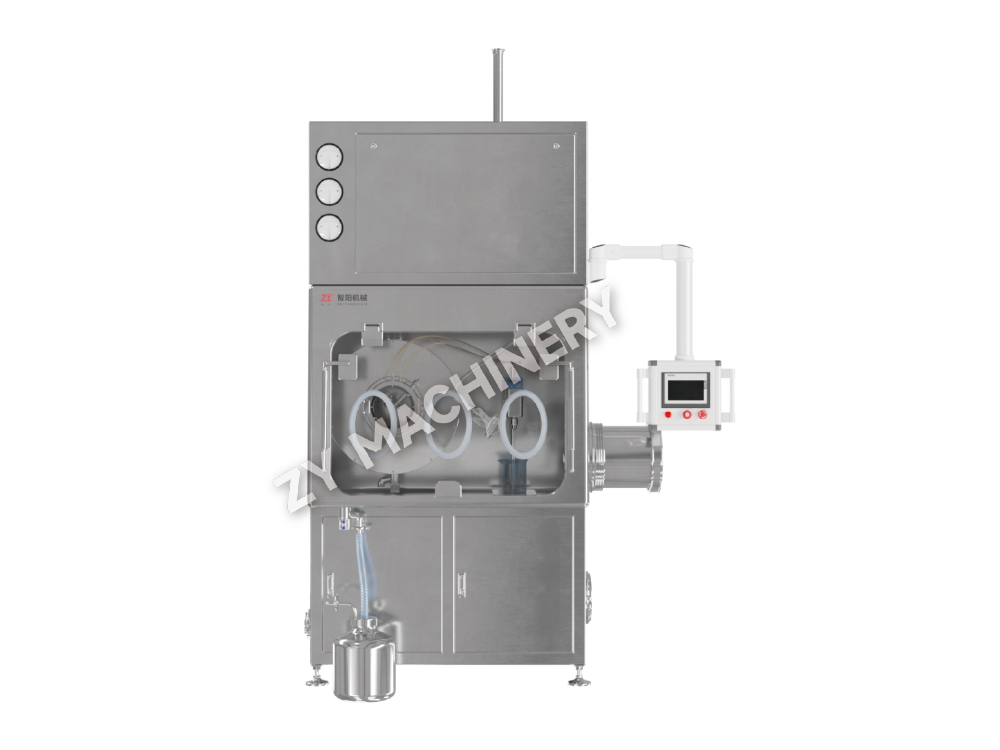
WF Dust-Free Crushing Machine
The WF dust-free crushing machine is used as a grinding process module in t.....

Content
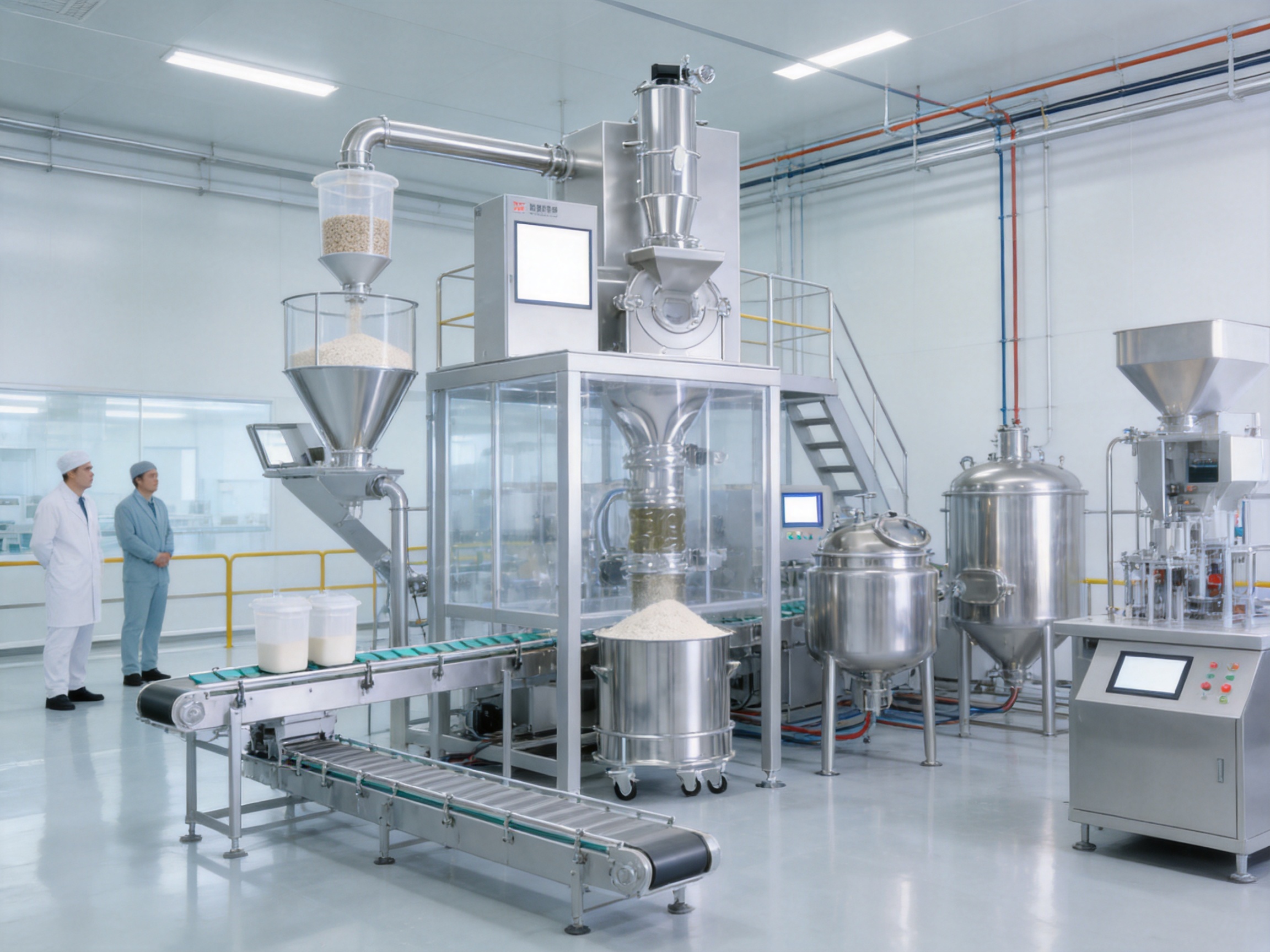
Modern pharmaceutical and food-processing plants increasingly require pulverizing equipment that can deliver consistent particle size, stable throughput, controlled temperature, and improved operator protection. Conventional open or partially enclosed crushers may create excessive dust, generate heat, lose material during transfer, and make cleaning more difficult. These limitations can affect product quality, production efficiency, workplace conditions, and the overall cost of ownership.
The WF dust-free crushing machine is designed as a closed grinding process module for pharmaceutical, food, nutraceutical, chemical, additive, and related powder-processing applications. It combines a stainless-steel pulverizing structure, rotating cutting and impact action, enclosed material handling, temperature monitoring, optional cooling, and a range of machine sizes. The result is a flexible crushing solution for operations that need reliable pulverization with reduced dust dispersion and improved process control.
Manufactured by Changzhou Zhiyang Machinery Equipment Co., Ltd., the WF series forms part of a wider equipment portfolio covering powder processing and oral solid dosage production. The company develops standalone machines, modular systems, and complete process lines for laboratory, pilot, and full-scale manufacturing. Its process-oriented approach allows the crusher to be selected and configured according to material characteristics, production capacity, site conditions, and downstream requirements.
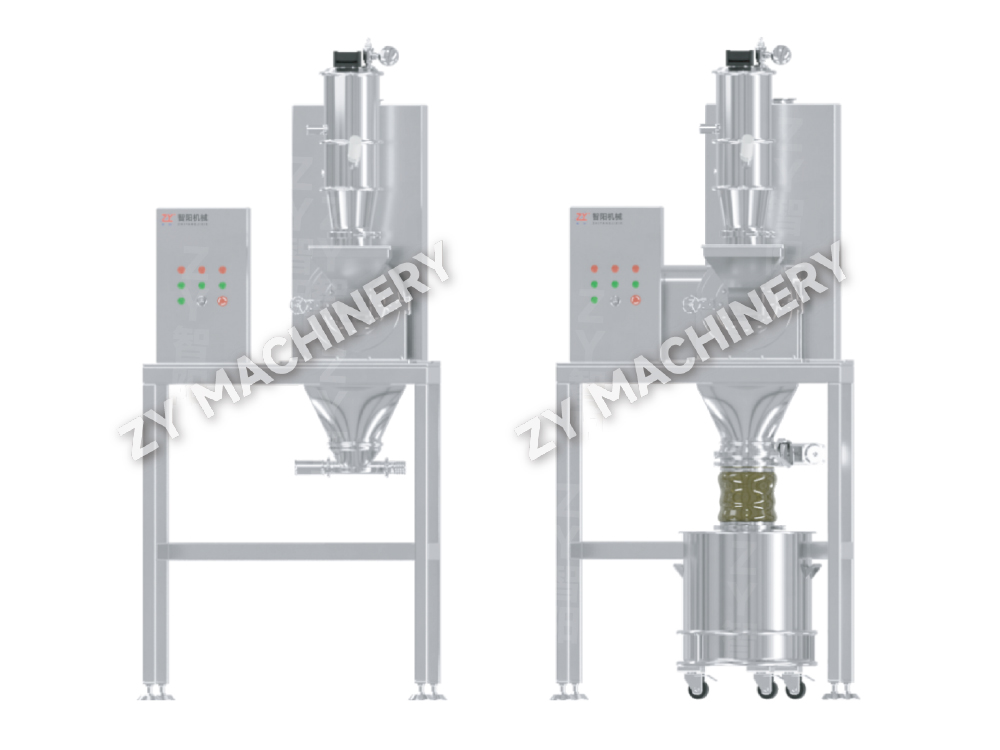
WF Dust-Free Crushing Machine
Pulverizing is often one of the most demanding stages in powder processing. A material may need to be reduced from coarse particles into a controlled powder before mixing, granulation, drying, coating, tablet production, capsule filling, or packaging. During this operation, the mechanical energy applied to the material can also create airborne fines, heat, vibration, and irregular discharge. If these effects are not controlled, they can influence both the product and the working environment.
Dust dispersion is a major concern in pharmaceutical and food facilities. Airborne powder can settle on nearby equipment, enter other processing areas, complicate cleaning, and increase the risk of cross-contamination. Certain materials may also be irritating, allergenic, combustible, or sensitive to moisture and temperature. A fully enclosed crushing process helps limit the release of powder into the surrounding area and supports a cleaner production environment.
The WF dust-free crushing machine is designed around this closed-processing principle. Material enters the pulverizing chamber, is processed by the rotating cutting and impact system, and is discharged through a controlled outlet without requiring an exposed grinding operation. This design does not eliminate the need for appropriate plant ventilation, containment validation, cleaning procedures, or safety controls, but it provides an important mechanical foundation for reducing dust escape during normal use.
Stable crushing is equally important. Irregular feeding or inconsistent discharge can create variations in particle size and downstream production. A uniform discharge rate helps subsequent equipment receive a more consistent material flow. This is particularly useful when the crusher is connected to a mixer, granulator, dryer, weighing system, conveying system, or automated production line.
The WF series operates by feeding material into an enclosed pulverizing chamber. Inside the chamber, a high-speed rotating cutting and impact system acts on the incoming material. Depending on the material properties, the machine can break, cut, impact, and progressively reduce particles until the desired discharge fineness is achieved.
The working effect depends on several variables, including the initial feed size, material hardness, toughness, moisture content, friability, bulk density, feeding rate, screen or internal configuration, rotor speed, and selected blade design. For this reason, the stated capacity and fineness ranges should be considered reference values rather than universal guarantees for every material.
As material is reduced, the enclosed design helps prevent powder from dispersing into the surrounding workplace. The machine is intended to maintain a controlled material path from feed to discharge. This arrangement also supports easier integration with downstream collection, conveying, weighing, or blending equipment.
Unlike a simple open crusher that may rely on manual transfer between stages, the WF machine can serve as part of a controlled process route. Material can be fed in a measured manner, pulverized at a selected operating condition, monitored for temperature, and discharged at a relatively uniform rate. This makes the system suitable for both individual processing and multi-equipment production lines.
The enclosed construction is one of the machine’s most important process advantages. By containing the grinding action within a closed chamber, the WF system reduces direct exposure of operators and surrounding equipment to airborne powder. It also helps keep the material path defined and limits unnecessary product loss during crushing.
Enclosure is especially valuable in facilities processing fine powders, low-dose materials, colored ingredients, strong-smelling substances, or products where cleaning and cross-contamination control are important. The exact level of containment depends on the complete installation, including seals, connections, dust collection, feeding, discharge, and operating procedures. Nevertheless, the closed machine body provides a stronger starting point than an open pulverizing arrangement.
The available WF-10B through WF-100B pulverizer heads are manufactured from stainless steel. Stainless steel is widely used in pharmaceutical and food equipment because it provides a durable, cleanable, and corrosion-resistant process-contact surface when properly selected and maintained.
A stainless-steel structure can support hygienic production by reducing the risk of corrosion-related contamination and by providing surfaces that are easier to inspect and clean. Material selection should still be confirmed for the specific product, cleaning chemicals, temperature, and regulatory requirements. For applications requiring special surface finishes, customized contact parts, or particular documentation, these details can be discussed during technical selection.
Mechanical pulverizing converts part of the motor’s energy into heat. Heat generation can increase when processing tough, oily, moist, or heat-sensitive materials, or when the machine operates continuously at a high load. Excessive temperature may affect product quality, cause caking, change volatile components, or place additional stress on bearings and other mechanical parts.
The WF dust-free crushing machine includes real-time grinding temperature monitoring. This feature gives operators direct information about the thermal condition of the process. It can help them identify abnormal operating conditions, adjust the feeding rate, verify cooling performance, and protect both the material and the equipment.
Temperature monitoring also supports process development. During laboratory or pilot trials, users can compare operating conditions and identify a practical balance between throughput, fineness, and heat generation. This information can then guide the selection of a production-scale model and the establishment of operating limits.
For materials that are sensitive to heat, the machine can be equipped with an optional cooling water jacket. The jacket provides a means of removing heat from the pulverizing area and maintaining a more suitable operating temperature.
Cooling is useful for ingredients that may soften, melt, oxidize, lose volatile components, or change physical properties when exposed to excessive temperature. It may also help reduce the risk of material adhesion and maintain a more stable discharge. The actual cooling effect depends on water temperature, flow rate, jacket design, ambient conditions, material properties, machine load, and operating time.
A water jacket should be integrated into a properly controlled utility system. Users should consider water quality, pressure, drainage, condensation, insulation, and cleaning requirements. When the product or facility has strict hygienic standards, the cooling arrangement should be included in the overall equipment qualification and maintenance plan.
The cutting and impact components are central to crushing performance. Different raw materials respond differently to mechanical force. Brittle materials may break readily under impact, while fibrous or tough materials may require stronger cutting action. Sticky or heat-sensitive materials may need a different operating condition and blade configuration.
The WF series allows an alloy blade system to be selected according to material characteristics. This provides greater flexibility than using one standard blade arrangement for every product. Blade material and geometry can influence wear resistance, cutting efficiency, heat generation, particle distribution, and service life.
Selection should be based on practical testing. A suitable blade system should provide the required fineness without excessive wear, contamination risk, or unnecessary energy consumption. When processing abrasive powders, users should also evaluate wear rates, inspection frequency, and the effect of blade condition on product quality.
The machine is designed for continuous and stable operation at maximum capacity, with a uniform discharge rate under suitable operating conditions. Consistent discharge is valuable because it reduces fluctuations in downstream equipment. A mixer, granulator, dryer, or weighing system performs more effectively when the incoming material flow is steady.
Continuous operation can also reduce the number of manual interventions required between batches or processing stages. This may improve labor efficiency and help maintain a more repeatable process route. However, continuous use should always follow the recommended operating envelope, including appropriate feeding, temperature control, inspection, lubrication, and scheduled maintenance.
The WF machine can be integrated with weighing systems for precise material control. Weighing integration is particularly useful when the pulverizer is part of a formulation process in which the quantity of each ingredient must be tracked accurately. Controlled feeding can help reduce overfeeding, improve batch consistency, and provide better production records.
The equipment can also be connected to transfer and conveying systems. A closed connection between the feed source, crusher, collection point, and downstream machine can reduce manual handling and limit powder exposure. Depending on the facility layout, the process may include bins, hoppers, screw conveyors, vacuum conveying, weighing modules, dust collection, or other auxiliary equipment.
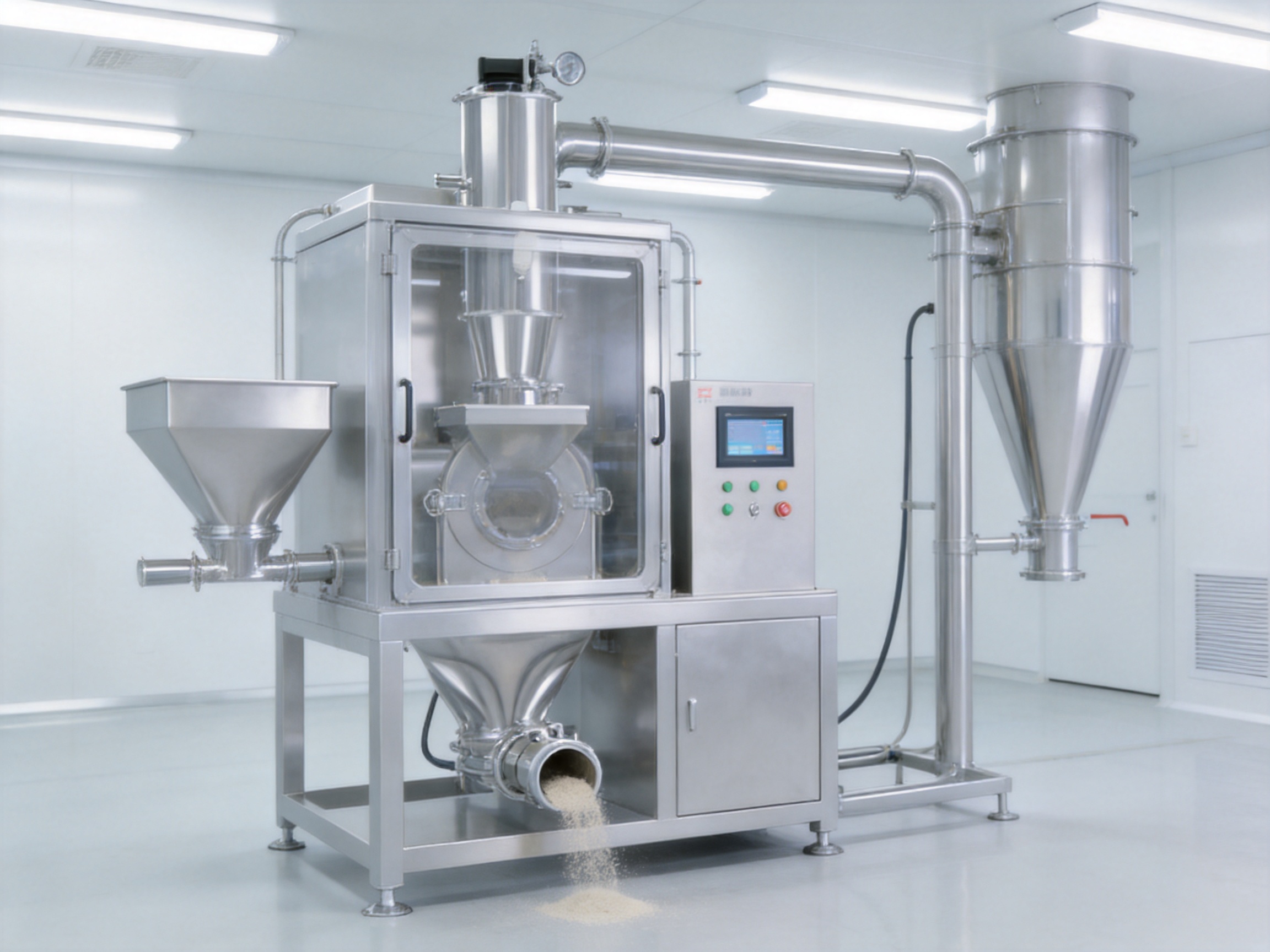
The WF series includes pulverizer heads from WF-10B to WF-100B. This range allows users to select a machine for small-scale testing, pilot production, or higher-capacity manufacturing. Model selection should be based not only on nominal capacity but also on the material’s behavior, required fineness, operating schedule, available floor space, utility conditions, and required containment level.
| Item | Unit | WF-10B | WF-20B | WF-30B | WF-40B | WF-60B | WF-80B | WF-100B |
| Reference Capacity | kg/h | 10–60 | 60–150 | 100–300 | 150–600 | 200–1200 | 200–1400 | 250–2000 |
| Feed Fineness | mm | <6 | <6 | <10 | <10 | <10 | <10 | <10 |
| Discharge Fineness | mesh | 20–120 | 20–120 | 20–120 | 20–120 | 20–120 | 20–120 | 20–120 |
| Crushing Motor Power | kW | 2.2 | 2.2 | 4 | 5.5 | 11 | 18.5 | 30 |
| Main Shaft Speed | rpm | 8000 | 4500–5000 | 3800 | 3200 | 2400 | 1800 | 1400 |
| Dimensions | mm | 1000×500×1180 | 1280×600×1660 | 1280×600×1660 | 1450×700×1800 | 1950×850×2100 | 2000×850×2200 | 2200×950×2400 |
| Weight | kg | 180 | 280 | 340 | 450 | 600 | 2000 | 2400 |
The reference capacity is based on test data using 60-mesh white sugar. Actual performance may differ according to the material and operating conditions. The general product information indicates grinding capacity from approximately 10 to 2500 kg per hour, while the listed standard table reaches 2000 kg per hour for the WF-100B. The higher figure may apply to a specific test condition or customized configuration and should therefore be confirmed through material testing and technical evaluation.
The feed fineness range is below 6 mm for the WF-10B and WF-20B models and below 10 mm for the larger models. The standard discharge range is 20 to 120 mesh across the series. This broad range allows the equipment to support different powder-processing requirements, although final particle-size distribution should be validated for the specific material and process objective.
Motor power increases from 2.2 kW on the smaller models to 30 kW on the WF-100B. Main shaft speed decreases as machine size increases, illustrating that crushing performance is determined by the complete mechanical configuration rather than speed alone. Larger models provide greater processing capacity while using a lower shaft speed and a larger working structure.
One of the clearest advantages of the WF machine over open crushers is its enclosed operating structure. Conventional open equipment can release fines during feeding, crushing, collection, and discharge. Operators may need additional local extraction, manual covers, or repeated cleaning to control the resulting dust.
The WF system reduces the number of exposed transfer points. By keeping the primary crushing action within a closed chamber, it supports a cleaner operating area and can reduce product loss. When combined with suitable seals, dust collection, and closed conveying, it can form part of a more comprehensive containment strategy.
Many basic crushers do not provide direct, real-time information about grinding temperature. Operators may only notice overheating after the material has changed appearance or the equipment has begun to show abnormal behavior. The WF machine’s temperature monitoring enables earlier recognition of thermal changes.
This is particularly valuable for pharmaceutical excipients, food ingredients, botanical materials, and other products where temperature can influence quality. The optional cooling water jacket provides an additional advantage for applications in which passive heat dissipation is not sufficient.
A single fixed crusher design may perform well with one material but poorly with another. The WF series offers multiple models, a broad discharge-fineness range, and optional alloy blade configurations. This makes it easier to match the equipment to the product rather than forcing different materials through one standard setup.
Flexible configuration also helps companies grow their production. A laboratory or pilot model can be used for trials and process development, while a larger model can be selected when demand increases. The available capacity range supports a gradual equipment strategy instead of requiring an immediate investment in the largest machine.
Uniform discharge is important when crushing is connected to another process. An unstable or intermittent flow can cause overloading, underfeeding, fluctuating blend ratios, and inconsistent residence times in downstream equipment. The WF machine is designed to deliver a stable discharge under suitable material and operating conditions.
Its compatibility with weighing and conveying equipment further supports controlled production. This can be an important difference between a standalone crusher and a process-ready crushing module designed for integration.
Stainless-steel construction supports the requirements of pharmaceutical and food environments better than ordinary painted or non-corrosion-resistant structures. Cleanable construction, appropriate contact materials, and a controlled product path can help facilities establish more repeatable sanitation and inspection procedures.
Construction material alone does not determine hygienic performance. Weld quality, surface finish, seals, dead-leg design, accessibility, cleaning method, and equipment installation are also important. The advantage of the WF design is that it is developed within a product range dedicated to powder processing and production-line integration.
Equipment quality depends on more than the machine’s visible structure. It also depends on how the manufacturer understands the process, selects components, manages fabrication, controls assembly, verifies operation, and supports the customer after delivery. Changzhou Zhiyang Machinery Equipment Co., Ltd. approaches equipment development through process engineering rather than treating each machine as an isolated commodity.
The company designs solutions according to material characteristics, capacity requirements, and site conditions. For a crushing application, this means evaluating the feed material, desired discharge fineness, throughput, temperature sensitivity, dust behavior, cleaning expectations, and connection requirements.
This approach is beneficial because a crusher’s success cannot be judged by motor power or nominal capacity alone. A machine that is technically large enough may still be unsuitable if it generates too much heat, cannot handle the material’s texture, creates excessive dust, or cannot connect effectively with the customer’s existing line. Process-oriented design helps address these issues before final equipment selection.
The company’s product scope includes laboratory equipment, mixing equipment, granulation equipment, drying equipment, coating equipment, auxiliary processing equipment, and transfer and conveying systems. This broad manufacturing capability supports a more complete understanding of how the WF crusher will operate within a larger process.
For example, a customer may need to receive raw material, weigh it, crush it, blend it, granulate it, dry it, coat it, and transfer it to packaging. A manufacturer familiar with each of these stages can design better interfaces between machines and help reduce unnecessary manual handling.
The use of stainless steel for the WF pulverizer heads reflects the company’s focus on equipment suitable for controlled production areas. During manufacturing, attention should be given to dimensional accuracy, rotor balance, blade installation, chamber fit, sealing, electrical configuration, and inspection of contact surfaces. These elements influence not only performance but also service life and operator confidence.
Changzhou Zhiyang Machinery Equipment Co., Ltd. has continued to expand its product portfolio, strengthen research and development capabilities, obtain quality system certification, and develop patented technologies. These activities indicate a long-term commitment to improving equipment performance and adapting designs to changing production requirements.
Research and development is especially important in pulverizing because materials vary widely. New formulations, plant-based ingredients, engineered additives, and specialized pharmaceutical powders may require different combinations of speed, blade design, cooling, feeding, and discharge control. Ongoing technical development allows the manufacturer to refine equipment options and respond to application-specific challenges.
The company provides equipment for laboratory, pilot, and full-scale production. This multi-scale capability helps customers establish a logical development path. Laboratory testing can identify how a material behaves under different crushing conditions. Pilot equipment can verify throughput, temperature, cleaning, and integration requirements. Production equipment can then be selected on the basis of actual process knowledge rather than assumptions.
Scale-up should never rely solely on multiplying laboratory capacity by a simple factor. Particle-size distribution, heat generation, feeding behavior, residence time, and material flow may change with machine size. A manufacturer with experience across multiple scales can help users identify these differences and define a more reliable scale-up strategy.
ZY Machinery provides practical process routes and engineering implementation plans in addition to standalone machinery. This is useful for customers that need support with equipment arrangement, material transfer, process sequencing, and line integration.
Overseas service capabilities and partnerships across multiple countries and regions also support international customers. Effective service includes technical communication, documentation, installation guidance, commissioning support, spare-parts planning, and troubleshooting. These factors can have a major influence on the actual value of a machine over its operating life.
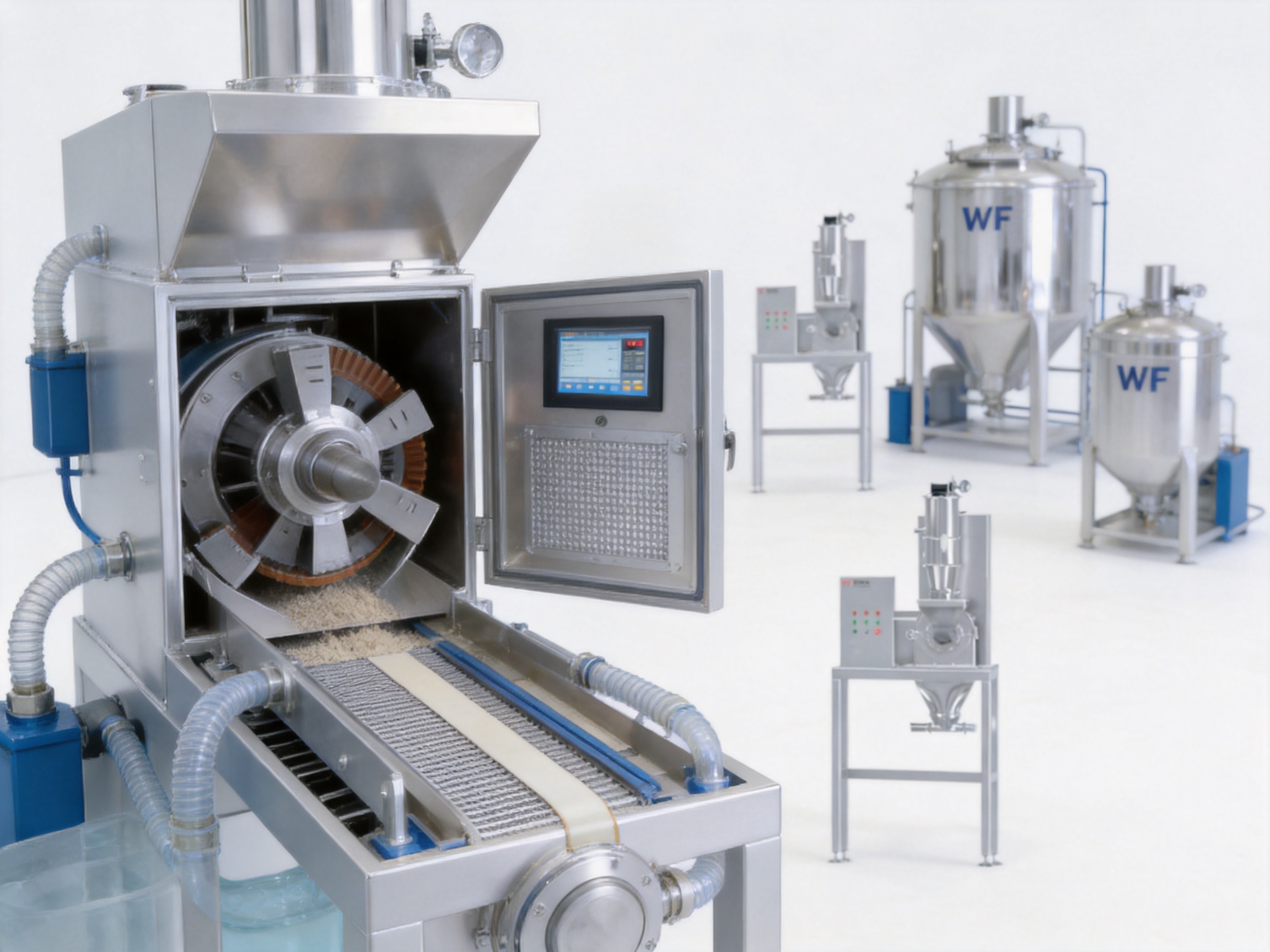
Pharmaceutical manufacturing often requires controlled powder properties before the material enters blending, wet granulation, dry granulation, capsule filling, or tablet compression. The WF machine can be used to reduce particle size and prepare materials for more consistent downstream processing.
Enclosed operation is useful when handling active ingredients, excipients, colored powders, or products requiring careful dust management. Temperature monitoring can help protect heat-sensitive materials and support the establishment of suitable process limits. The correct model, blade system, and cleaning method should be confirmed through application testing and the customer’s quality requirements.
Botanical ingredients and nutraceutical powders may contain fibrous, brittle, oily, or moisture-sensitive components. These materials can behave differently from conventional crystalline powders. The adjustable equipment range and optional alloy blades provide a basis for adapting the crushing process to the raw material.
For botanical products, temperature control may be important because excessive heat can affect aroma, color, volatile constituents, or other quality attributes. A cooling water jacket may be selected when testing shows that the process requires additional heat removal.
The reference capacity data is based on 60-mesh white sugar, demonstrating the machine’s suitability for fine food-ingredient processing under test conditions. Other food materials may include starches, dried ingredients, seasonings, sweeteners, dehydrated vegetables, and powdered additives.
Food applications benefit from stainless-steel construction, enclosed processing, and controlled transfer. The exact machine configuration should consider the ingredient’s moisture content, stickiness, oil content, abrasiveness, and desired final texture. Hygienic design and cleaning validation remain essential parts of the complete installation.
Veterinary formulations and feed or process additives may require controlled particle reduction before blending or dosing. The ability to connect the WF machine with weighing systems can support more precise material control, especially where small quantities or multiple ingredients are handled.
Dust management is also valuable in additive production because powders may be fine, strongly colored, or irritating. A closed process route can reduce the exposure of personnel and help maintain a cleaner working environment.
Model selection should begin with the material rather than the motor rating. Users should provide information about the material name, initial particle size, moisture content, hardness, density, abrasiveness, oiliness, fibrous nature, temperature sensitivity, and required discharge fineness.
The required capacity should be stated as both an average and a peak requirement. A machine operating continuously near its maximum rating may have less flexibility for changes in feed properties or production demand. In some cases, selecting a larger model at a moderate operating rate can provide additional process margin, while in other cases a smaller machine may be more economical and easier to clean.
Feed size is another key consideration. The listed feed fineness is below 6 mm for the smaller models and below 10 mm for the larger models. If the incoming material is coarser than the specified limit, a pre-crushing or screening stage may be necessary.
Discharge fineness should be evaluated together with particle-size distribution. A nominal mesh value does not fully describe the shape, spread, and proportion of particles produced. Testing should determine whether the output meets the actual requirements of the next process, such as blending uniformity, granulation behavior, dissolution, compression, or filling.
Temperature requirements should be discussed at the beginning of selection. If the material is heat-sensitive or prone to softening, the user should consider the monitored temperature range, cooling water conditions, blade selection, feeding rate, and cleaning strategy. The optional cooling water jacket may be an important part of the final configuration.
Finally, the physical installation must be reviewed. Dimensions, weight, access for maintenance, electrical supply, discharge height, dust collection, conveying route, and operator access all affect the suitability of the selected model. Changzhou Zhiyang Machinery Equipment Co., Ltd. can use site and process information to help develop a practical implementation plan.
Before installation, the foundation, floor loading, clearance, power supply, grounding, ventilation, and material-transfer route should be checked. Larger models such as the WF-80B and WF-100B have substantial weight and dimensions, so lifting, positioning, and maintenance access should be planned in advance.
All feed and discharge connections should be properly aligned and sealed. Poorly fitted connections can introduce vibration, cause powder leakage, or interfere with stable feeding. If the machine is connected to a dust collector or conveying system, the complete air and material balance should be reviewed during commissioning.
Operators should follow a controlled start-up sequence. The machine should be inspected before feeding, and the selected operating speed, feeding rate, cooling conditions, and temperature limits should be confirmed. Sudden overfeeding can increase motor load, heat generation, vibration, and the risk of blockage.
Routine maintenance should include inspection of blades, fasteners, seals, bearings, electrical components, and safety devices. Blade wear can affect crushing efficiency and particle-size consistency. Bearings should be monitored for unusual noise or temperature, while seals should be inspected for damage that could allow powder escape.
Cleaning procedures should be developed according to the material and facility requirements. The process-contact area should be accessible for inspection, and any cleaning method should be compatible with the stainless-steel surfaces, seals, bearings, and electrical components. If products with different colors, active ingredients, or allergenic properties are processed, cleaning verification may be required.
A dust-free crushing machine should be evaluated as part of a complete process system. Closed construction supports dust reduction, but the final containment result also depends on feeding equipment, seals, transfer points, discharge collection, ventilation, and operating practice.
Pharmaceutical and food manufacturers may need documentation such as material certificates, equipment drawings, operating instructions, inspection records, and maintenance recommendations. Depending on the application, they may also conduct installation qualification, operational qualification, performance qualification, cleaning verification, and process validation.
Safety measures should include guarding, emergency stopping, electrical protection, appropriate grounding, access control, and procedures for clearing blockages. If the material presents a combustible-dust risk, the user should conduct a formal hazard assessment and specify the necessary protective measures. The equipment configuration must be reviewed against the applicable site, industry, and regulatory requirements.
Temperature monitoring supports safer operation by providing information about thermal conditions, but it should not replace standard safety systems. Operators still need defined limits, alarm responses, inspection procedures, and preventive maintenance. Similarly, an alloy blade may improve wear resistance, but blade condition must still be checked regularly.
Purchasing a crusher from a manufacturer with a broader process-equipment portfolio can provide advantages during project development. The WF machine may need to work with a mixer, granulator, dryer, coating system, conveying line, or weighing unit. If these systems are supplied or coordinated by one engineering partner, interface responsibilities can be clearer.
Changzhou Zhiyang Machinery Equipment Co., Ltd. serves pharmaceutical, biopharmaceutical, biotechnology, nutraceutical, veterinary, additives, and related industries. Its experience in powder processing and oral solid dosage equipment enables it to consider the crusher’s role in the complete manufacturing sequence.
The company’s engineering philosophy emphasizes practical process routes, reliability, consistency, efficiency, and cost control. This is especially important for customers that are building a new line or upgrading an existing facility. The best equipment solution is not necessarily the machine with the largest capacity; it is the system that achieves the required output while remaining manageable to clean, operate, maintain, and validate.
Customer reputation, responsive service, research and development, and product quality are identified as important corporate values. These strengths support long-term cooperation because industrial equipment is expected to operate reliably for many years after delivery. Technical support, spare parts, process advice, and equipment upgrades may be just as important as the initial purchase decision.
A structured evaluation can help customers determine whether the WF dust-free crushing machine is appropriate for a particular application. First, the customer should define the material and the required final powder properties. Representative samples should be supplied whenever possible.
Second, the user should identify the desired capacity, operating hours, batch or continuous production method, and expected future expansion. This information helps determine whether the machine should operate near its maximum rating or provide additional capacity margin.
Third, crushing trials should be used to evaluate output fineness, particle-size distribution, temperature rise, power demand, dust behavior, blade wear, and discharge stability. If the material is heat-sensitive, trials should compare standard operation with cooling-water-jacket operation.
Fourth, the customer should review the proposed equipment layout. The review should include feeding, weighing, crushing, discharge, collection, conveying, cleaning, maintenance, and operator access. A technically capable crusher may still be unsuitable if the surrounding system creates excessive manual handling or difficult cleaning conditions.
Fifth, documentation and service expectations should be clarified. Customers should confirm the scope of supply, electrical standards, spare parts, training, commissioning, warranty, technical files, and after-sales support. Clear communication at this stage reduces the chance of delays during installation and validation.
The machine is used for enclosed pulverizing and grinding operations in pharmaceutical, food, nutraceutical, veterinary, additive, and related powder-processing applications. It can prepare materials for mixing, granulation, drying, coating, dosing, compression, capsule filling, or packaging.
The machine uses a fully enclosed pulverizing structure that limits dust dispersion during crushing and material handling. It should be installed with suitable feeding, discharge, sealing, ventilation, and collection arrangements. The complete system and operating conditions determine the final level of dust control.
The WF series can be considered for many brittle, fibrous, crystalline, and dry powder materials. Suitability depends on hardness, moisture, stickiness, abrasiveness, oil content, and temperature sensitivity. Material testing is recommended before final model and blade selection.
The listed standard model range covers approximately 10 to 2000 kg per hour, depending on the model and material. General product information indicates a possible range up to approximately 2500 kg per hour under specific test or configured conditions. The reference test uses 60-mesh white sugar, so actual capacity for another material may be different.
The listed discharge range is 20 to 120 mesh. Actual results depend on the material and operating conditions. Users should confirm the required particle-size distribution through representative testing rather than relying only on a nominal mesh value.
Yes, the machine includes real-time grinding temperature monitoring, and an optional cooling water jacket is available. The final suitability depends on the material’s thermal properties, production rate, blade configuration, cooling conditions, and allowable temperature range.
Yes. The WF-10B through WF-100B pulverizer heads are manufactured from stainless steel. Specific material grades, surface finishes, seals, and contact-part requirements should be confirmed according to the product and facility standards.
Yes. The machine can be integrated with weighing systems for more precise material control. It can also be connected with conveying and downstream processing equipment as part of a modular or complete production line.
Selection should consider material properties, feed size, required discharge fineness, capacity, temperature sensitivity, operating schedule, installation space, cleaning requirements, and downstream connections. Testing with the actual material is the most reliable basis for selection.
Changzhou Zhiyang Machinery Equipment Co., Ltd. provides standalone machines, modular systems, and complete production lines. Its product range includes mixing, granulation, drying, coating, auxiliary processing, transfer, and conveying equipment, allowing the company to support broader process-integration requirements.
The WF dust-free crushing machine is designed for manufacturers that need more than basic particle reduction. Its enclosed pulverizing chamber supports reduced dust dispersion, while stainless-steel construction provides a suitable foundation for pharmaceutical and food processing. Temperature monitoring helps operators protect materials and mechanical components, and the optional cooling water jacket extends the machine’s flexibility to heat-sensitive applications.
The series offers multiple models from WF-10B to WF-100B, a reference capacity range from small-scale production to high-throughput processing, discharge fineness from 20 to 120 mesh, and blade options matched to different material characteristics. Its ability to connect with weighing, conveying, and downstream equipment makes it suitable as a standalone machine or as part of an integrated process line.
Compared with open or less adaptable crushers, the WF system provides advantages in dust control, process monitoring, configuration flexibility, stainless-steel construction, and downstream integration. These advantages are strengthened by the manufacturer’s broader capabilities in powder processing, oral solid dosage equipment, process engineering, research and development, quality systems, and overseas service.
For the best result, customers should evaluate the machine through representative material trials and a complete process review. When the model, blade system, cooling arrangement, feeding method, discharge connection, and operating procedure are correctly matched, the WF dust-free crushing machine can provide a stable and practical solution for controlled powder processing.
1. Changzhou Zhiyang Machinery Equipment Co., Ltd. WF Dust-Free Crushing Machine Product Information and Technical Parameters.
2. Changzhou Zhiyang Machinery Equipment Co., Ltd. Powder Processing and Oral Solid Dosage Equipment Manufacturing Information.
3. General Principles of Pharmaceutical Powder Processing, Particle-Size Control, and Process Equipment Selection.
4. General Hygienic Design Considerations for Stainless-Steel Equipment Used in Food and Pharmaceutical Manufacturing.
5. General Guidance on Equipment Qualification, Cleaning Verification, and Process Validation for Powder-Processing Systems.
Want to stay up to date?
Contact us via the email address below.
Don't worry about spam. We hate it too!
Mobile Client

Video Account
Phone:+86-15161130178
Tel:+86-519-88674267
Email:czzy188@163.com
Phone:+86-15161132798
Email:zy@zy-drying.com

WeChat ID

Copyright 2026 Changzhou Zhiyang Machinery Equipment Co., Ltd. All Rights Reserved  Oral Solid Dosage Equipment Manufacturer