 English
 Español
 русский
 中文简体

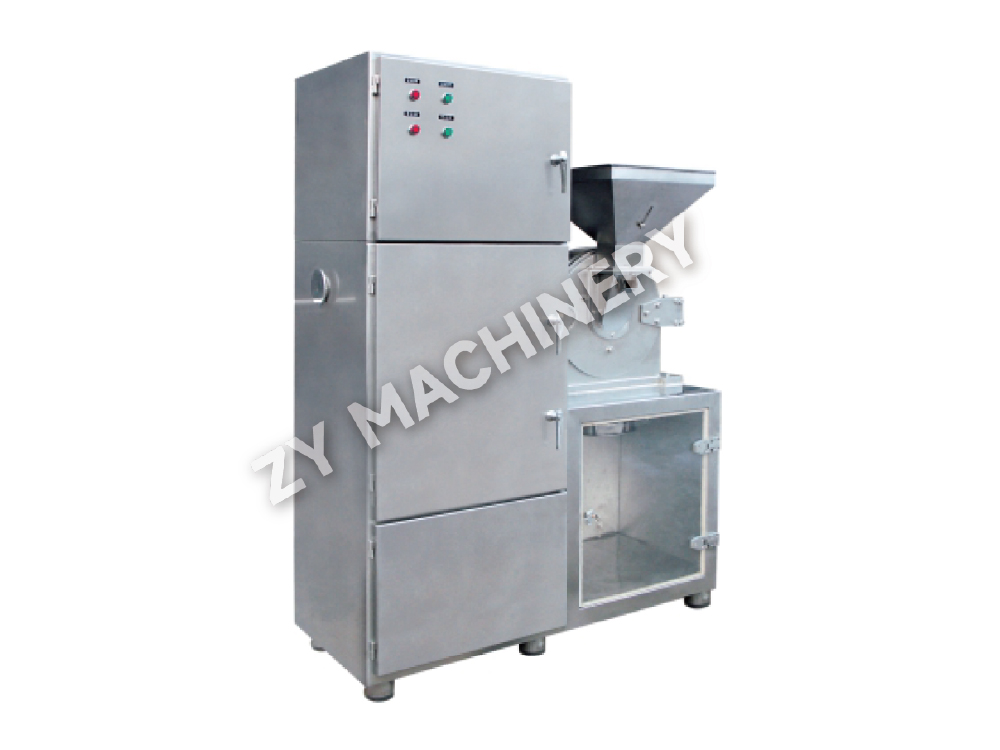
WF Dust-Free Crushing Machine
The WF dust-free crushing machine is used as a grinding process module in t.....

Content
Powder processing is a critical stage in pharmaceutical, food, nutraceutical, veterinary, additive, and related manufacturing. The quality of the final powder affects downstream mixing, granulation, drying, coating, filling, tableting, encapsulation, packaging, and dissolution performance. For this reason, a pulverizer must do more than reduce particle size. It must provide controlled feeding, stable throughput, repeatable fineness, effective dust containment, manageable heat generation, reliable operation, and compatibility with modern production systems.
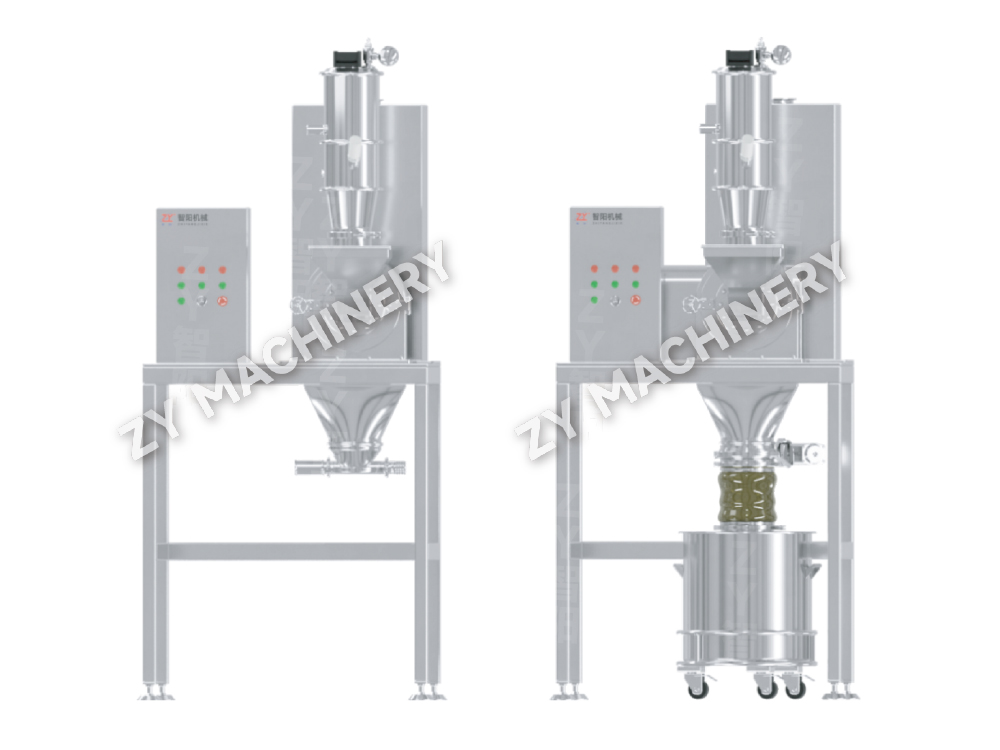
The WF dust-free crushing machine is designed as a grinding process module for enclosed and controlled pulverizing operations. It is particularly suitable for manufacturers that need to process materials while reducing dust dispersion and maintaining stable product flow. The machine uses a rotating cutting and impact system within a fully enclosed pulverizing chamber. This design supports continuous processing while helping operators maintain a cleaner production environment and more consistent output.
With pulverizer head options from WF-10B to WF-100B, the equipment covers laboratory-scale, pilot-scale, and production-oriented requirements. Depending on the selected model, material properties, screen configuration, and test conditions, capacity ranges from small-batch processing to high-throughput operation. The published reference capacity extends from approximately 10 kg/h to as much as 2,000 kg/h in the standard parameter table, while overall test-based processing capability may reach approximately 2,500 kg/h for suitable materials.
Manufactured by Changzhou Zhiyang Machinery Equipment Co., Ltd., the WF series reflects a process-oriented approach to powder handling equipment. The company develops standalone machines, modular systems, and complete production lines for pharmaceutical, biopharmaceutical, biotechnology, nutraceutical, veterinary, food, additives, and other industries. Its strength lies not only in supplying machinery but also in matching equipment selection to material characteristics, required capacity, process sequence, and site conditions.
WF Dust-Free Crushing Machine
Pulverizing creates a large quantity of fine particles. When a crushing process is operated in an open or poorly sealed configuration, dust can escape at the feed point, inside the grinding chamber, around the discharge outlet, or during transfer to the next process. This can increase cleaning requirements, cause material loss, affect operator comfort, and create cross-contamination risks in facilities that handle multiple products.
In pharmaceutical and food manufacturing, dust control is also closely related to hygiene and process organization. A machine that keeps the material path enclosed can reduce the amount of powder released into the surrounding workspace. This does not replace a complete facility dust-extraction, containment, or safety strategy, but it can significantly improve the control of the immediate grinding operation.
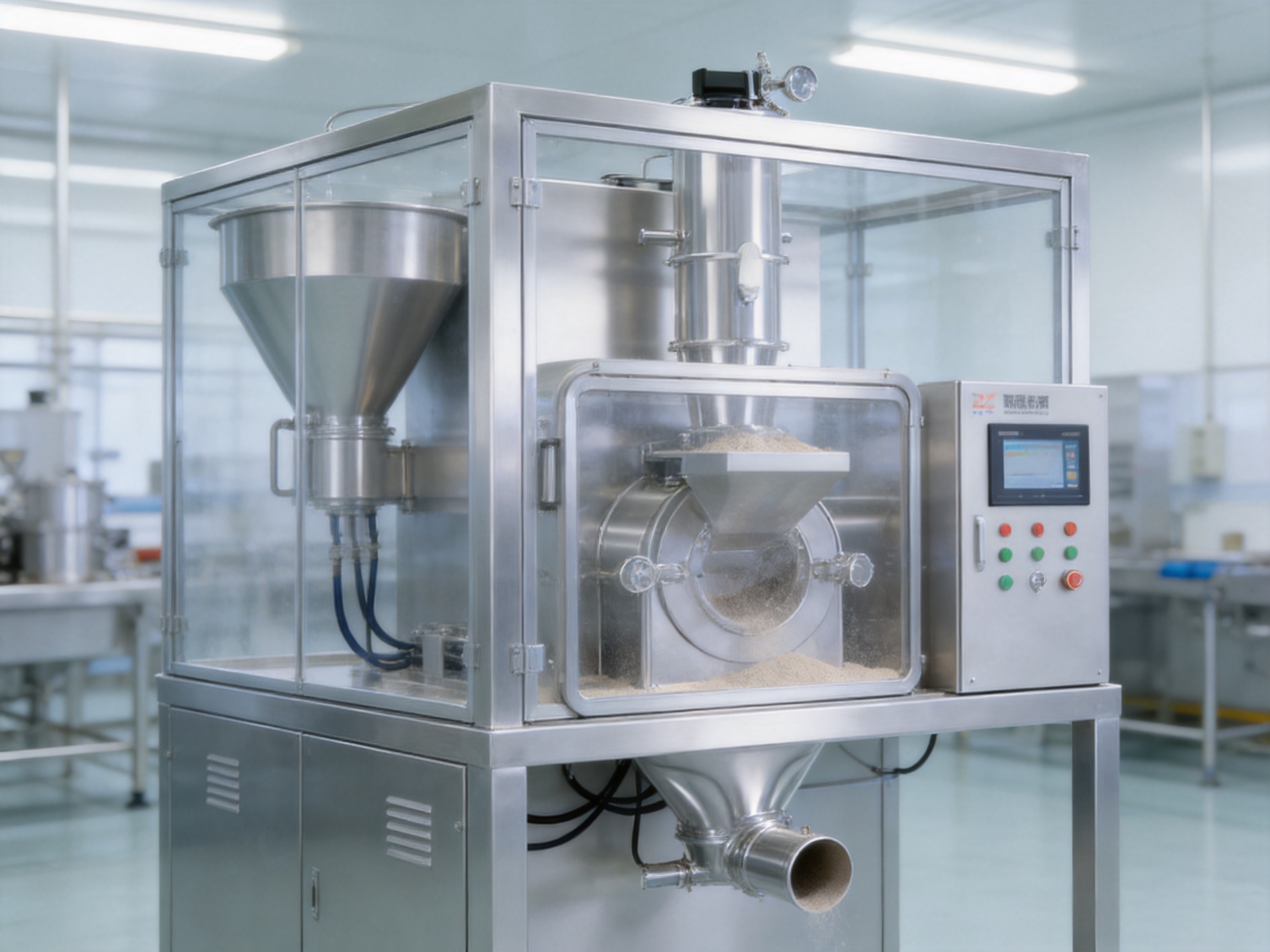
The WF dust-free crushing machine addresses this challenge through a fully enclosed structure. Material enters the pulverizing chamber, is processed by the rotating cutting and impact system, and exits through a controlled discharge route. Because the working zone is enclosed, the material remains within the intended process path instead of being exposed to the surrounding environment.
Compared with conventional open crushing arrangements, the enclosed design offers several practical advantages:
• Reduced visible dust dispersion during feeding, pulverizing, and discharge.
• Better protection of the surrounding work area from unnecessary powder deposits.
• Lower risk of product loss caused by airborne material escaping from the machine.
• More orderly connection with downstream equipment such as weighing, mixing, granulation, or conveying systems.
• Easier integration into controlled production environments where cleaning and material segregation are important.
• Improved operator access to process information because temperature and operating conditions can be monitored in real time.
Dust-free should be understood as a process-oriented design objective rather than an absolute claim that no airborne particles can ever exist. Actual performance depends on material properties, installation, sealing, feeding conditions, extraction arrangements, maintenance, and operating procedures. Nevertheless, the enclosed WF configuration provides a strong foundation for controlled powder processing.
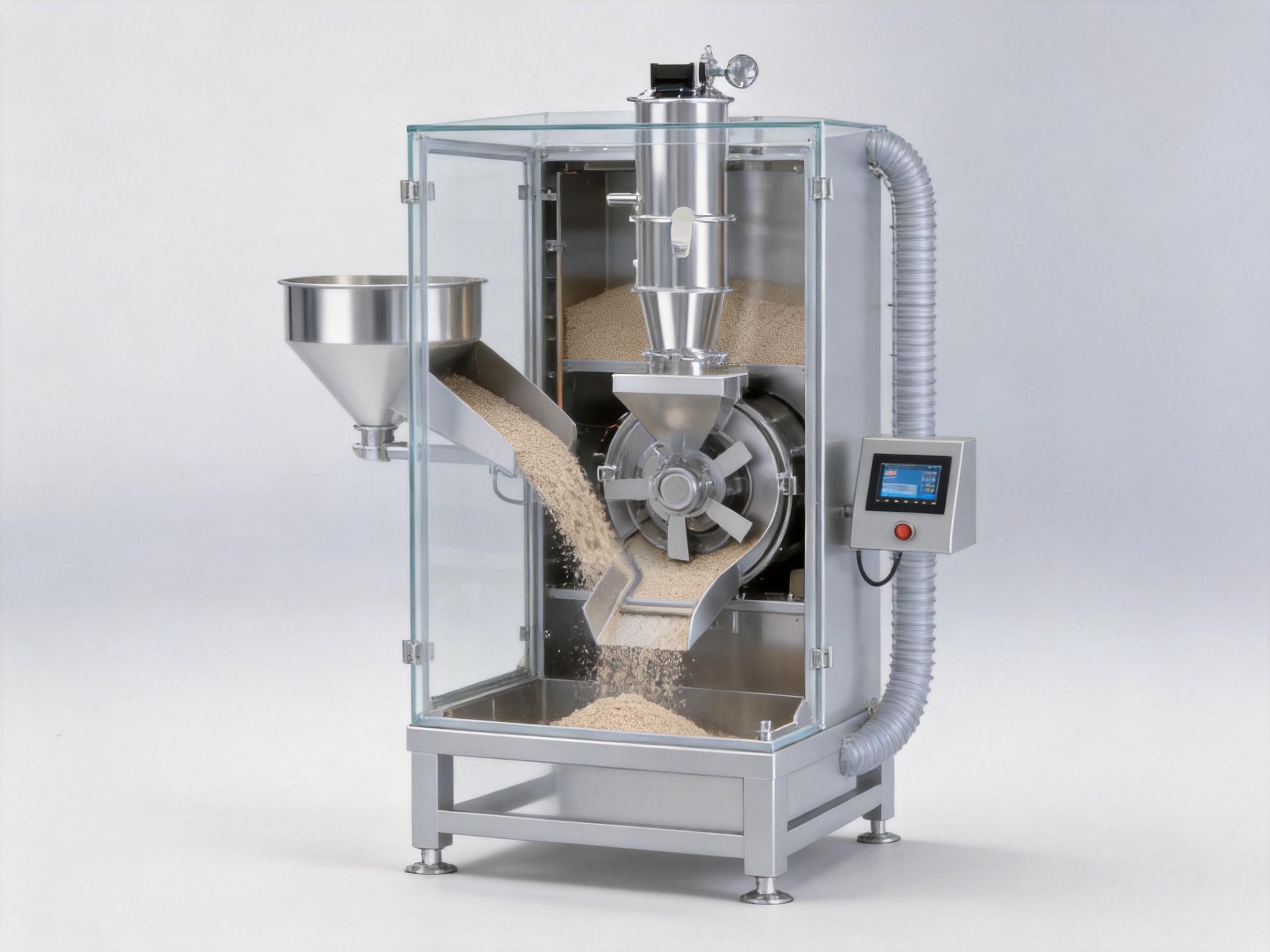
The WF machine uses a rotating cutting and impact system to break down incoming material. Feed material enters the pulverizing chamber at a controlled rate. Inside the chamber, the high-speed rotating assembly applies mechanical forces that reduce the material into smaller particles. Cutting action helps divide and shear the material, while impact action contributes to further size reduction.
As the material is processed, the particles move through the grinding zone until they reach the required discharge condition. The final particle size is influenced by the selected model, rotor speed, blade design, screen or grading arrangement, material hardness, moisture content, feed size, and throughput. The machine can be configured for a discharge fineness range of approximately 20 to 120 mesh, subject to material and operating conditions.
The process takes place in an enclosed chamber. This is essential to the machine’s dust-reduction performance and also supports a more stable material flow. Instead of allowing the pulverized material to spread into an open working area, the equipment guides it toward the discharge path for collection or transfer.
Temperature monitoring is incorporated into the operating concept. Grinding can generate heat, especially when processing hard, fibrous, sticky, or heat-sensitive materials. Excessive temperature may affect the material, reduce product quality, or place additional stress on bearings and other mechanical components. Real-time temperature monitoring gives operators the opportunity to observe conditions and respond before thermal variation becomes a larger process problem.
For materials that require additional thermal control, an optional cooling water jacket can be selected. The water jacket helps remove heat from the relevant processing area and can be valuable when the product is sensitive to elevated temperatures. Cooling requirements should be assessed through material trials because the actual temperature rise depends on feed rate, material characteristics, fineness, ambient conditions, and operating speed.
The principal advantage of the WF dust-free crushing machine is its enclosed operating structure. The closed material path limits dust dispersion and keeps the process more organized. This is particularly beneficial for powder products that are light, fine, easily airborne, or difficult to recover after release.
An enclosed structure also supports better material accountability. When less product is lost to the surrounding environment, the amount entering the downstream process can be more predictable. This can help manufacturers improve yield calculations and reduce unnecessary material waste.
The machine is designed for continuous and stable operation at maximum capacity, with a uniform discharge rate. Consistent discharge is important because fluctuations in powder flow can affect downstream mixing, granulation, weighing, feeding, and packaging.
A stable discharge rate also makes it easier to coordinate the pulverizer with adjacent equipment. For example, the machine may be connected to a weighing system for controlled batching or linked to a conveyor, mixer, granulator, or storage hopper. When the grinding process produces a predictable flow, the overall line can be managed more efficiently.
The availability of WF-10B through WF-100B pulverizer heads allows users to select equipment according to production scale. Smaller models may be suitable for laboratory development, formulation trials, or limited-volume production. Medium models can support pilot projects and intermediate production. Larger models are intended for higher-volume industrial processing.
This range can reduce the need for a single oversized machine to handle every application. Selecting a properly sized model helps manufacturers balance investment, capacity, energy use, floor space, and operational flexibility.
The pulverizer heads are manufactured from stainless steel. Stainless steel is widely used in pharmaceutical and food processing because it offers a hygienic, durable, and cleanable surface when properly designed, finished, installed, and maintained. It also provides resistance to many common processing environments.
The exact grade, surface finish, sealing arrangement, and contact-part configuration should be confirmed according to the application. Different products may require different material compatibility considerations, especially when processing corrosive, abrasive, moisture-sensitive, or highly reactive ingredients.
Temperature monitoring helps operators observe the thermal condition of the grinding process in real time. This is an important feature for products whose quality may change under excessive heat. It also supports preventive attention to bearings and other components that should operate within an appropriate temperature range.
The optional cooling water jacket expands the machine’s application range. When the process generates more heat than the product can tolerate, controlled cooling can help maintain more suitable operating conditions. The combination of monitoring and cooling is more effective than relying only on a fixed operating speed or operator experience.
An alloy blade system can be selected according to material characteristics. This is significant because no single blade arrangement is ideal for every product. Soft, brittle, fibrous, hard, sticky, or abrasive materials may respond differently to cutting and impact forces.
Blade selection can affect throughput, energy demand, particle-size distribution, wear rate, and temperature generation. By considering the material before finalizing the blade system, users can obtain a more suitable balance between processing efficiency and product quality.
The WF machine can be integrated with weighing systems for precise material control. This is valuable for batch manufacturing, formulation preparation, and processes where a specific quantity of powder must be transferred to the next stage.
Weighing integration may help reduce manual handling and improve batch consistency. It can also support production records and material tracking, depending on the design of the complete line and the customer’s control system.
Model selection should be based on more than the desired hourly capacity. A complete evaluation should consider feed particle size, target discharge fineness, bulk density, moisture content, hardness, abrasiveness, stickiness, temperature sensitivity, cleaning method, production schedule, and available installation space.
The following table summarizes the principal published parameters for the WF series.
| Item | Unit | WF-10B | WF-20B | WF-30B | WF-40B | WF-60B | WF-80B | WF-100B |
| Capacity | kg/h | 10–60 | 60–150 | 100–300 | 150–600 | 200–1,200 | 200–1,400 | 250–2,000 |
| Feed Fineness | mm | <6 | <6 | <10 | <10 | <10 | <10 | <10 |
| Discharge Fineness | mesh | 20–120 | 20–120 | 20–120 | 20–120 | 20–120 | 20–120 | 20–120 |
| Crushing Motor Power | kW | 2.2 | 2.2 | 4 | 5.5 | 11 | 18.5 | 30 |
| Main Shaft Speed | rpm | 8,000 | 4,500–5,000 | 3,800 | 3,200 | 2,400 | 1,800 | 1,400 |
| Dimensions | mm | 1,000 × 500 × 1,180 | 1,280 × 600 × 1,660 | 1,280 × 600 × 1,660 | 1,450 × 700 × 1,800 | 1,950 × 850 × 2,100 | 2,000 × 850 × 2,200 | 2,200 × 950 × 2,400 |
| Weight | kg | 180 | 280 | 340 | 450 | 600 | 2,000 | 2,400 |
The capacity figures are reference values based on test data using 60-mesh white sugar. Actual capacity may vary considerably. White sugar is relatively uniform and should not be treated as a universal performance standard for all pharmaceutical, food, or industrial materials. A fibrous botanical ingredient, for example, may require a different feed rate and blade configuration from a brittle crystalline product.
The WF-10B and WF-20B models are suitable for lower-throughput applications and development work. The WF-30B and WF-40B models provide an intermediate range for pilot production or moderate industrial demand. The WF-60B, WF-80B, and WF-100B models address larger production requirements, although the correct selection must still be verified through testing.
Main shaft speed is not simply an indicator of machine performance. Smaller machines often operate at higher speeds, while larger machines may use lower rotational speeds with greater working capacity. The appropriate speed depends on the mechanical design and the product being processed. Higher speed may increase impact intensity but can also increase heat generation, energy demand, and wear in some applications.
Many conventional pulverizers can reduce particle size effectively, but their performance may be limited when the process requires strict dust control, temperature awareness, flexible configuration, or direct integration with other production equipment. The WF machine is differentiated by combining these features in one enclosed processing module.
Open or semi-open systems may expose the operator and surrounding equipment to powder during feeding and discharge. The WF machine keeps the principal grinding operation enclosed. This makes it more suitable for facilities seeking to improve housekeeping and reduce powder release from the processing zone.
Uncontrolled discharge can create surges, interruptions, or uneven downstream feeding. The WF design emphasizes continuous operation and a uniform discharge rate. This supports more predictable transfer to weighing, mixing, granulation, or collection systems.
Some basic crushing machines provide little information about internal temperature. The WF machine includes real-time grinding temperature monitoring, allowing operators to identify thermal changes during processing. The optional water jacket provides an additional solution for heat-sensitive applications.
The range of models, blade choices, and optional cooling arrangements allows the machine to be adapted to different process requirements. This is more flexible than a one-configuration machine intended for only a narrow material range.
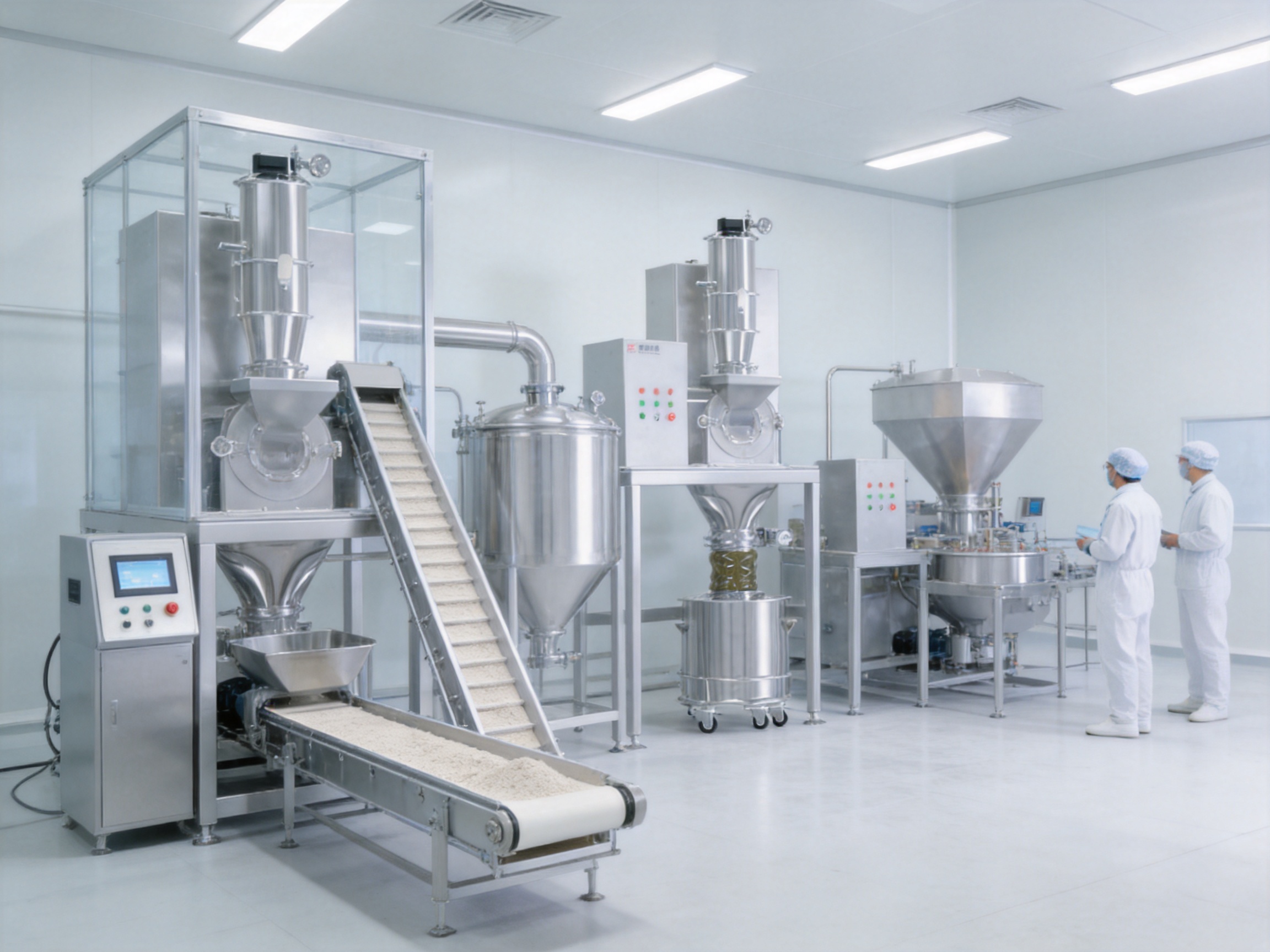
The WF unit is designed as a process module rather than an isolated piece of equipment. Its ability to connect with weighing systems and other material-handling equipment makes it suitable for modular lines and complete production systems. This can help manufacturers develop a more coherent material route from raw material feeding through final collection.
In pharmaceutical manufacturing, pulverizing may be required for active ingredients, excipients, intermediates, granulation materials, or returned process material, provided that the material and equipment configuration are appropriate. Particle-size reduction can improve blend uniformity, support dissolution objectives, and prepare materials for subsequent processing.
The WF machine may also be used as part of oral solid dosage production. In such applications, the pulverizer can be positioned upstream of mixing, wet granulation, dry granulation, or other powder-conditioning operations. The final process route depends on the formulation, material sensitivity, regulatory requirements, and validation strategy.
For nutraceutical and food products, the machine may be used to process sugar, botanical materials, dried ingredients, additives, and other suitable solids. The enclosed construction is useful where powder cleanliness and controlled handling are important. However, each food product should be evaluated for moisture, oil content, stickiness, allergen control, and cleaning requirements.
In veterinary and additive production, the machine can support the preparation of powders for blending or further formulation. The ability to select different models and blade systems is helpful when the product range includes materials with different mechanical properties.
Potential process applications include:
• Pulverizing crystalline or brittle materials before blending.
• Preparing ingredients for granulation.
• Reducing the size of dried materials after drying operations.
• Processing selected food, nutraceutical, or botanical powders.
• Reworking suitable oversized particles within an approved process route.
• Supporting laboratory, pilot, and commercial-scale formulation development.
Application suitability must always be confirmed through material testing. A customer should provide representative samples and information about the desired capacity, feed size, target fineness, moisture level, temperature limit, cleaning method, and any special containment requirements.
The manufacturer, Changzhou Zhiyang Machinery Equipment Co., Ltd., was founded in 2010 and is based in Changzhou, China. Its business is focused on powder processing and oral solid dosage equipment. This specialization gives the company an engineering perspective that extends beyond individual machines.
Instead of treating a pulverizer as an isolated product, the company develops equipment and process routes around the customer’s complete production objective. This approach considers the material, capacity, site conditions, downstream equipment, operating method, and desired level of automation. As a result, the WF machine can be supplied as a standalone unit, a modular process component, or part of a complete production line.
Material behavior is central to powder-processing design. Different materials require different combinations of impact, cutting, speed, cooling, feeding, and discharge control. The company’s process-oriented approach allows the equipment configuration to be considered in relation to the actual application rather than relying solely on nominal machine ratings.
This is especially important when a customer is transitioning from laboratory development to pilot or commercial production. A material that performs well in a small test machine may behave differently at higher throughput. The larger system may require changes to feeding, ventilation, cooling, discharge collection, and cleaning procedures. Process integration helps address these differences earlier in the project.
The company’s product scope includes laboratory equipment, mixing equipment, granulation equipment, drying equipment, coating equipment, auxiliary processing equipment, and transfer and conveying systems. This portfolio allows the WF pulverizer to be considered alongside other stages of powder and solid-dose production.
For example, a customer may require a route that includes material transfer, pulverizing, weighing, mixing, granulation, drying, coating, and final conveying. When equipment is selected as part of a coordinated system, the interfaces between stages can be planned more effectively. This may reduce unnecessary manual transfers and improve overall process organization.
The company emphasizes reliable products, customer reputation, research and development, and innovation. It has strengthened its R&D capabilities, obtained quality system certification, developed patented technologies, and expanded its overseas service capabilities. These strengths support the development of equipment intended for demanding powder-processing environments.
Quality in machinery manufacturing is not limited to the final assembly stage. It involves material selection, component sourcing, dimensional control, welding quality, surface treatment, mechanical balance, electrical integration, testing, documentation, packaging, and after-sales support. For pharmaceutical and food equipment, attention to contact surfaces, cleanability, sealing, and access for inspection is particularly important.
The manufacturing process should therefore be viewed as a complete chain. A well-designed machine begins with correct application analysis, continues through engineering and fabrication, and is completed by functional testing and installation support. This approach helps reduce the risk that an apparently suitable machine will fail to perform when connected to the customer’s real production system.
Production sites vary in floor area, ceiling height, utility availability, room classification, cleaning method, material flow, and automation level. The manufacturer’s engineering approach allows these conditions to be considered when planning the equipment arrangement.
Customization may involve model selection, blade material, cooling configuration, feeding system, weighing connection, discharge arrangement, control requirements, and integration with conveying equipment. The objective is not to add unnecessary complexity but to provide a practical configuration that matches the process.
Correct installation is essential for reliable performance. The machine should be positioned on a stable foundation with adequate space for inspection, cleaning, blade replacement, and maintenance. Electrical power, cooling-water connections where required, material feeding, and discharge collection should be planned before delivery.
The upstream feed system should deliver material within the specified feed-size range. Oversized material can reduce throughput, increase mechanical stress, or create unstable operation. A controlled feed rate is also important because overfeeding can affect fineness, temperature, motor load, and discharge consistency.
Operators should monitor the machine during startup, normal operation, and shutdown. Important observations may include unusual vibration, noise, temperature rise, motor load, discharge consistency, and changes in product appearance. Any abnormal condition should be investigated before continued operation.
Routine maintenance may include inspection of blades, fasteners, seals, bearings, screens or grading components, electrical connections, and cooling arrangements. Wear parts should be checked according to the material being processed and the operating schedule. Abrasive products may require more frequent inspection than soft materials.
Cleaning procedures should be established according to the product, the required hygiene level, and the customer’s validated manufacturing process. The enclosed construction can help limit contamination during operation, but effective cleaning still depends on access, disassembly procedures, surface condition, operator training, and documented instructions.
Where multiple products are processed on the same machine, the customer should evaluate cross-contamination risks and define suitable cleaning verification methods. Product-contact materials, blade alloys, seals, and cleaning agents should be reviewed for compatibility before routine production begins.
Users can improve the performance of the WF machine by treating pulverizing as a controlled process rather than simply a mechanical size-reduction step.
First, define the target product. The required particle-size range, distribution, bulk density, flowability, and temperature limit should be identified. A target described only as “fine powder” is usually not sufficient for reliable equipment selection.
Second, characterize the feed material. Important properties include moisture, hardness, brittleness, fiber content, oil content, stickiness, abrasiveness, and sensitivity to heat. These factors affect blade selection, operating speed, cooling requirements, and expected capacity.
Third, conduct representative testing. Test material should reflect actual production conditions as closely as possible. Test results should include capacity, discharge fineness, temperature behavior, energy demand, product recovery, and cleaning observations.
Fourth, coordinate the pulverizer with upstream and downstream equipment. A high-capacity crusher cannot deliver its full value if the feeding hopper is too small, the weighing system is inaccurate, or the downstream conveyor cannot accept the discharge rate.
Fifth, establish operating limits. These may include maximum feed rate, acceptable product temperature, inspection intervals, cleaning frequency, and blade replacement criteria. Clear limits help operators maintain repeatable performance.
The WF dust-free crushing machine can contribute to a more controlled production environment, but complete compliance depends on the entire installation and the customer’s quality system. Equipment selection should be reviewed alongside facility design, dust-control strategy, electrical classification, operator safety, cleaning validation, process validation, and documentation requirements.
Dust-producing operations should be assessed for combustible dust or other hazards where applicable. The customer and responsible engineering team should determine whether additional extraction, inerting, explosion protection, grounding, or specialized electrical equipment is required. These decisions depend on the material and local regulations and cannot be determined solely from the machine model.
Operator safety should include protection from rotating components, unexpected startup, hot surfaces, moving parts, and maintenance hazards. Lockout and isolation procedures should be defined before service work begins. Training should cover normal operation, emergency response, cleaning, inspection, and fault reporting.
For pharmaceutical and food applications, documentation may include equipment specifications, material certificates, drawings, test records, operating instructions, maintenance procedures, and commissioning information. The exact documentation package should be agreed during project planning.
It is used for enclosed pulverizing and grinding operations in pharmaceutical, food, nutraceutical, veterinary, additive, and related industries. It can prepare materials for mixing, granulation, drying, coating, weighing, conveying, or other downstream processes.
The machine uses a fully enclosed pulverizing structure that limits dust dispersion during material feeding, grinding, and discharge. Actual dust performance depends on sealing, installation, feed conditions, extraction, material properties, and maintenance.
The standard model table lists capacities from approximately 10 to 2,000 kg/h, depending on the model. Broader test-based capacity references may reach approximately 2,500 kg/h for suitable materials and operating conditions. Actual capacity must be confirmed through material testing.
The available pulverizer head range includes WF-10B, WF-20B, WF-30B, WF-40B, WF-60B, WF-80B, and WF-100B. These models cover lower-throughput, pilot, intermediate, and larger production requirements.
The listed discharge fineness range is approximately 20 to 120 mesh. The actual result depends on the material, feed condition, blade configuration, speed, screen or grading arrangement, and throughput.
It can be configured for applications requiring temperature control. Real-time grinding temperature monitoring is provided, and an optional cooling water jacket is available. Material trials should be performed to confirm suitability.
An alloy blade system can be selected according to material characteristics. The appropriate selection depends on hardness, abrasiveness, moisture, fibrous content, desired fineness, and production requirements.
Yes. The WF machine can be integrated with weighing systems for more precise material control. It can also be incorporated into a broader conveying, mixing, granulation, or production-line arrangement.
The pulverizer heads are manufactured from stainless steel. The exact stainless-steel grade, finish, and contact-part specifications should be confirmed according to the product and hygiene requirements.
Selection should consider target capacity, feed size, discharge fineness, material properties, temperature sensitivity, cleaning requirements, installation space, and downstream equipment. Representative material testing is the most reliable basis for final selection.
No. Its enclosed design helps reduce dust dispersion at the pulverizing point, but the complete installation may still require facility ventilation, extraction, containment, grounding, or other safety measures based on the material and applicable regulations.
The manufacturer supplies equipment for laboratory work, mixing, granulation, drying, coating, auxiliary processing, transfer, and conveying. This product range allows the WF machine to be supplied as a standalone unit, modular system, or part of a complete production line.
The WF dust-free crushing machine is designed for manufacturers that need controlled, enclosed, and stable powder processing. Its main advantages include a fully enclosed material path, continuous operation, uniform discharge, real-time temperature monitoring, optional cooling, stainless-steel pulverizer heads, selectable alloy blades, and compatibility with weighing systems.
Compared with conventional open pulverizing arrangements, the machine provides stronger support for dust reduction, material containment, process organization, and integration with downstream equipment. Its range of models enables users to select equipment for laboratory, pilot, intermediate, or larger production requirements.
The product is also supported by a manufacturing and engineering organization focused on powder processing and oral solid dosage equipment. Changzhou Zhiyang Machinery Equipment Co., Ltd. combines equipment production with process planning, modular system development, complete-line integration, R&D, quality management, and overseas service capability.
For the best result, the machine should be selected through a complete application review. Capacity figures, discharge fineness, temperature behavior, blade material, cooling requirements, and system interfaces should all be verified using representative materials. When properly configured and integrated, the WF dust-free crushing machine can serve as a dependable grinding module for modern pharmaceutical, food, nutraceutical, and related powder-processing facilities.
1. Product technical information for the WF dust-free crushing machine, including operating principle, features, and model parameters.
2. Internal product data based on reference testing with 60-mesh white sugar.
3. General principles of powder processing, particle-size reduction, and material handling in pharmaceutical and food manufacturing.
4. General guidance for hygienic equipment design, enclosed powder processing, cleaning, and process integration.
5. Manufacturer information concerning powder processing equipment, oral solid dosage systems, R&D activities, quality management, and integrated production-line engineering.
Want to stay up to date?
Contact us via the email address below.
Don't worry about spam. We hate it too!
Mobile Client

Video Account
Phone:+86-15161130178
Tel:+86-519-88674267
Email:czzy188@163.com
Phone:+86-15161132798
Email:zy@zy-drying.com

WeChat ID

Copyright 2026 Changzhou Zhiyang Machinery Equipment Co., Ltd. All Rights Reserved  Oral Solid Dosage Equipment Manufacturer