 English
 Español
 русский
 中文简体
中文简体
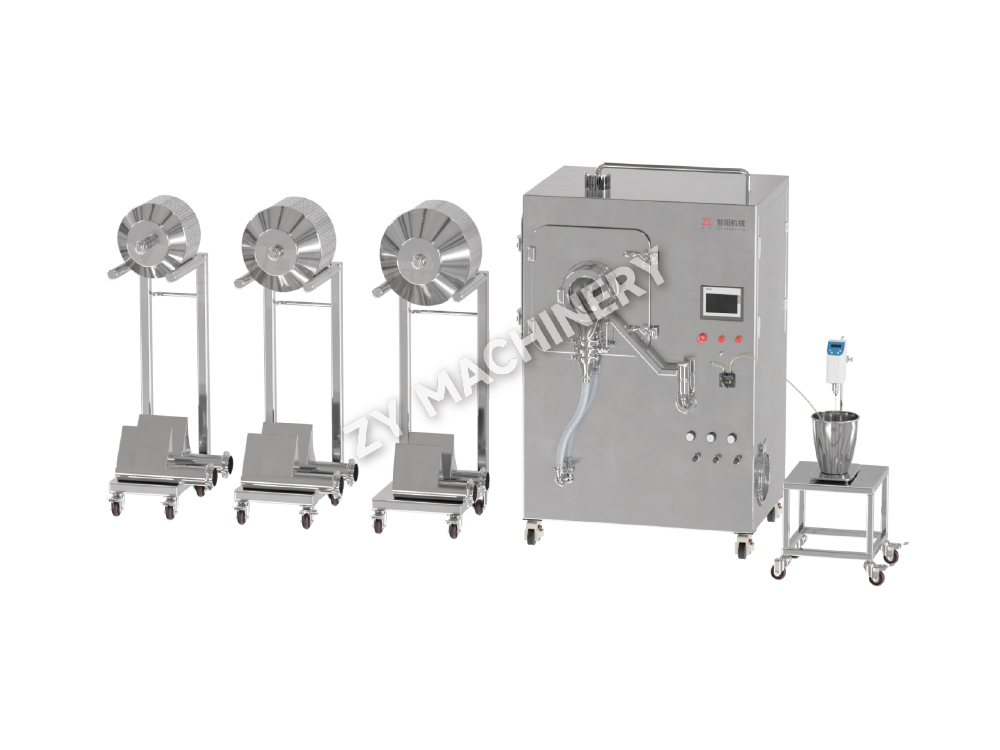
BGB R&D High-Efficiency Film Coating Lab Machine
The BGB R&D high-efficiency film coating lab machine is designed to mee.....

Content
Film coating is one of the most important finishing operations in the production of tablets, pellets, confectionery products, and other solid dosage forms. A well-designed coating process can protect an active ingredient, improve product appearance, mask unpleasant taste or odor, control release characteristics, increase resistance to moisture and light, and make the finished product easier to handle and package. However, achieving a consistent coating layer requires much more than simply spraying a liquid onto a rotating bed of cores. Airflow, pan movement, atomization, drying, pressure balance, spray-gun positioning, equipment hygiene, and process control must work together as one integrated system.
The BGB High-Efficiency Film Coating Machine is developed for laboratory, pilot-scale, and production-oriented coating applications across the pharmaceutical, food, bioproduct, nutraceutical, and related industries. It is suitable for organic film coating, aqueous film coating, conventional sugar coating, and selected controlled-release applications. Its configuration is intended to provide the process flexibility required by research and development teams while also supporting the repeatability and operational discipline expected in modern solid dosage manufacturing.
Unlike a basic coating pan that depends heavily on manual intervention, the high-efficiency design combines a rotating coating vessel, adjustable spray equipment, controlled hot-air supply, exhaust management, enclosed operation, and automated material handling. This integration allows spraying, drying, and exhaust to take place continuously within a controlled environment. The result is a more stable coating process, improved batch consistency, easier cleaning, and a more practical route from laboratory trials to larger-scale production.
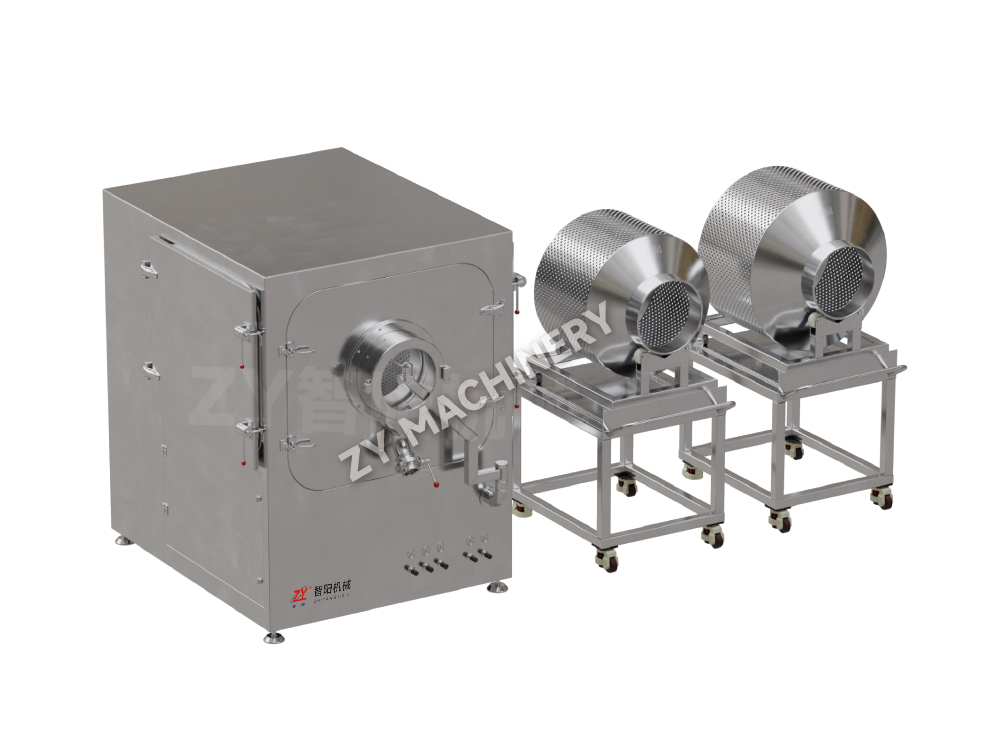
BGB High-Efficiency Film Coating Machine
Film coating is commonly applied after tablet compression or pellet formation. During the operation, a coating solution or suspension is atomized into droplets and distributed over the moving product bed. At the same time, heated and filtered air passes through the bed to evaporate the solvent or water. Repeated application and drying create a continuous film on the surface of each core.
The coating may serve several purposes. Immediate-release film coating can improve appearance, swallowing properties, mechanical durability, and taste masking. Enteric coating can help protect a formulation from acidic conditions in the stomach and allow release in the intestine. Controlled-release coating can regulate the movement of an active ingredient through a polymeric barrier. In food and confectionery production, coating can add color, gloss, flavor, texture, and protection from environmental exposure.
Every formulation responds differently to coating conditions. Tablet hardness, friability, shape, density, porosity, surface roughness, and moisture sensitivity all influence the process. The properties of the coating liquid are equally important. Viscosity, solids content, surface tension, polymer type, solvent system, pigment concentration, and temperature can change the atomization pattern and drying behavior.
For this reason, the coating machine must provide a controllable environment rather than only a rotating container. A coating system should encourage uniform mixing of the cores, provide accurate and adjustable liquid application, remove moisture efficiently, prevent external contamination, and allow operators to clean and inspect the product-contact areas without unnecessary difficulty.
The cores are loaded into a clean, enclosed rotating coating pan. As the pan rotates, the cores move continuously along complex trajectories. This movement repeatedly exposes different areas of each tablet or pellet to the spray zone, while also promoting mixing and redistribution within the product bed.
The coating solution is delivered to specially designed spray guns. The liquid is atomized into controlled droplets and applied to the moving cores. The position and angle of the spray guns can be adjusted to match the product bed, pan size, liquid flow rate, and desired coating pattern. This adjustment helps operators place the spray zone where it can achieve effective coverage without excessive overwetting.
Filtered hot air enters the coating chamber from the hot-air cabinet. It penetrates the bed of cores and accelerates evaporation of the water or solvent on the product surface. Exhaust air is removed through the exhaust system, helping maintain the desired pressure balance and preventing excessive humidity from accumulating inside the chamber.
The interaction between movement, atomization, airflow, and exhaust determines the final coating quality. If the product movement is too aggressive, tablets may chip or break. If the movement is too slow, distribution may become uneven. If the spray rate is too high for the available drying capacity, tablets may become tacky or form bridges. If the air volume is excessive, spray droplets may dry before reaching the product or create undesirable spray loss. The equipment is therefore designed to provide adjustment capability across the main process variables.
Micro-negative pressure supports enclosed operation by helping prevent unfiltered air from entering the coating area. This arrangement reduces the risk of external contamination and helps keep coating vapors, aerosols, and process dust within the intended air-handling path. It is particularly valuable in pharmaceutical and bioproduct environments where cleanliness and containment are central operating requirements.
One of the most practical features of the system is the ability to use one main machine with multiple coating pans of different capacities. This configuration allows a facility to adapt the equipment to different batch sizes, product types, and development stages. A research team may begin with a small quantity of material, then move to a larger pan for pilot work without replacing the entire machine platform.
This multi-pan concept is useful for companies that develop several formulations or handle products with widely varying bulk densities. It can reduce the need for multiple independent machines and make better use of available floor space. It also provides a more consistent mechanical and control environment across different batch sizes, supporting more reliable process comparisons.
Laboratory coating equipment is often expected to do more than produce a small batch. It must help engineers understand how a coating formulation behaves, determine suitable spray rates, evaluate drying requirements, test different polymers and pigments, and establish a repeatable process before scale-up. The BGB platform is suited to this type of work because it offers adjustable pan speed, hot-air conditions, spray-gun positioning, and air-handling parameters.
At larger capacities, the same principles support pilot and production activities. The available models range from 5 kilograms per batch to 600 kilograms per batch. This range gives users options for research, process validation, commercial production, and specialized applications. The exact choice depends on the product’s bulk density, loading factor, coating weight gain, process time, and required production output.
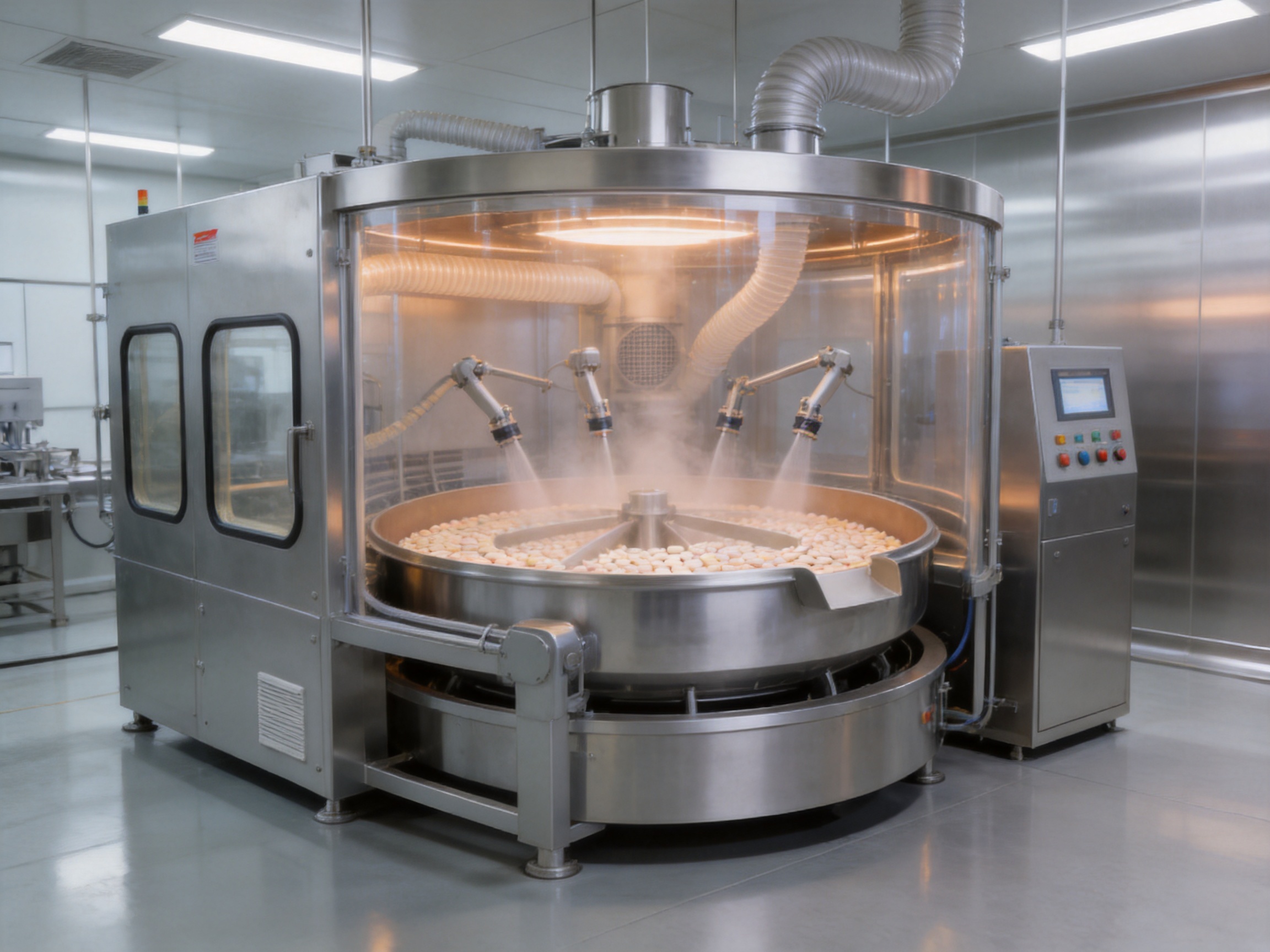
Traditional coating arrangements may require separate machines for different batch sizes. That approach can increase capital cost, maintenance requirements, operator training needs, and validation workload. A main machine that accepts coating pans of different capacities offers greater flexibility. It also allows a facility to select a pan that matches the batch without operating a very large vessel at an inefficiently low fill level.
Using an appropriately sized pan improves process control. The product bed can remain within a useful working range, allowing better contact with the spray pattern and more predictable drying. This is especially important during development, when the same machine may be used for small experimental batches and larger confirmation batches.
Spray-gun adjustment is essential for controlling coating distribution. The ideal position depends on pan diameter, product bed depth, tablet shape, spray rate, atomizing-air conditions, and coating formulation. Fixed spray equipment limits the operator’s ability to respond to these variables.
The adjustable arrangement allows the spray guns to be positioned and angled for more precise application. Operators can optimize the distance between the guns and product bed, control the overlap of spray patterns, and reduce the risk of localized overwetting. This contributes to more uniform film thickness and better visual quality.
Open or poorly sealed coating systems may expose the product to room air, dust, and uncontrolled humidity. They may also release coating aerosols into the production environment. The fully enclosed configuration of the machine addresses these concerns by separating the product from the surrounding area during processing.
Micro-negative pressure provides an additional layer of protection. Rather than allowing air to flow outward from the coating chamber, the system is arranged to draw air inward through controlled paths. This supports product protection and helps manage process emissions. The result is a cleaner and more controlled operating environment for both the product and personnel.
Some basic coating systems rely on intermittent spraying followed by separate drying periods. Although this method can be useful for simple applications, it may extend processing time and create variations between coating cycles. The high-efficiency system is designed for continuous film coating, with spraying, drying, and exhaust taking place in one enclosed container.
Continuous operation can improve productivity by reducing idle time between process stages. It also supports a more stable coating history because the product remains in the same controlled environment throughout the batch. When properly adjusted, the process can deliver more consistent drying and reduce the risk of excessive moisture accumulation.
Manual loading and unloading can increase operator workload and create additional opportunities for product loss, contamination, or mechanical damage. Automated feeding and discharging simplify material movement and support a more orderly process flow.
Automation is especially useful when the equipment is integrated into a broader solid dosage production line. It can help coordinate the transfer of cores into the coating machine and move finished product to the next stage. Reduced manual handling may also improve batch-to-batch consistency and support better ergonomic conditions for operators.
Cleaning is a major factor in pharmaceutical and food manufacturing. Product residues, pigments, polymers, and sugar-based materials can accumulate in corners, around spray devices, or on internal surfaces if the equipment is difficult to access. A coating machine should therefore be designed with practical cleaning in mind.
The BGB configuration emphasizes easy cleaning as part of its operating design. Accessible product-contact areas, organized spray equipment, and automated discharge help reduce the time required for changeover. Easier cleaning can support improved hygiene, lower cross-contamination risk, and more efficient use of production capacity.
The spray gun is one of the most important components in the entire coating system. Poor atomization can create large droplets, uneven coverage, spray drying, surface roughness, or excessive material loss. The specially designed spray guns used with the equipment are intended to improve atomization and coating uniformity.
Consistent spray performance helps operators maintain a stable process as the batch progresses. It also makes it easier to compare coating formulations during research and development. When the spray pattern remains predictable, process engineers can focus on formulation and drying parameters rather than compensating for inconsistent liquid application.
The equipment family includes seven principal models. Their rated batch capacities range from 5 kilograms to 600 kilograms. Pan speed, main-machine power, blower power, exhaust-fan power, dimensions, and weight increase according to the capacity and air-handling requirements of each model.
| Item | Unit | BGB-5 | BGB-10 | BGB-40 | BGB-75 | BGB-150 | BGB-350 | BGB-600 |
| Capacity | kg/batch | 5 | 10 | 40 | 75 | 150 | 350 | 600 |
| Drum speed | rpm | 4–60 | 6–30 | 4–19 | 4–19 | 2–15 | 2–11 | 2–10 |
| Main-machine power | kW | 0.55 | 0.55 | 0.75 | 1.1 | 2.2 | 4 | 5.5 |
| Hot-air range | °C | Room temperature to 80°C | ||||||
| Hot-air filter fineness | μm | 0.5 μm, 100,000-class filtration | ||||||
| Blower power | kW | 0.55 | 0.75 | 1.1 | 1.1 | 1.1 | 2.2 | 5.5 |
| Exhaust-fan power | kW | 1.5 | 2.2 | 2.2 | 3 | 5.5 | 7.5 | 15 |
| Vibration-cleaning motor power | kW | 0.37 | ||||||
| Peristaltic-pump power | kW | 0.18 | ||||||
| Overall size, L × W × H | mm | 800 × 650 × 1300 | 1100 × 750 × 1540 | 1200 × 950 × 1600 | 1350 × 1010 × 1630 | 1570 × 1260 × 2000 | 2000 × 1560 × 2300 | 2000 × 2240 × 2330 |
| Main-machine weight | kg | 300 | 380 | 450 | 550 | 900 | 1650 | 2500 |
Capacity should not be selected solely according to the nominal batch mass. The physical properties of the cores, the desired loading ratio, the required coating weight gain, and the expected cycle time must also be considered. A low-density pellet batch may occupy more volume than a high-density tablet batch of the same mass. Similarly, a product that requires a heavy controlled-release coating may need additional spraying and drying time.
For research laboratories, the smaller models provide a practical platform for formulation screening and process development. Pilot facilities may select an intermediate model to evaluate scale-up behavior. Commercial manufacturers can choose larger models according to their required output and production schedule. The availability of multiple sizes creates a logical development path and reduces the risk of relying on a machine that is either too small for future needs or too large for current development work.
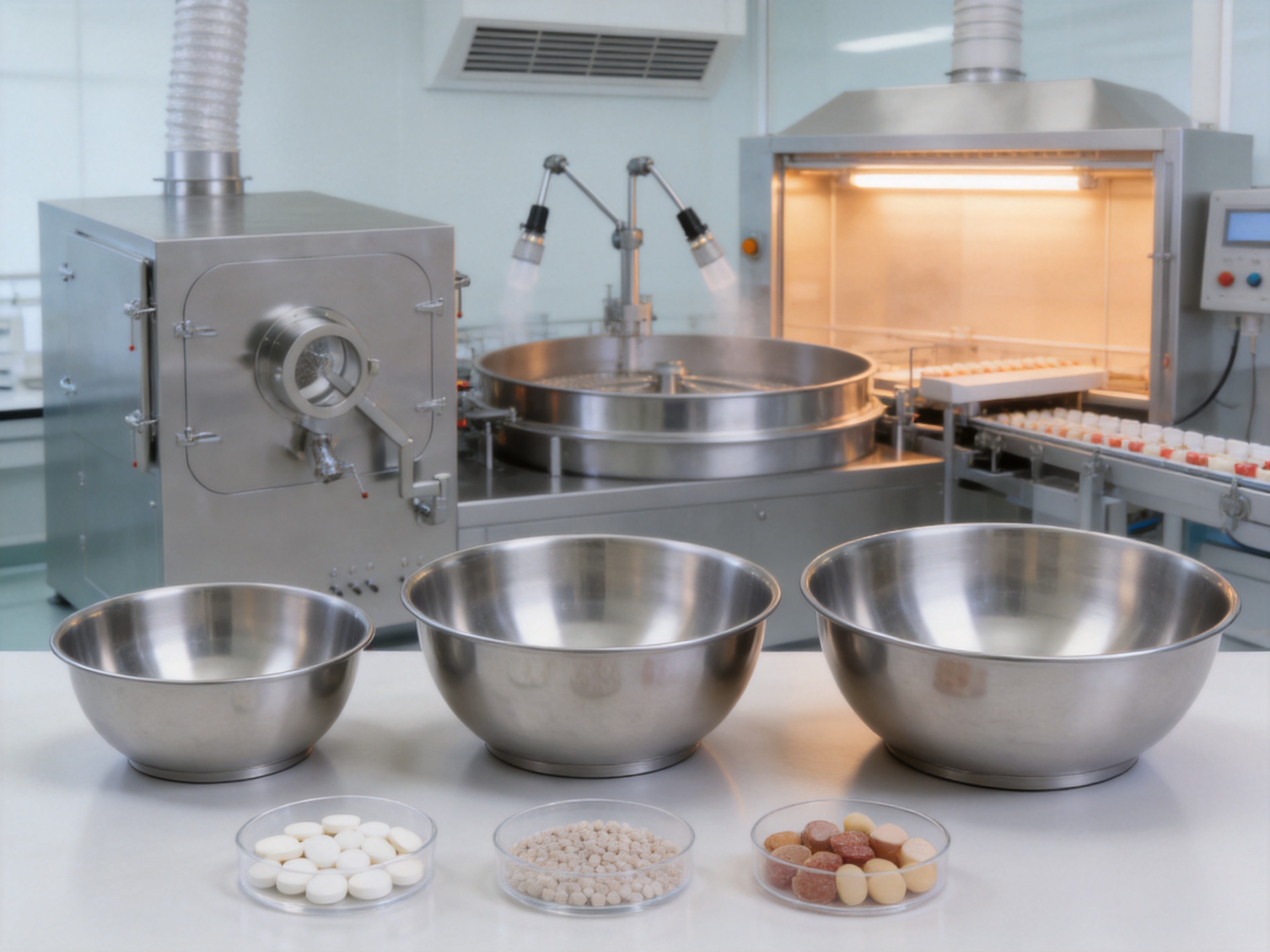
Pharmaceutical tablets are the most common application for film coating equipment. Immediate-release tablets can receive a protective or cosmetic film, while modified-release products may use polymeric layers to control dissolution. The machine’s controlled spray and drying environment is suitable for processing a wide range of tablet shapes and sizes, provided that the formulation and operating parameters are properly established.
Coating can improve tablet identification through color coding, enhance resistance to abrasion during handling, and reduce the unpleasant taste of certain active ingredients. For moisture-sensitive products, the coating may also contribute to protection during storage. The final result depends on formulation design as well as machine operation, but uniform process conditions are essential in every case.
Pellets are used in capsules, sachets, suspensions, and modified-release dosage forms. Their small size and large surface area make coating uniformity particularly important. The movement pattern inside the pan must promote sufficient mixing without causing excessive attrition or agglomeration.
Adjustable spray-gun positioning and controlled drying are valuable when processing pellets because the acceptable operating window may be narrower than for conventional tablets. Operators can adjust the spray pattern and air conditions to support gradual film formation and minimize sticking.
Coating is widely used for candies, confectionery centers, nutritional products, and selected food ingredients. In these applications, the coating may provide flavor, color, gloss, sweetness, texture, or protection against environmental conditions. Water-soluble films, organic coatings, and sugar-based systems may all be considered depending on the product.
A fully enclosed machine can help protect food products from external contamination and keep coating materials within the process area. Adjustable operation also makes it easier to accommodate different product shapes, surface characteristics, and coating thickness requirements.
Bioproduct and nutraceutical manufacturers often require flexible equipment for products with specialized handling requirements. Tablets and pellets may contain sensitive ingredients, natural extracts, minerals, vitamins, or veterinary actives. Coating can support taste masking, appearance improvement, protection from humidity, and controlled release.
Because product characteristics can vary considerably between batches and formulations, a machine that allows changes in pan capacity, spray position, rotation speed, and drying conditions can provide a useful production advantage.
The performance of a coating machine depends not only on its published specifications but also on the quality of its engineering, fabrication, assembly, testing, and application support. The manufacturer behind this equipment specializes in powder processing and oral solid dosage machinery, with capabilities covering laboratory equipment, mixing, granulation, drying, coating, auxiliary processing, transfer, conveying, and complete production-line integration.
This broader product scope is important because coating is rarely an isolated operation. A typical oral solid dosage process may include dispensing, blending, wet or dry granulation, drying, milling, lubrication, compression, coating, inspection, and packaging. Experience across these stages allows the equipment supplier to understand how upstream material properties affect coating performance and how downstream requirements influence the choice of process conditions.
The company’s process-driven approach focuses on material characteristics, capacity requirements, and site conditions. Instead of treating the machine as a standard item disconnected from the customer’s process, the engineering work can address the intended application, production scale, available utilities, layout, material-transfer route, and cleaning requirements.
Research and development are central to successful equipment improvement. Coating technology continues to evolve as manufacturers work with new polymers, more sensitive active ingredients, multiparticulate systems, and higher expectations for energy efficiency and process repeatability.
A manufacturer with laboratory, pilot, and production experience can use equipment development to address practical process challenges. These may include improving spray distribution, optimizing air movement, reducing dead zones, simplifying cleaning, improving product discharge, and making the machine more adaptable to changing batch sizes.
The R&D orientation of the equipment supports customers that need to conduct trials before committing to full-scale production. Laboratory work can identify suitable coating materials and process windows, while pilot-scale work can reveal how spray rate, drying capacity, and product movement change with scale.
Process integration is another important strength. A coating machine may be supplied as a standalone unit, but it can also form part of a modular system or complete production line. Integration may involve material loading, powder or tablet transfer, air handling, coating-liquid preparation, discharge, intermediate storage, and connection with inspection or packaging equipment.
Integrated planning can reduce transfer distances, simplify operator movement, improve material traceability, and support more efficient use of the manufacturing area. It can also help ensure that the coating machine’s air, electrical, and material-handling requirements are considered during the design stage rather than addressed after installation.
The equipment is intended for pharmaceutical, biopharmaceutical, biotechnology, nutraceutical, veterinary, food, additives, and related applications. Each industry places different demands on hygiene, containment, material compatibility, batch flexibility, documentation, and process control.
Exposure to multiple sectors can strengthen the manufacturer’s ability to adapt machine design to specific materials and operating environments. A pharmaceutical customer may prioritize cleaning and controlled conditions, while a food manufacturer may emphasize throughput and product appearance. A research institution may need rapid changeover and multiple pan sizes. The same core platform can be configured around these differing priorities.
The company has expanded its product portfolio, strengthened its research capabilities, obtained quality-system certification, developed patented technologies, and built overseas service capabilities. These strengths indicate an organization focused on more than equipment fabrication alone.
Quality-system practices can help create more consistent manufacturing and inspection procedures. Patented technologies may support distinctive solutions in equipment structure, process control, air handling, or material transfer. Overseas service capabilities are also valuable to international customers that require installation guidance, commissioning support, technical communication, spare-parts coordination, and after-sales assistance.
Reliability begins with design decisions. The rotating pan, support structure, drive system, spray assemblies, hot-air cabinet, exhaust system, filters, pumps, seals, and control components must be selected and assembled to work together under repeated production conditions. The machine must also tolerate cleaning, thermal cycling, product changeovers, and the mechanical demands of continuous operation.
Fabrication quality affects the stability of the equipment. Accurate machining and careful assembly help maintain proper alignment of rotating components and reduce vibration. Well-organized piping and electrical routing can make maintenance easier and reduce the risk of accidental damage during cleaning or inspection.
Material selection is equally important. Product-contact surfaces should be suitable for the intended application and compatible with the coating liquids and cleaning agents used by the customer. Smooth, accessible surfaces are generally easier to clean and inspect. Sealing and enclosure design should support the desired pressure relationship and minimize uncontrolled leakage.
Before delivery, a well-managed manufacturing process should include inspection of key assemblies, verification of mechanical operation, checking of spray and pumping functions, examination of air-handling performance, and review of electrical and control systems. These activities help identify issues before installation and provide a stronger foundation for commissioning.
Although the machine provides the necessary adjustment capability, successful coating still requires a disciplined process-development approach. Operators should establish the relationship among pan speed, spray rate, atomizing conditions, inlet-air temperature, exhaust volume, product-bed behavior, and coating formulation.
Pan speed influences the movement and mixing of the cores. A suitable speed should provide regular turnover without excessive impact or tablet damage. The correct range depends on product size, shape, density, friability, and batch quantity.
Spray rate must be balanced with drying capacity. Increasing the spray rate may shorten the theoretical application time, but it can also increase the risk of overwetting, sticking, picking, twinning, or agglomeration. The air system should be capable of removing the solvent or water at a rate that maintains a stable product surface.
Inlet-air temperature must be selected according to the thermal sensitivity of the product and the evaporation characteristics of the coating liquid. The stated hot-air range extends from room temperature to 80°C, providing room for different formulation requirements. The actual product temperature may differ from the inlet-air temperature and should be considered during process development.
Exhaust management affects humidity, pressure, and drying. Excessive exhaust may increase energy use or disturb the spray pattern, while insufficient exhaust may allow humidity to build up inside the chamber. The micro-negative-pressure arrangement should be adjusted and verified as part of the overall operating procedure.
Pharmaceutical and food manufacturers increasingly require equipment that supports hygienic production without creating excessive downtime. The enclosed coating chamber reduces exposure to the surrounding environment during operation. Filtered air further supports control of airborne contamination entering the process area.
Micro-negative pressure contributes to containment by directing air movement into the enclosure. This is useful when coating materials contain volatile solvents, pigments, fine particles, or other substances that should not freely disperse into the room. The appropriate exhaust treatment and facility controls should always be determined according to the coating chemistry and applicable safety requirements.
Cleaning procedures should be defined according to the product, coating material, and site validation strategy. Operators should inspect the pan, spray guns, liquid lines, filters, exhaust path, seals, and discharge areas after each batch or campaign. The practical accessibility of these components can influence the efficiency of routine cleaning and maintenance.
Automated discharge helps remove residual product from the pan and reduces the amount of manual handling required. The vibration-cleaning device can further assist with product removal in the applicable configuration. Together, these features can support shorter changeovers and more predictable preparation for the next batch.
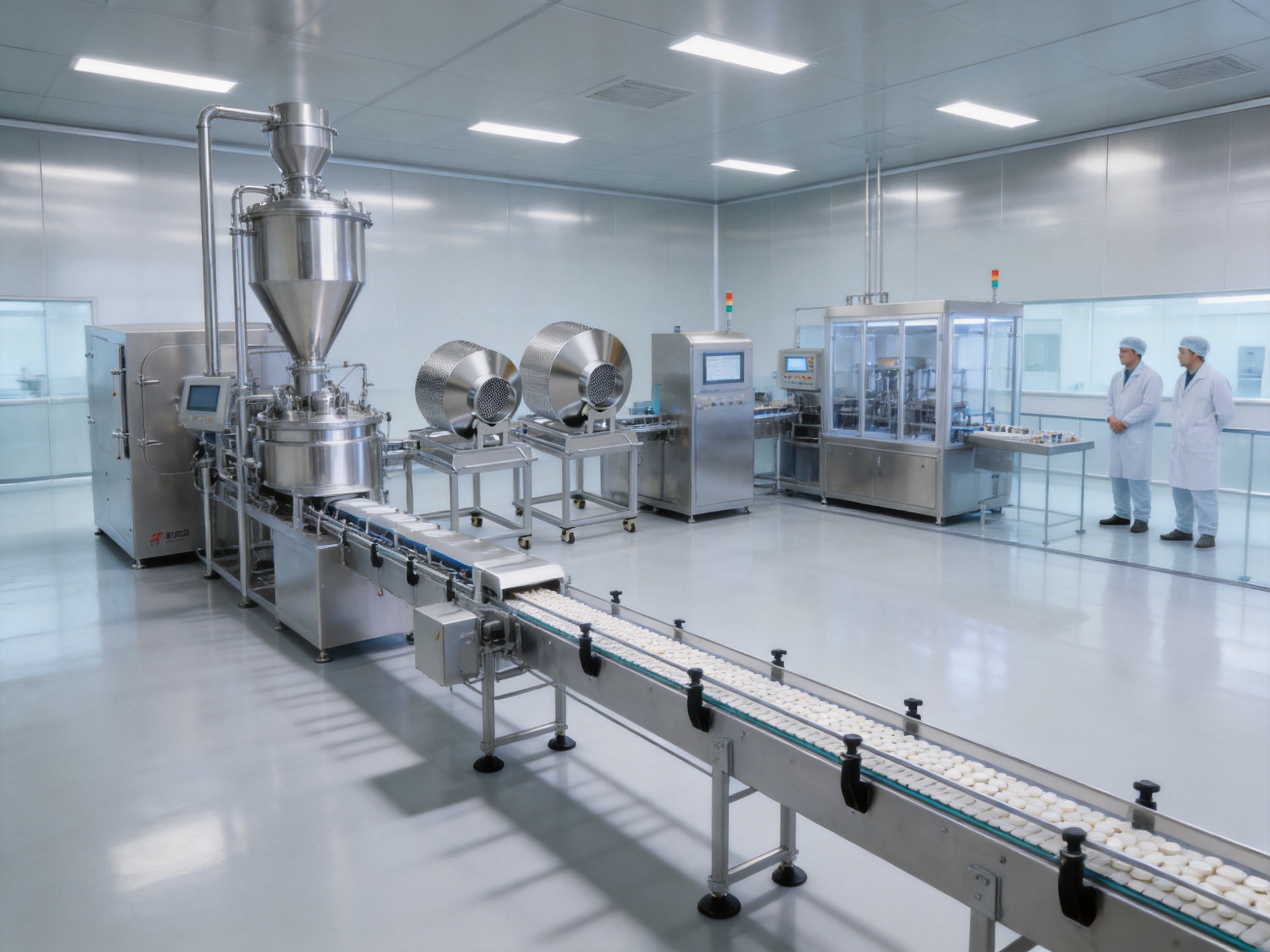
Customers should begin equipment selection by defining the material and process rather than choosing a model based only on capacity. Important questions include the type of cores to be coated, the desired coating material, the target weight gain, the batch size, the expected cycle time, the required containment level, and the available installation space.
For a laboratory, the smallest model may provide sufficient capacity for formulation screening, although a slightly larger model could be preferable if the development program is expected to move quickly toward pilot production. Facilities with multiple products may benefit from the interchangeable-pan approach because it permits different batch sizes without requiring several complete machines.
Utility requirements should also be reviewed. The air-handling system requires appropriate electrical power and connection arrangements. Exhaust requirements may depend on whether the coating liquid is water-based or solvent-based. The facility should evaluate ventilation, solvent recovery, fire safety, room classification, and environmental controls before selecting the final configuration.
Layout planning should include access for loading, unloading, cleaning, inspection, maintenance, and replacement of consumable components. Adequate clearance around the hot-air cabinet, exhaust system, and electrical control areas helps support safer and more efficient operation.
Scale-up is one of the principal reasons to select a flexible coating platform. A coating process developed in the laboratory must eventually be translated to larger equipment while maintaining comparable product quality. The critical variables may not remain identical when the pan size, air volume, spray-gun arrangement, and product-bed depth change.
A structured scale-up program should record pan speed, loading quantity, spray rate, coating-solution solids, atomization conditions, inlet-air temperature, exhaust conditions, product temperature, process time, and final coating weight gain. Visual appearance, friability, dissolution, moisture content, and other product-specific tests should also be evaluated.
Using equipment from the same general platform at different scales can simplify this work. Operators and process engineers become familiar with the same fundamental movement and air-handling principles. Training materials, operating procedures, and maintenance practices may also be adapted more efficiently from one scale to another.
The manufacturer’s ability to supply laboratory equipment, pilot machinery, production machines, and complete lines provides an additional advantage for companies seeking continuity through the development cycle. Engineering discussions can consider both immediate research needs and long-term manufacturing objectives.
The competitive value of a coating machine should be evaluated through total process performance rather than purchase price alone. A lower-cost machine may become expensive if it requires extensive manual intervention, produces inconsistent coating, consumes excessive time during cleaning, or cannot accommodate new products.
The high-efficiency system offers value through flexibility, enclosure, adjustable spraying, integrated drying, automated handling, and a broad capacity range. These features can help reduce process variability and support more efficient labor utilization. The ability to use multiple pans on one main machine can also improve capital efficiency for facilities with varied batch requirements.
Uniform coating reduces the risk of rejecting batches because of color variation, rough surfaces, poor taste masking, insufficient protection, or inconsistent release performance. While final quality depends on the formulation and validated operating procedure, equipment that provides stable mechanical movement and controllable air and spray conditions gives operators a stronger foundation for achieving those results.
Service and engineering support are also part of competitive performance. A supplier that can assist with process routes, equipment selection, layout planning, commissioning, and after-sales service may provide greater long-term value than a supplier that only delivers a machine. This is especially relevant to international customers developing new facilities or upgrading existing production lines.
Before starting a batch, operators should confirm that the coating pan is clean, the spray guns are correctly installed, the liquid lines are free from blockage, the filters are in suitable condition, and the exhaust route is ready. The coating solution should be prepared and mixed according to the formulation procedure, with viscosity and solids content checked where required.
The cores should be loaded within the recommended working range for the selected pan. Pan speed should be started at a suitable setting and adjusted according to product movement. Spray should begin only after stable airflow and temperature conditions have been established.
During processing, operators should observe the product bed, spray pattern, exhaust behavior, product temperature, and coating appearance. Signs of overwetting, sticking, agglomeration, chipping, or excessive spray drying should be addressed promptly by adjusting the relevant variables.
At the end of the batch, the product should be discharged completely. The equipment should then be cleaned according to the approved procedure. Spray guns, pump tubing, filters, internal surfaces, discharge areas, and seals should be inspected. Maintenance records and batch records should be completed to support traceability and equipment reliability.
The machine is designed for tablets, pellets, candies, and other suitable solid products. It can apply organic films, water-soluble films, and conventional sugar coatings. It may also be used for selected controlled-release pharmaceutical applications when the formulation and process are appropriately developed.
No. In addition to pharmaceutical and oral solid dosage applications, the equipment can serve food, confectionery, bioproduct, nutraceutical, veterinary, additives, and related industries. The final configuration and cleaning procedure should be selected according to the product and regulatory requirements.
The listed models provide nominal capacities from 5 kilograms per batch to 600 kilograms per batch. The correct model depends on product density, volume, loading ratio, coating weight gain, and required production output.
Yes. One main machine can be used with multiple coating pans of different capacities. This makes the system suitable for facilities that handle different materials or need to move from laboratory batches to larger pilot or production batches.
The spray pattern must match the movement and depth of the product bed. Adjustable position and angle allow operators to optimize coverage, reduce localized overwetting, and improve coating uniformity across different products and pan sizes.
Micro-negative pressure helps prevent uncontrolled air from entering or escaping the coating chamber. It supports enclosed operation, reduces the risk of external contamination, and assists with the management of coating vapors, aerosols, and process dust.
The stated hot-air range is from room temperature to 80°C. The actual setting should be selected according to the coating liquid, core stability, solvent or water evaporation behavior, and product-quality requirements.
Uniformity is supported through continuous product movement, adjustable spray-gun positioning, specially designed spray guns, controlled hot-air distribution, and coordinated exhaust. Operators must still establish suitable formulation and process parameters for each product.
Yes. The supplier provides standalone machines, modular systems, and complete production-line solutions. The coating machine can therefore be considered alongside upstream processing, material transfer, discharge, and downstream handling requirements.
Solvent-based processing requires a detailed review of ventilation, exhaust, electrical equipment, fire safety, solvent recovery, operator protection, and local regulations. The coating machine configuration must be matched to the specific solvent and facility design.
Yes. The smaller models and interchangeable-pan concept are suitable for laboratory trials, formulation screening, process development, and preparation for scale-up. Adjustable operating conditions allow researchers to study the relationship between spraying, drying, movement, and coating quality.
The supplier specializes in process integration and designs solutions according to material characteristics, capacity requirements, and site conditions. Its product range covers powder processing, oral solid dosage, coating, drying, granulation, mixing, conveying, and complete production systems, allowing broader engineering coordination.
The BGB High-Efficiency Film Coating Machine provides a flexible and integrated approach to the coating of tablets, pellets, candies, and other solid products. Its main advantages include multiple pan capacities on one machine, adjustable spray-gun position and angle, fully enclosed micro-negative-pressure operation, continuous spraying and drying, automated feeding and discharging, easy cleaning, and specially designed spray equipment.
With models ranging from 5 kilograms to 600 kilograms per batch, the equipment can support laboratory research, pilot production, process validation, and commercial manufacturing. Its operating principle combines controlled product movement, precise liquid atomization, filtered hot-air drying, and managed exhaust to create a stable environment for uniform film formation.
The manufacturer’s strengths extend beyond the machine itself. Its experience in powder processing, oral solid dosage equipment, process integration, research and development, quality systems, patented technologies, and overseas service enables it to address complete project requirements. For customers seeking a coating system that can grow with product development and production needs, this combination of equipment flexibility and engineering support represents a practical competitive advantage.
As coating requirements become more demanding, manufacturers need equipment that supports repeatable quality, efficient changeover, controlled operating conditions, and future expansion. A high-efficiency enclosed coating platform can help meet these goals while providing a logical path from laboratory experimentation to full-scale production.
1. User-provided technical specification sheet for the high-efficiency film coating machine.
2. General principles of tablet coating, spray atomization, fluid movement, and drying in oral solid dosage manufacturing.
3. Good manufacturing practice principles for pharmaceutical equipment design, cleaning, containment, and process control.
4. Standard engineering practices for powder processing, oral solid dosage production, air handling, and material transfer.
5. General guidelines for scale-up and process validation of pharmaceutical coating operations.
Want to stay up to date?
Contact us via the email address below.
Don't worry about spam. We hate it too!
Mobile Client

Video Account
Phone:+86-15161130178
Tel:+86-519-88674267
Email:czzy188@163.com
Phone:+86-15161132798
Email:zy@zy-drying.com

WeChat ID

Copyright 2026 Changzhou Zhiyang Machinery Equipment Co., Ltd. All Rights Reserved  Oral Solid Dosage Equipment Manufacturer