 English
 Español
 русский
 中文简体
中文简体
QWQY Mobile CIP Cleaning Station
The QWQY Mobile CIP Cleaning Station is used in solid dosage manufacturing .....

Content
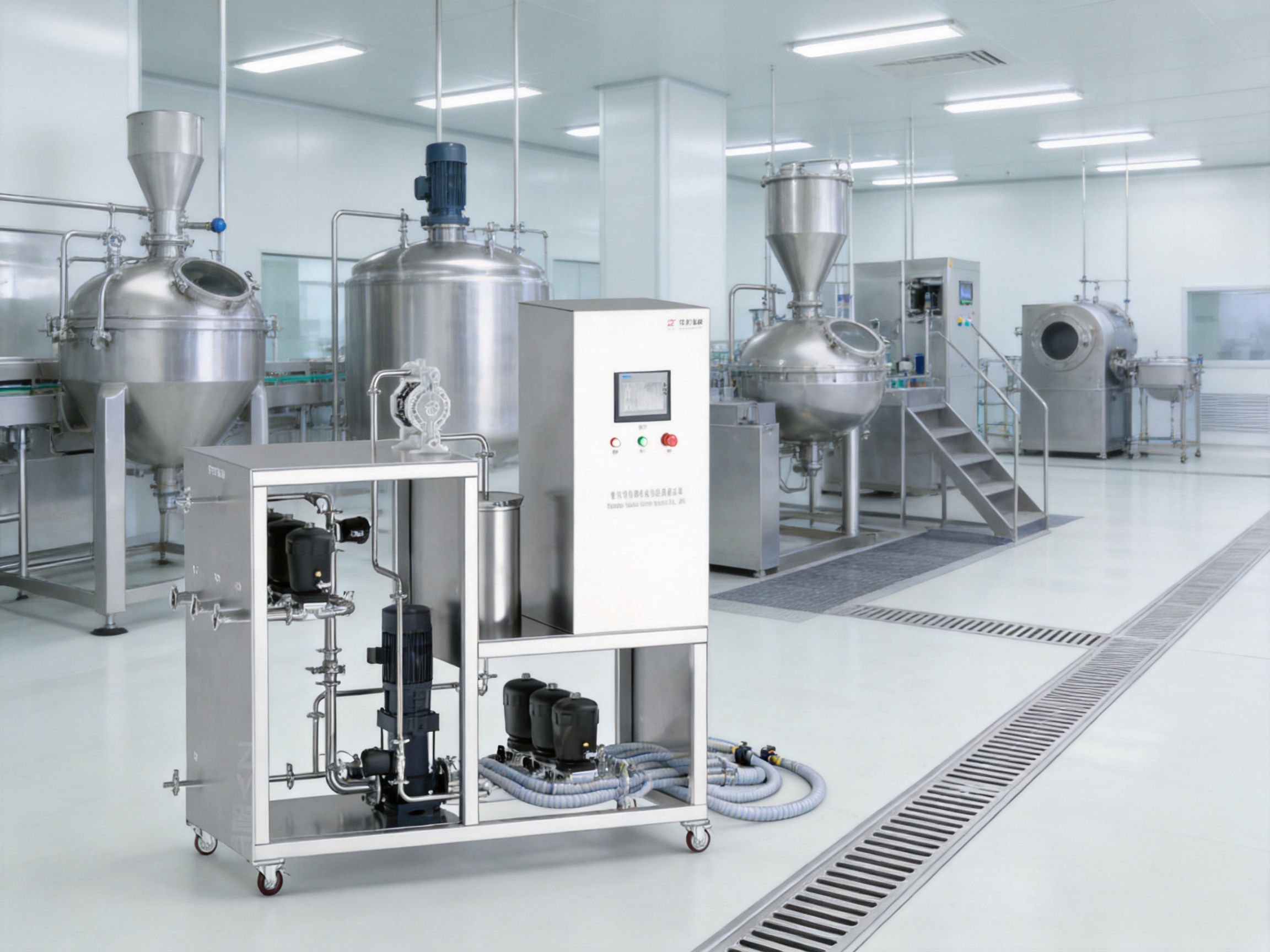
In pharmaceutical manufacturing, cleaning is not a secondary activity performed after production has finished. It is a controlled process that directly affects product quality, batch integrity, operator safety, equipment availability, and regulatory confidence. Process equipment used for wet granulation, fluid-bed processing, coating, mixing, and related solid dosage operations can retain powders, binders, suspensions, and other residues on internal surfaces. If these residues are not removed through a repeatable and properly designed procedure, they may create risks of cross-contamination, microbial growth, material degradation, or inconsistent future batches.
The QWQY Mobile CIP Cleaning Station is designed to address these challenges through a flexible cleaning platform for pharmaceutical, chemical, food, and related processing environments. The unit combines a pump station, cleaning circuit, and control system in a mobile configuration. It can be connected to the designated cleaning ports of compatible process equipment, allowing internal chamber surfaces to be cleaned in place without requiring the complete dismantling and relocation of the target machine.
Its intended applications include wet granulation mixers, fluid bed granulators, coating machines, and other production equipment requiring controlled and repeatable cleaning. A single station can support several types of equipment, helping manufacturers improve asset utilization while reducing the manual workload associated with traditional cleaning operations. The system can also support external cleaning through a high-pressure water gun, extending its function beyond internal circulation and making it practical for broader cleaning activities within the production area.
For companies seeking a compact cleaning system that can move between process machines, the mobile design offers a useful alternative to permanently installed cleaning infrastructure. It can help production facilities adapt their cleaning resources to changing product schedules, equipment layouts, capacity requirements, and future expansion plans.
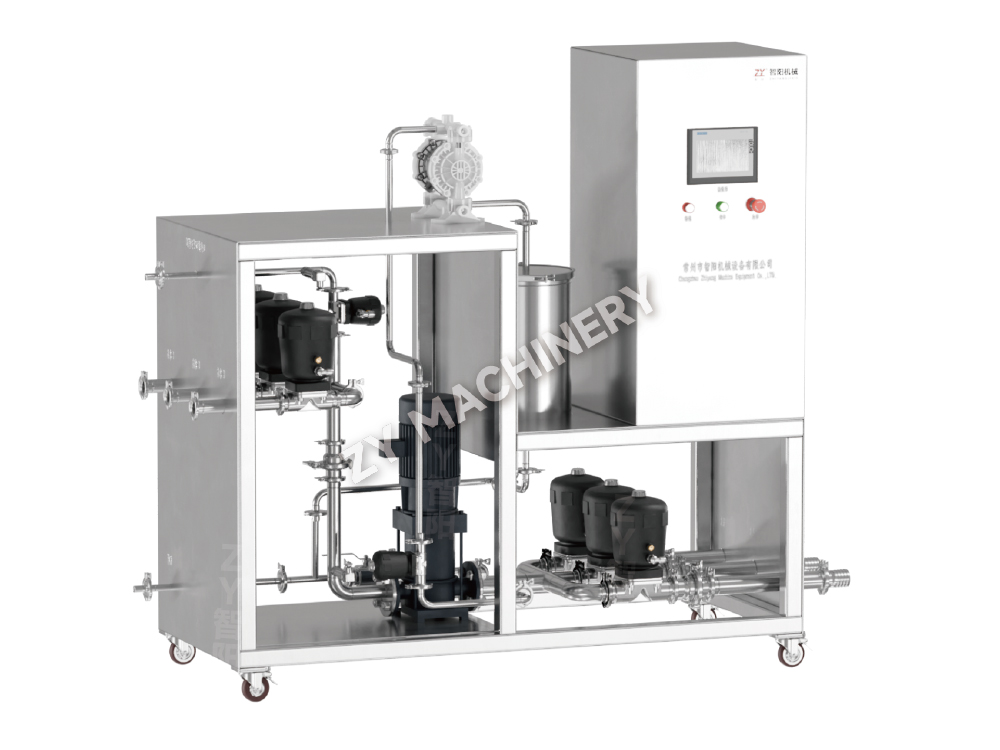
QWQY Mobile CIP Cleaning Station
Solid dosage manufacturing involves multiple processing stages, and each stage can expose equipment to different types of material residues. During wet granulation, powders may combine with a liquid binder and form cohesive masses on mixers, impellers, walls, discharge areas, and transfer surfaces. Fluid-bed granulation can leave particles, binder films, and agglomerated material on air distribution components, product containers, filters, and chamber surfaces. Coating processes may introduce film-forming solutions, pigments, plasticizers, or other formulations that adhere to spray zones and internal equipment components.
These residues can be difficult to remove through simple manual rinsing. They may dry onto surfaces, accumulate in corners, remain behind spray assemblies, or become trapped around valves and connections. A cleaning system must therefore deliver an appropriate combination of water flow, pressure, circulation, coverage, contact time, and programmed sequencing. The exact cleaning recipe depends on the product, equipment geometry, residue characteristics, cleaning agents, water quality, and plant procedures.
Traditional cleaning methods often rely heavily on operators using hoses, brushes, buckets, and manually controlled rinsing steps. Such methods can remain useful for certain external surfaces or specialized tasks, but they may create variability when used as the primary method for internal process chambers. Operator access can be restricted, cleaning coverage may be difficult to verify, and repeated manual intervention can increase both labor requirements and safety exposure.
A mobile clean-in-place station provides a more structured approach. The station is brought to the target equipment, connected to the appropriate ports, and operated according to a predefined cleaning program. This arrangement can improve process organization while maintaining flexibility. Rather than dedicating a separate permanent cleaning system to every production machine, the facility can use one mobile unit across multiple compatible assets.
The QWQY Mobile CIP Cleaning Station consists of three main functional elements: the pump station, the cleaning circuit, and the control system. Each part contributes to the overall cleaning operation, and their integration allows the system to perform controlled internal cleaning from a compact mobile platform.
The pump station provides the driving force for the cleaning liquid. Its purpose is to circulate water or an approved cleaning solution through the connected circuit and into the target equipment. Depending on the selected model, the station provides a water flow rate of 5, 10, or 15 cubic meters per hour. The available water pressure range is 2 to 7 bar for all three listed configurations.
Appropriate flow and pressure are important because cleaning performance is influenced by the mechanical action created by the moving liquid. A suitable flow can help wash residues from chamber walls, internal surfaces, fittings, and product-contact areas. The required operating condition should always be selected in accordance with the target machine’s design limits, cleaning validation strategy, and process requirements.
The cleaning circuit connects the mobile station with the equipment being cleaned. Operators connect the cleaning assemblies to the designated cleaning ports of the target machine before starting the selected program. Once the connections are confirmed, cleaning liquid can pass through the circuit and reach the internal chamber surfaces in a controlled sequence.
A properly organized cleaning circuit helps reduce unnecessary manual movement during the cleaning cycle. It also establishes a repeatable flow path that can be used as part of documented standard operating procedures. The circuit arrangement may vary according to the equipment type, chamber configuration, connection points, and required cleaning coverage.
The control system allows users to set cleaning programs according to process requirements. Programs may be organized around different cleaning stages, such as initial wetting, circulation, rinsing, and other plant-defined steps. The actual sequence, duration, temperature, cleaning agent concentration, and verification requirements should be determined by the user’s validated procedures and the characteristics of the material being removed.
By using programmed operation rather than relying entirely on manual timing, the station can support greater consistency between cleaning cycles. This is especially valuable in facilities where several operators work different shifts or where multiple products are manufactured on shared equipment. A defined program can provide a common operating framework and help reduce variation caused by individual cleaning habits.
The station can be connected to a high-pressure water gun for manual cleaning of external surfaces and auxiliary components within the cleaning area. This feature complements the internal CIP function. Process equipment often includes external frames, doors, covers, transfer points, platforms, guards, hoses, and other components that may require direct operator attention.
External cleaning is not always suitable for automated internal circulation, particularly where surfaces are open, irregularly shaped, or located outside the primary product-contact chamber. The water gun gives operators a practical tool for addressing these areas while the mobile station handles the main in-place cleaning sequence.
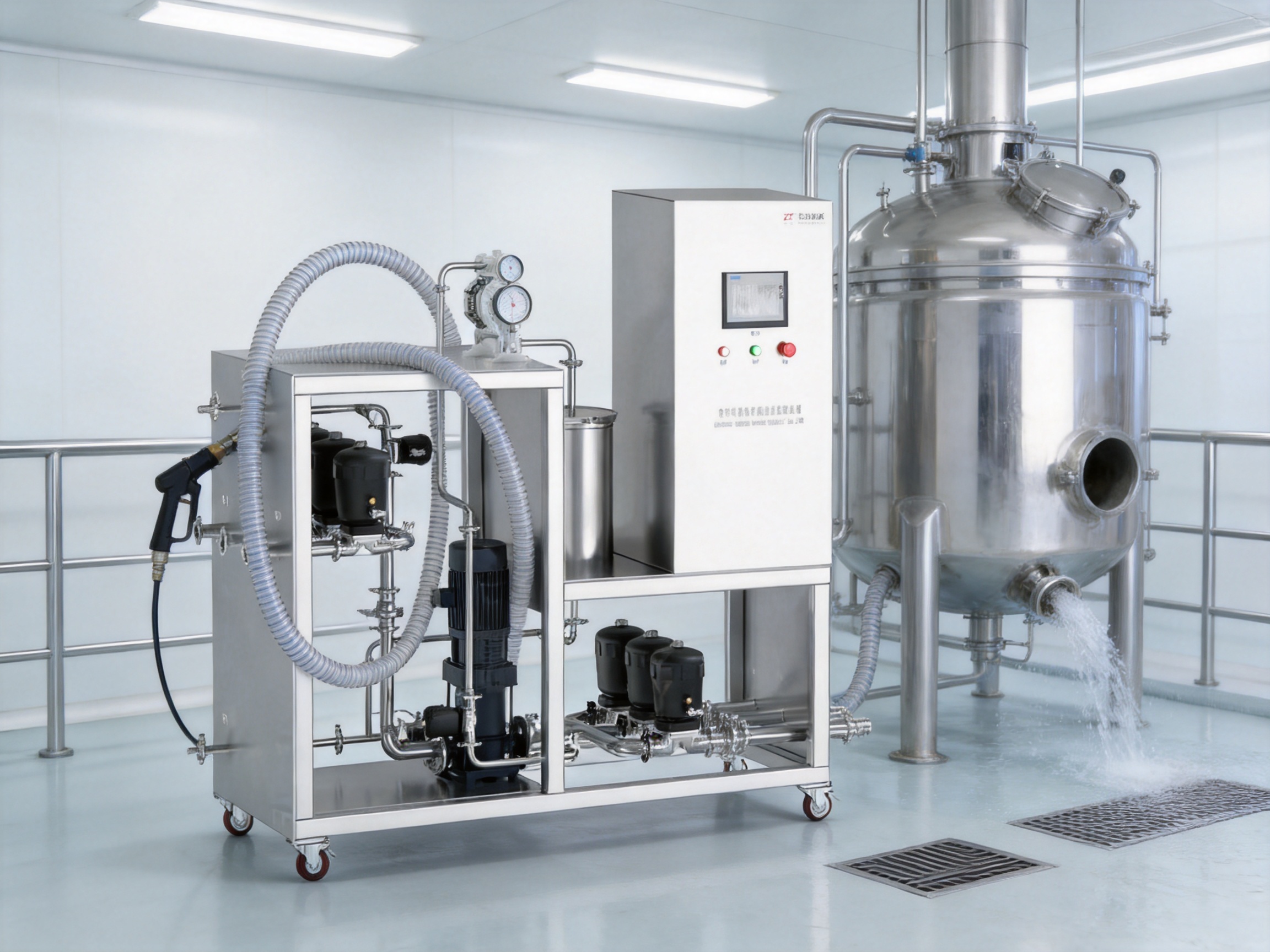
The QWQY Mobile CIP Cleaning Station is used by first positioning the unit near the designated equipment. Because it is mobile, the station can be moved between compatible machines as the production schedule changes. Before connection, operators should confirm that the target equipment is ready for cleaning, that relevant product residues have been removed or discharged, and that all required safety and isolation procedures have been completed.
The cleaning assemblies are then connected to the designated cleaning ports of the target machine. The connections should be checked for correct installation, secure attachment, suitable seals, and compatibility with the cleaning circuit. The equipment manufacturer’s instructions and the user’s site procedures should govern connection, isolation, and start-up activities.
After connection, the operator selects or prepares the appropriate cleaning program. The program should reflect the type of equipment, the formulation previously processed, the nature of the residue, and the required cleaning standard. A program may include a preliminary rinse, circulation of a cleaning solution, an intermediate rinse, a final rinse, and any other steps required by the site’s cleaning strategy.
Once the program is initiated, the station circulates the cleaning medium through the connected equipment. The internal chamber surfaces are treated according to the selected sequence. The combination of fluid movement, pressure, and programmed operation helps support the removal of residues without requiring the complete disassembly of the process chamber.
When internal cleaning is complete, operators can use the high-pressure water gun for external surfaces and auxiliary components in the cleaning area. This stage allows attention to be given to locations that are not included in the internal cleaning circuit. The operator can then perform the required inspection, sampling, rinse checks, or other verification activities according to the site procedure.
After cleaning, the equipment may undergo a drying process before being returned to standby status for future production use. Drying requirements depend on the equipment design, material compatibility, environmental conditions, and product-specific procedures. The mobile CIP station is therefore best understood as part of an overall cleaning and readiness workflow rather than as an isolated device.
One of the most important advantages of the QWQY configuration is its ability to serve multiple types of process equipment. In a facility containing mixers, fluid-bed granulators, coating machines, and other solid dosage equipment, a dedicated cleaning system for every machine can require considerable capital, floor space, piping, and maintenance resources.
A mobile station can be moved to the equipment that requires cleaning. This arrangement may reduce duplication of cleaning assets and allow a facility to allocate the station according to production priorities. It can be particularly useful for pilot plants, multiproduct factories, contract manufacturers, research facilities, and production areas where equipment is changed or rearranged frequently.
Manual cleaning can require operators to enter difficult-to-access areas, handle hoses for extended periods, perform repeated rinsing, and manually control each part of the procedure. By supporting in-place internal cleaning, the mobile station can reduce the extent of dismantling and lessen the amount of direct physical work required.
Reduced manual workload does not eliminate the need for trained operators. Personnel still need to establish connections, select the correct program, inspect the equipment, manage external cleaning, and follow safety and quality procedures. However, the system can shift the operator’s role from continuous manual washing toward controlled setup, supervision, verification, and documentation.
Cleaning repeatability is an important consideration in pharmaceutical manufacturing. When cleaning depends mainly on individual technique, differences in operator experience, fatigue, access, timing, and attention can influence the result. A controlled cleaning program gives the facility a common sequence that can be repeated across batches and shifts.
Repeatability also supports training and procedural control. New operators can be trained to follow the same connection and program-selection process rather than learning an entirely manual cleaning technique. Supervisors can review defined operating steps, and quality teams can establish verification procedures around a consistent cleaning method.
Permanent cleaning systems can require fixed pipework, dedicated pump rooms, large tanks, and carefully planned utility routes. These installations may be appropriate for large, highly standardized plants, but they can be less attractive where production layouts are compact or subject to change.
The compact and practical design of the QWQY station offers a mobile alternative. The equipment can be stored or positioned according to the needs of the facility, helping manufacturers use floor space more flexibly. The mobile approach may also simplify the introduction of cleaning capability into an existing production area where major construction work is undesirable.
Pharmaceutical and related manufacturing operations increasingly require flexible handling of different products, batch sizes, and production schedules. A cleaning station that can move between machines supports this operating model. It can be assigned to a high-priority machine after a batch changeover and then transferred to another area when the cleaning task is completed.
This flexibility can be valuable for companies that are expanding gradually. A facility may begin with a limited number of production machines and add equipment as demand increases. A mobile CIP system can provide shared cleaning capability during the early stages, while the company evaluates future requirements for additional stations or permanent infrastructure.
Manual cleaning methods are familiar and may involve relatively simple equipment. They can be suitable for external surfaces, small components, or operations where automated circulation is not practical. However, manual cleaning of large or complex internal chambers can be labor-intensive and difficult to standardize.
The mobile CIP approach offers several operational differences. Instead of relying on repeated direct scrubbing and open-ended rinsing, the operator connects the station and uses a defined circulation sequence. The cleaning liquid is delivered through the equipment’s designated ports, reducing the need to dismantle every component. The control system provides a clearer framework for timing and sequencing, while the pump station supplies the required flow and pressure range.
Compared with fixed CIP installations, a mobile station generally emphasizes flexibility and shared utilization. A fixed system may offer high integration with a specific production line, permanent automation, and centralized utility management. A mobile system, by contrast, can be deployed across different assets and may be easier to introduce into an existing plant. The best selection depends on the number of machines, cleaning frequency, facility layout, validation strategy, utility availability, and capital plan.
Compared with simple portable pumps or hoses, an integrated mobile CIP station provides a more organized combination of pumping, cleaning connections, and control functions. This integration can help reduce the risk of improvised setups and create a more consistent cleaning workflow. It also allows the station to support both internal in-place cleaning and external manual washing through the high-pressure water gun.
The QWQY series is available in three listed configurations. The primary differences are motor power and water flow. Each configuration provides a water pressure range of 2 to 7 bar, allowing the user to select a model according to the cleaning demand and compatible equipment requirements.
| Item | Unit | QW/QY-5 | QW/QY-10 | QW/QY-15 |
| Power | kW | 2.2 | 3.0 | 5.5 |
| Water flow | m³/h | 5 | 10 | 15 |
| Water pressure | bar | 2–7 | 2–7 | 2–7 |
The QW/QY-5 model, with a rated power of 2.2 kW and a water flow of 5 m³/h, may be suitable for lower-throughput cleaning duties or smaller compatible equipment. The QW/QY-10 model provides 10 m³/h through a 3.0 kW configuration, offering an intermediate option for facilities with broader cleaning requirements. The QW/QY-15 model uses 5.5 kW and provides 15 m³/h for applications requiring a higher flow rate.
Model selection should not be based only on nominal flow. Users should also evaluate the internal volume and geometry of the target equipment, number of cleaning ports, drainage arrangement, utility conditions, cleaning agent requirements, connection standards, and the cleaning program established through process development. The pressure range should be checked against the mechanical limits of the connected machine and the requirements of the cleaning assembly.
Wet granulation mixers can accumulate wet powder and binder residues around the mixing vessel, impeller, chopper, discharge valve, and other product-contact areas. If the residue dries, it may become more difficult to remove and may require extended soaking or manual intervention.
A mobile CIP station can be connected to the designated cleaning points of a compatible mixer. The programmed circulation process can help rinse internal surfaces after product discharge and support a repeatable changeover procedure. External components, frame areas, covers, and surrounding surfaces can be addressed using the high-pressure water gun when required.
Fluid-bed granulators combine airflow, particle movement, and liquid spraying. These operating conditions can produce deposits on chamber walls, air distribution areas, filters, spray assemblies, and related components. Cleaning requirements may vary significantly depending on the formulation and process parameters.
For compatible fluid-bed granulation equipment, the mobile station can provide an organized method for delivering cleaning liquid through designated connections. The cleaning program can be selected according to the residue and the equipment’s validated procedure. Because fluid-bed machines may contain multiple internal zones, connection planning and cleaning coverage verification remain essential.
Coating equipment may handle aqueous or solvent-based coating formulations, depending on the manufacturing process and machine design. Film-forming materials can adhere to spray guns, chambers, air handling components, product-contact surfaces, and exhaust-related areas.
The QWQY system can support in-place cleaning of compatible coating machines by circulating the selected cleaning medium through the established cleaning circuit. The external water gun can assist with auxiliary surfaces and areas requiring direct operator attention. Cleaning agents, solvent compatibility, ventilation, and safety measures must be determined by the specific coating process and facility procedures.
The station may also be considered for other compatible equipment used in pharmaceutical, chemical, food, nutraceutical, veterinary, and related processing applications. Suitability depends on the equipment’s cleaning ports, internal construction, material compatibility, drainage design, operating pressure limits, and required cleaning sequence.
Before implementation, users should conduct a technical review of each target machine. This review helps determine whether the station can achieve the required flow path and cleaning coverage. It also provides a basis for selecting connection assemblies, developing operating procedures, and planning cleaning verification.
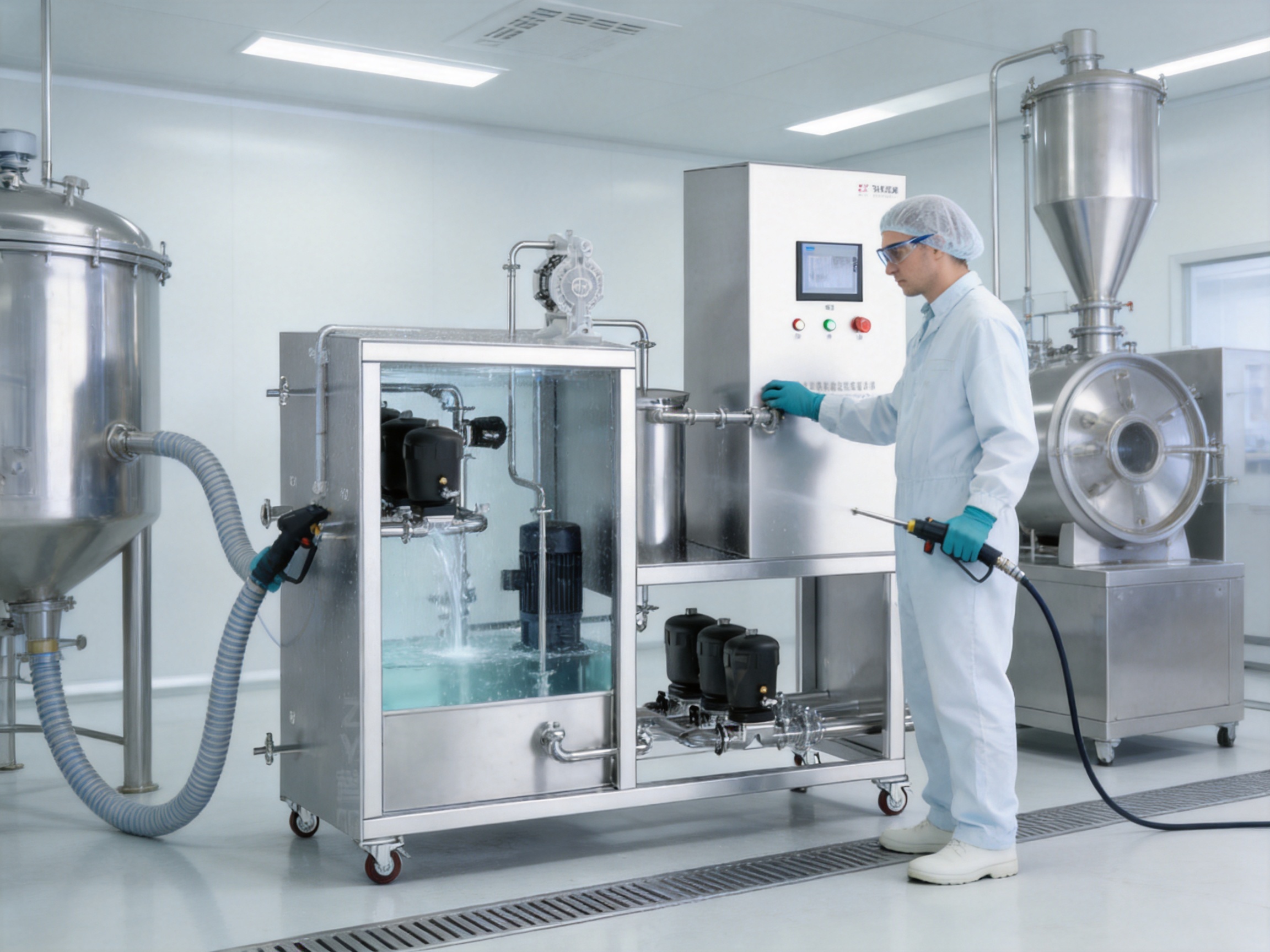
The same principles that apply to pharmaceutical cleaning are relevant in chemical and food processing. In chemical production, vessels and process chambers may retain powders, liquids, additives, emulsions, or crystallized material. In food processing, hygiene procedures may involve the removal of fats, proteins, sugars, starches, colorants, and other residues.
A mobile cleaning station can provide practical value in facilities where several production machines share cleaning resources. It may support equipment changeover, seasonal production, pilot operations, and manufacturing environments with limited permanent infrastructure. The cleaning program must be adapted to the material being removed and the applicable industry requirements.
Food and chemical facilities may use different cleaning agents, temperatures, verification methods, and safety controls from pharmaceutical plants. The station should therefore be integrated into the user’s own hazard assessment, sanitation program, wastewater management process, and equipment compatibility review.
The value of a CIP station depends not only on its pump and control functions but also on the manufacturer’s ability to understand process requirements. Changzhou Zhiyang Machinery Equipment Co., Ltd., also known as ZY Machinery, specializes in powder processing and oral solid dosage equipment. Its product portfolio covers laboratory equipment, mixing systems, granulation equipment, drying equipment, coating equipment, auxiliary processing equipment, and transfer and conveying systems.
This broader equipment scope is important because cleaning performance is closely related to process equipment design. A manufacturer that works across mixing, granulation, drying, coating, and material transfer can approach cleaning as part of the complete production route rather than as an isolated utility. Such an approach helps connect equipment geometry, product characteristics, process capacity, material handling, and sanitation requirements.
ZY Machinery describes its engineering approach as process-driven. Solutions are developed according to material characteristics, production capacity, and site conditions. This approach is relevant to mobile CIP projects because every facility has different equipment arrangements, connection requirements, utility conditions, and cleaning objectives.
Material characteristics can influence the cleaning strategy. Fine powders, sticky granules, binder-containing deposits, coating suspensions, and heat-sensitive residues do not necessarily respond to the same cleaning sequence. Capacity also affects the required flow rate and cleaning time. Site conditions influence how the station is positioned, connected, drained, stored, and maintained.
By considering these factors together, the equipment supplier can help the customer develop a more practical implementation plan. The result may include equipment selection, connection recommendations, cleaning program concepts, operating procedures, and coordination with other machines in the production line.
The company provides standalone machines, modular systems, and complete production lines for laboratory, pilot, and full-scale production. This range gives customers the possibility of developing equipment strategies as their manufacturing requirements change.
Laboratory and pilot facilities often need flexible, compact, and easily relocated equipment. Production plants may prioritize throughput, automation, repeatability, and integration with existing utilities. A mobile CIP station can be evaluated in either context, provided that the system is correctly matched to the target equipment and cleaning procedure.
Experience across different scales also helps manufacturers understand that a solution suitable for a development laboratory may not be directly transferable to a commercial plant without further process evaluation. Flow rates, chamber volumes, connection arrangements, cleaning times, and documentation expectations can all change as equipment size increases.
A company that manufactures or integrates mixers, granulators, dryers, coaters, and conveying systems can help customers consider equipment interfaces at an early stage. Cleaning ports, hose routing, drainage points, access doors, product-contact materials, and external washdown zones can be reviewed as part of the equipment design process.
This integrated perspective may help reduce compatibility problems during installation. It can also support more efficient future expansion, particularly when a facility plans to use one mobile station across several machines from the same or related equipment families.
ZY Machinery reports that it has strengthened its research and development capabilities, expanded its product portfolio, obtained quality system certification, developed patented technologies, and built overseas service capabilities. These activities indicate an emphasis on continued technical development rather than limited product supply.
For cleaning equipment, ongoing development can involve improvements in pump arrangement, control logic, connection design, mobility, operator usability, materials, and integration with process equipment. The exact configuration should be confirmed for each project, but a manufacturer with an established research and engineering function is better positioned to adapt equipment to evolving customer requirements.
Pharmaceutical cleaning systems must be considered within a quality management framework. The QWQY Mobile CIP Cleaning Station is designed to support integrated cleaning workflows and pharmaceutical manufacturing requirements under GMP standards. The station itself should be incorporated into the customer’s documented quality system, including equipment qualification, cleaning procedure development, training, maintenance, and verification.
GMP-oriented implementation typically requires more than purchasing a machine. The user may need to define the equipment boundaries, identify product-contact surfaces, determine worst-case residues, establish cleaning agents and concentrations, specify water quality, set operating parameters, and define acceptance criteria. Cleaning validation or verification activities should be based on the actual process and regulatory expectations applicable to the facility.
Documentation may include equipment specifications, operating instructions, connection diagrams, maintenance requirements, spare-parts information, cleaning programs, changeover procedures, and inspection records. Clear documentation helps ensure that the unit is operated consistently and that deviations can be investigated when necessary.
The practical design of the station can support this documentation effort by providing a defined cleaning circuit and control-based operating sequence. Nevertheless, users remain responsible for establishing and validating the complete cleaning process. The station’s flow and pressure specifications should be evaluated alongside the performance requirements of the connected equipment.
Before installation or routine use, the facility should identify all equipment intended to be cleaned by the mobile station. Each machine should be reviewed for cleaning-port location, connection size, internal flow path, drainage, seals, surface finish, and pressure limitations.
The movement path should also be considered. A mobile unit must be able to reach the equipment without obstructing personnel, material movement, emergency exits, or other production activities. The facility may need designated storage areas, utility connection points, hose management practices, and cleaning-agent handling procedures.
Drainage is particularly important. Cleaning liquid must be directed safely away from the equipment and production area. The drainage route should be compatible with the volume and composition of the discharged liquid. If detergents or other chemicals are used, the facility should follow its established chemical handling and wastewater requirements.
Electrical and utility requirements should be confirmed before commissioning. The model’s power rating, available water supply, pressure conditions, and operating environment must be compatible with the installation site. Environmental factors such as humidity, temperature, corrosive materials, and washdown conditions should also be reviewed.
Where the station is used with several equipment types, each application should have a clearly defined connection and cleaning procedure. Color coding, labeled hoses, dedicated accessories, or other identification methods may be used to reduce connection errors. The specific method depends on the facility’s quality and safety system.
Operators should be trained in the safe use of the pump station, cleaning circuit, control system, and high-pressure water gun. Training should cover equipment isolation, connection checks, pressure control, cleaning-agent handling, splash protection, emergency stop procedures, and post-cleaning inspection.
High-pressure water can create hazards if directed toward personnel, electrical components, fragile seals, or unsuitable surfaces. The water gun should be used only in accordance with site safety procedures and the compatibility limits of the equipment being cleaned.
Routine maintenance should include inspection of hoses, fittings, seals, pumps, valves, control components, and mobile frame elements. Leaks, unusual vibration, pressure instability, damaged cables, or abnormal operating noise should be investigated before continued use.
Cleaning the station itself is also important. Residues can remain in the pump circuit, hoses, connectors, or external surfaces if the unit is moved between products. The station should therefore have a defined post-use cleaning, draining, drying, and storage procedure. This procedure is particularly important when the same unit is shared by products with different formulations or sensitizing potential.
Preventive maintenance can help protect performance and reduce unplanned downtime. Maintenance frequency should be determined by operating hours, cleaning-agent exposure, water quality, usage intensity, and the manufacturer’s recommendations.
The economic value of a mobile CIP station may come from several sources rather than from a single cost reduction. Shared use can reduce the number of cleaning units required across a facility. A smaller physical footprint can reduce the need for dedicated infrastructure. Programmed cleaning can reduce the time operators spend on repetitive manual tasks. Faster and more consistent changeovers can improve equipment availability.
Reduced dismantling may also lower the risk of damage caused by frequent disassembly and reassembly. Fewer manual interventions can help protect seals, fasteners, panels, and other components from unnecessary handling. However, these benefits depend on correct equipment compatibility, appropriate cleaning program development, and disciplined operation.
For contract manufacturers and multiproduct facilities, flexibility may be especially valuable. Production schedules can change frequently, and the cost of long changeover periods can be significant. A mobile cleaning resource can be assigned where it is needed without requiring every production line to contain an independent cleaning system.
The selection of the correct model is essential. A station with insufficient flow may extend cleaning times or fail to provide the required circulation. An oversized model may increase energy use or exceed the limits of smaller equipment. The QW/QY-5, QW/QY-10, and QW/QY-15 options allow users to consider different cleaning capacities while retaining the same general mobile CIP concept.
List the mixers, granulators, coating machines, and other process equipment that may be cleaned by the station. Record chamber volumes, internal geometries, connection points, drainage arrangements, and manufacturer-specified cleaning limitations.
Review the materials processed in each machine. Consider whether residues are dry, sticky, oily, binder-based, pigment-containing, water-soluble, solvent-based, heat-sensitive, or otherwise difficult to remove. The residue profile will influence the cleaning medium and sequence.
Establish the required level of cleaning, including visual cleanliness, chemical residue limits, microbiological expectations, allergen control, product changeover requirements, and any other applicable acceptance criteria.
Compare the required water flow and pressure with the capabilities of each model. The QW/QY-5 provides 5 m³/h, the QW/QY-10 provides 10 m³/h, and the QW/QY-15 provides 15 m³/h. Confirm that the selected unit is appropriate for the largest and most demanding intended application without exceeding equipment limits.
Define hoses, fittings, cleaning assemblies, return lines, drainage routes, and equipment-specific connection points. The plan should make the cleaning circuit clear to operators and reduce the chance of incorrect connection.
Develop cleaning programs based on actual process data. Programs should be evaluated through appropriate testing and verification. If the station is used for pharmaceutical production, the cleaning process should be incorporated into the facility’s qualification and validation documentation.
Train operators, maintenance personnel, production supervisors, and quality staff as appropriate. Review cleaning results, downtime, operator feedback, maintenance history, and changeover performance to identify opportunities for improvement.
The QWQY Mobile CIP Cleaning Station has several characteristics that distinguish it from less integrated cleaning approaches. First, it combines the pump station, cleaning circuit, and control system within one practical unit. This reduces the need to assemble unrelated components for each cleaning task.
Second, it combines automated internal cleaning with manual external cleaning capability. Internal chambers can be cleaned through the designated circuit, while the high-pressure water gun addresses external and auxiliary surfaces. This combination reduces the need for a separate external washdown resource for every application.
Third, the unit is designed for use with several categories of process equipment. Its value is therefore not limited to a single machine or single production step. The same station can be included in a broader plant cleaning strategy covering granulation, fluid-bed processing, and coating operations where compatibility has been confirmed.
Fourth, the compact mobile configuration can be more adaptable than fixed systems in facilities with changing layouts or multiple production areas. It supports a shared-resource model without requiring the same level of permanent pipework and dedicated space associated with some centralized installations.
Finally, the manufacturer’s experience with powder processing and oral solid dosage equipment provides a relevant engineering foundation. Cleaning requirements are closely connected to the way powders are mixed, granulated, dried, coated, transferred, and discharged. A supplier familiar with these processes can help customers evaluate the station in the context of the complete production system.
Equipment selection is only one part of a successful CIP project. Customers may need support with process analysis, model selection, connection planning, operating procedures, training, spare parts, and after-sales service. ZY Machinery provides standalone machines, modular systems, complete production lines, and overseas service capabilities for customers in different industries and regions.
The company’s experience with equipment for pharmaceutical, biopharmaceutical, biotechnology, nutraceutical, veterinary, additives, chemical, and related applications allows it to address different production environments. Each application should still be reviewed individually because material properties, regulatory expectations, facility utilities, and equipment interfaces can vary considerably.
Application engineering is particularly useful when one mobile station will serve several machines. The supplier and user can jointly identify the required accessories, define the sequence for each equipment type, and determine whether additional connection assemblies are needed. This planning can improve implementation efficiency and reduce the risk of purchasing a unit without sufficient compatibility information.
Modern production facilities increasingly focus on flexible manufacturing, efficient changeovers, controlled sanitation, and the ability to expand without excessive disruption. A mobile CIP station can contribute to these goals by providing a reusable cleaning resource that follows the equipment rather than remaining permanently tied to one location.
The unit can support a gradual approach to infrastructure development. A company may use the station as part of an initial cleaning strategy, collect operating data, and later determine whether additional mobile units or fixed systems are justified. This approach can help align investment with actual production growth.
It can also support centralized cleaning management in facilities with several production rooms. Instead of allowing each room to develop separate manual methods, the company can establish common equipment, training, and documentation principles. The cleaning process can then be coordinated with production planning and quality oversight.
For manufacturers operating in regulated environments, the ability to organize cleaning into a defined workflow is an important practical benefit. The station does not replace validation, verification, or operator judgment, but it can provide a stable technical foundation for those activities.
The station is designed to support in-place cleaning of internal chambers and surfaces in compatible process equipment. It is intended for applications such as wet granulation mixers, fluid bed granulators, coating machines, and related equipment used in pharmaceutical, chemical, and food processing.
Yes. A principal advantage of the mobile configuration is that one unit can be moved between multiple compatible process machines. Each machine should have suitable cleaning ports and a defined connection and operating procedure.
Yes. A high-pressure water gun can be connected for manual cleaning of external surfaces and auxiliary components within the cleaning area. External cleaning should be performed according to site safety procedures and equipment compatibility requirements.
The listed models are QW/QY-5, QW/QY-10, and QW/QY-15. Their water flow rates are 5, 10, and 15 m³/h, respectively. Their rated powers are 2.2, 3.0, and 5.5 kW, while the listed water pressure range is 2 to 7 bar for each model.
Selection should consider the largest target equipment, required cleaning flow, chamber geometry, connection arrangement, drainage, cleaning sequence, utility conditions, and pressure limits. The nominal flow rate should be evaluated together with the actual cleaning performance required by the process.
The station is designed to support pharmaceutical manufacturing cleaning workflows and GMP-oriented requirements. However, the user must incorporate it into the facility’s own quality system, operating procedures, qualification activities, cleaning verification, and validation strategy.
The station may be used according to a cleaning program established for the relevant process, but the user must confirm chemical compatibility with the pump, hoses, seals, fittings, target equipment, and drainage system. Cleaning-agent concentration, temperature, and handling requirements should be determined by the user’s validated procedure and safety assessment.
After cleaning, the equipment can undergo a drying process before returning to standby status. The specific drying method and requirements depend on the target equipment, product, environmental conditions, and site procedure.
No. It can reduce manual work and support automated internal cleaning, but operators may still need to perform setup, inspection, external cleaning, verification, and specialized tasks. Some components may require removal or separate cleaning depending on the equipment design.
Operators should confirm equipment isolation, correct cleaning-port identification, hose and fitting compatibility, secure connections, drainage readiness, cleaning-program selection, pressure limits, and required personal protective equipment.
The principal application is solid dosage pharmaceutical manufacturing, but the station can also be considered for chemical, food, nutraceutical, veterinary, biotechnology, and related processing environments where flexible on-site equipment cleaning is required.
Changzhou Zhiyang Machinery Equipment Co., Ltd. specializes in powder processing and oral solid dosage equipment and offers equipment ranging from laboratory machines to complete production lines. Its experience across mixing, granulation, drying, coating, auxiliary processing, and conveying provides a process-oriented foundation for evaluating cleaning equipment alongside production equipment.
The QWQY Mobile CIP Cleaning Station provides a flexible approach to the cleaning of compatible pharmaceutical and process equipment. By integrating a pump station, cleaning circuit, and control system, it supports a more organized alternative to fully manual internal cleaning. Its mobile design allows one unit to serve multiple machines, while the high-pressure water gun extends the system’s usefulness to external surfaces and auxiliary components.
The three available configurations offer water flow rates of 5, 10, and 15 m³/h, with rated powers of 2.2, 3.0, and 5.5 kW. All listed models provide a water pressure range of 2 to 7 bar. These options allow users to consider different cleaning capacities while selecting a model that matches the connected equipment and process requirements.
Compared with less integrated or equipment-specific alternatives, the station can offer advantages in shared utilization, operator workload, cleaning repeatability, space efficiency, and production flexibility. Its effectiveness will depend on correct connection design, suitable cleaning programs, operator training, equipment compatibility, and proper cleaning verification.
The manufacturing and engineering capabilities of Changzhou Zhiyang Machinery Equipment Co., Ltd. further support the product’s application value. With experience in powder processing, oral solid dosage systems, modular equipment, complete production lines, and process integration, the company is positioned to evaluate cleaning as part of a broader manufacturing solution. For pharmaceutical, chemical, and food manufacturers seeking a practical mobile cleaning platform, the QWQY series can serve as a useful component of a controlled and adaptable sanitation strategy.
1. Good Manufacturing Practice principles for pharmaceutical production and quality systems.
2. Cleaning validation and cleaning verification guidance for pharmaceutical manufacturing equipment.
3. Principles of Clean-in-Place system design for process industries.
4. Hygienic equipment design practices for pharmaceutical, food, and chemical processing.
5. Process equipment considerations for wet granulation, fluid-bed granulation, and film coating.
6. Manufacturer-provided technical information for the QWQY Mobile CIP Cleaning Station.
7. Manufacturer-provided product parameters for QW/QY-5, QW/QY-10, and QW/QY-15 configurations.
Want to stay up to date?
Contact us via the email address below.
Don't worry about spam. We hate it too!
Mobile Client

Video Account
Phone:+86-15161130178
Tel:+86-519-88674267
Email:czzy188@163.com
Phone:+86-15161132798
Email:zy@zy-drying.com

WeChat ID

Copyright 2026 Changzhou Zhiyang Machinery Equipment Co., Ltd. All Rights Reserved  Oral Solid Dosage Equipment Manufacturer