 English
 Español
 русский
 中文简体
中文简体
LCP Weighing and Feeding Station
The LCP Weighing and Feeding Station is designed to accurately dose multipl.....

Content
In pharmaceutical, nutraceutical, chemical, food, and related powder-processing industries, accurate material dosing is one of the most important conditions for stable product quality. A formulation may contain several active ingredients, excipients, additives, or processing aids, and each material must be delivered in the correct quantity before mixing, granulation, drying, coating, or final compression. Even a small dosing deviation can affect potency, uniformity, flowability, dissolution, appearance, and batch-to-batch consistency.
The LCP Weighing and Feeding Station is developed to address these requirements through an integrated system combining dust-free feeding, vacuum conveying, temporary storage, screw feeding, precision weighing, and mobile material handling. Instead of treating loading, transfer, metering, and weighing as separate operations, the station connects them into a coordinated batching process. Materials are introduced into an enclosed feeding station, conveyed to an elevated temporary storage silo, metered by a screw feeder, and accurately discharged into weighing hoppers installed on an AGV mobile cart.
This integrated arrangement helps reduce manual handling, limit dust emissions, improve dosing accuracy, shorten batching time, and support a cleaner production environment. It is particularly suitable for production facilities seeking to upgrade from manual weighing or disconnected conveying systems to a more controlled and traceable material preparation process.
Material weighing is often regarded as a basic production activity, but it directly influences almost every downstream operation. In oral solid dosage manufacturing, the proportions of active pharmaceutical ingredients and excipients must remain within strict formulation limits. In nutraceutical production, the concentration of vitamins, minerals, extracts, and functional ingredients must be controlled carefully. In chemical and industrial powder processing, incorrect feed ratios can change reaction performance, density, particle properties, or final product behavior.
Traditional weighing methods frequently depend on operators manually transferring bags, opening containers, scooping powders, and adding materials to a scale. This approach can work for small-scale or low-frequency production, but it becomes increasingly difficult to control as the number of ingredients, batch size, and production demand increase. Manual operations may create several problems:
First, open handling can generate dust and expose operators to active or irritating powders. Second, repeated manual transfer increases the risk of cross-contamination. Third, the process may depend heavily on operator experience and attention. Fourth, waiting time can develop when one weighing hopper or one operator becomes a bottleneck. Finally, manual records and repeated handling can make production less efficient and less consistent.
The LCP system addresses these weaknesses by integrating the essential stages of the operation. The material path is enclosed, the transfer process is mechanized, the feed rate is controlled, and the weighing process is performed in dedicated hoppers. The use of an AGV mobile cart also provides flexibility for moving weighed materials to the next production stage without requiring every operation to be performed at a fixed location.
The LCP Weighing and Feeding Station is a precision batching system designed to dose multiple materials according to production orders and approved formulations. It consists of several coordinated functional areas:
• A dust-free feeding station for material loading.
• A vacuum conveying system for transporting powders and other suitable materials.
• An elevated temporary storage silo for holding material before metering.
• A screw feeder for stable and controlled material discharge.
• Weighing hoppers installed on an AGV mobile cart.
• An intelligent control system for coordinating transport, feeding, weighing, and process timing.
The system can support multiple weighing arrangements, allowing different materials to be dosed according to a production formula. Its configuration may be selected according to the required number of materials, the weighing range, production capacity, material characteristics, and the layout of the facility.
According to the supplied product data, two representative configurations are LCP4-200/5 and LCP2-300. The LCP4-200/5 configuration is listed with four units and weighing capacities of 200 kg and 5 kg, while the LCP2-300 configuration is listed with two units and a weighing capacity of 300 kg. Both models are specified with an accuracy class of X(0.1) and a stated capacity range of approximately 500 to 2,000 kg/h.
| Item | LCP4-200/5 | LCP2-300 |
| Configuration listed in the supplied data | 4 | 2 |
| Weighing range | 200 kg and 5 kg | 300 kg |
| Accuracy class | X(0.1) | X(0.1) |
| Capacity | 500–2,000 kg/h | 500–2,000 kg/h |
| Primary function | Multi-material weighing and feeding | Multi-material weighing and feeding |
| Material transfer method | Vacuum conveying | Vacuum conveying |
| Feeding method | Screw metering | Screw metering |
| Mobile arrangement | Weighing hoppers on AGV cart | Weighing hoppers on AGV cart |
The final configuration should always be confirmed against the actual material characteristics, batch size, required weighing tolerance, facility layout, cleaning strategy, and regulatory expectations. The product data provides a reference point for the available models, while a project-specific technical review determines the most suitable engineering solution.
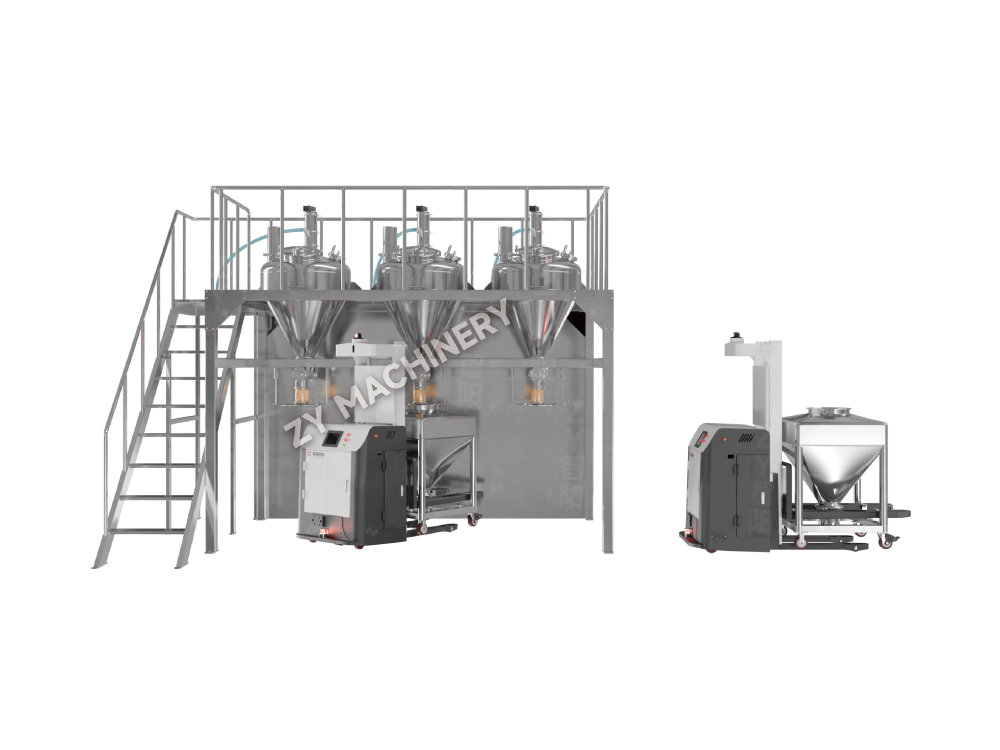
LCP Weighing and Feeding Station
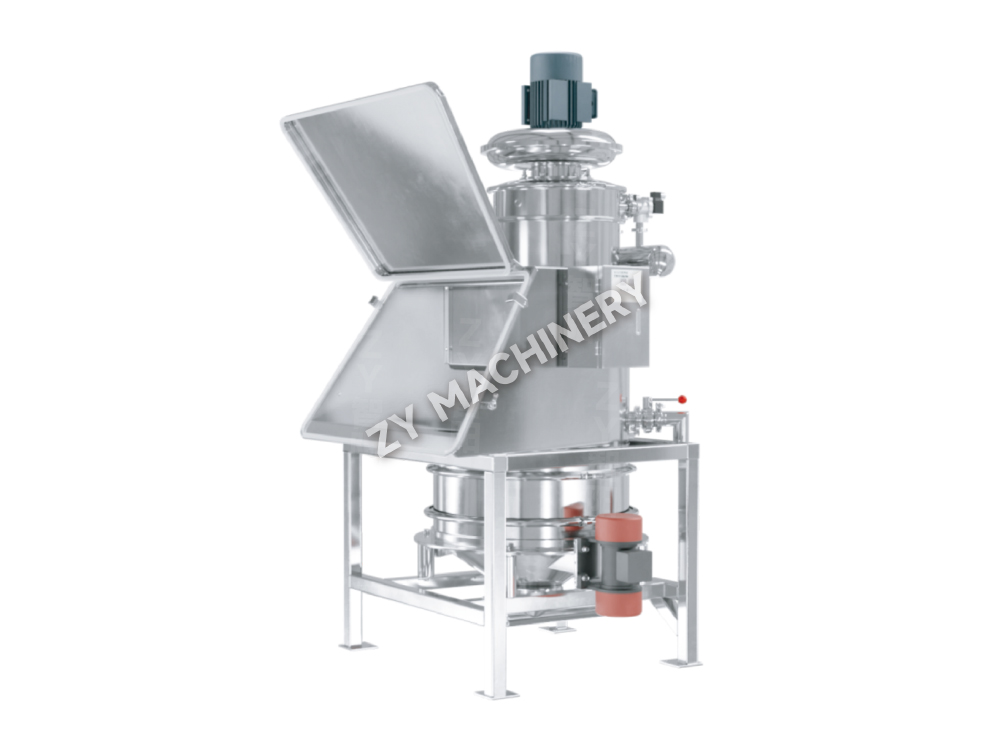
The process begins when raw materials are loaded into the enclosed feeding station. The feeding area is designed to reduce the release of airborne powder during bag emptying, container discharge, or other loading activities. By keeping the loading point controlled and enclosed, the system helps protect operators and maintain a cleaner room environment.
Dust-free loading is especially valuable when the formulation includes fine powders, potent ingredients, hygroscopic materials, or substances that are difficult to clean after they become airborne. Enclosure also helps reduce the possibility that material will settle on nearby equipment, floors, or structural surfaces.
The feeding station can be incorporated into the material management strategy of the facility. Depending on the project requirements, operators may load materials from drums, bags, intermediate bulk containers, or other approved containers. The specific connection and discharge arrangement should be selected according to powder flowability, particle size, bulk density, moisture sensitivity, and the required cleaning method.
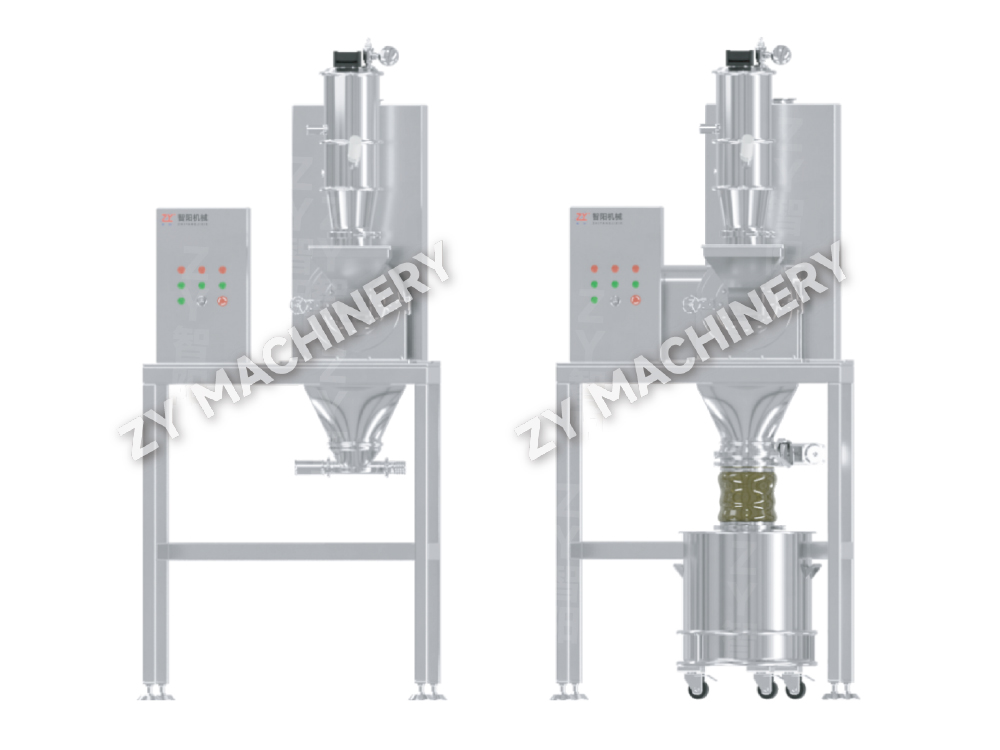
After loading, the material is transported by vacuum conveying to an elevated temporary storage silo. Vacuum conveying is well suited to enclosed powder transfer because the material moves through a closed pipeline rather than being carried manually in open containers. This reduces handling steps and helps control dust during transfer.
The temporary storage silo serves as a buffer between the feeding operation and the precision weighing operation. This buffer is important because material loading and material dosing do not always occur at exactly the same rate. The silo can receive material in advance and provide a stable supply to the screw feeder. As a result, the weighing process does not need to stop every time an upstream loading activity is completed.
Elevating the storage silo also supports a compact and organized process route. The material can be positioned above the screw-feeding point, allowing the system to use controlled discharge and gravity-assisted material flow where appropriate. The design must be adapted to the flow behavior of the material, since cohesive powders and free-flowing powders may require different hopper geometries, agitation arrangements, or discharge controls.
The screw feeder delivers material from the temporary storage silo into the weighing hoppers. Screw feeding is a practical metering method because the rotating screw can provide a relatively stable and adjustable flow. The feed rate can be controlled through operating parameters such as screw speed, feeding time, and staged coarse or fine feeding logic.
In a precision batching system, the objective is not simply to move material quickly. The system must balance throughput with control. A high initial feed rate can rapidly approach the target weight, while a slower final feed rate can help reduce overshoot and improve accuracy. The control system can coordinate the feeding sequence so that the hopper receives the required quantity according to the formulation.
The screw feeder also separates the storage function from the weighing function. The silo holds material, while the screw feeder determines how much material enters the weighing hopper at a given time. This separation improves process control and makes the operation less dependent on uncontrolled material discharge.
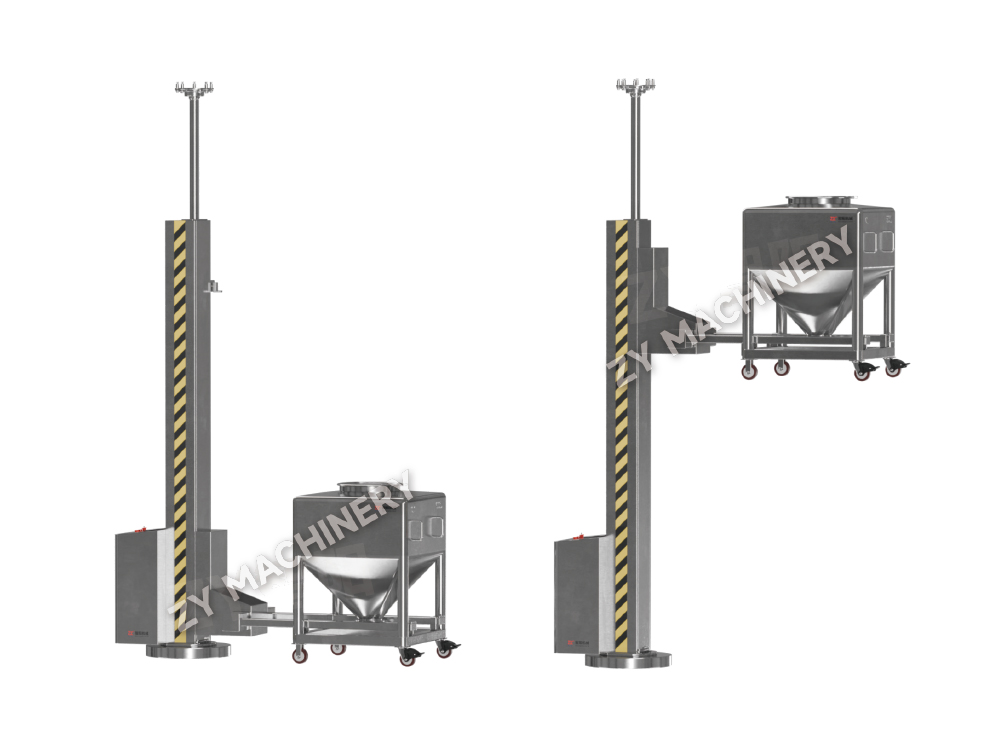
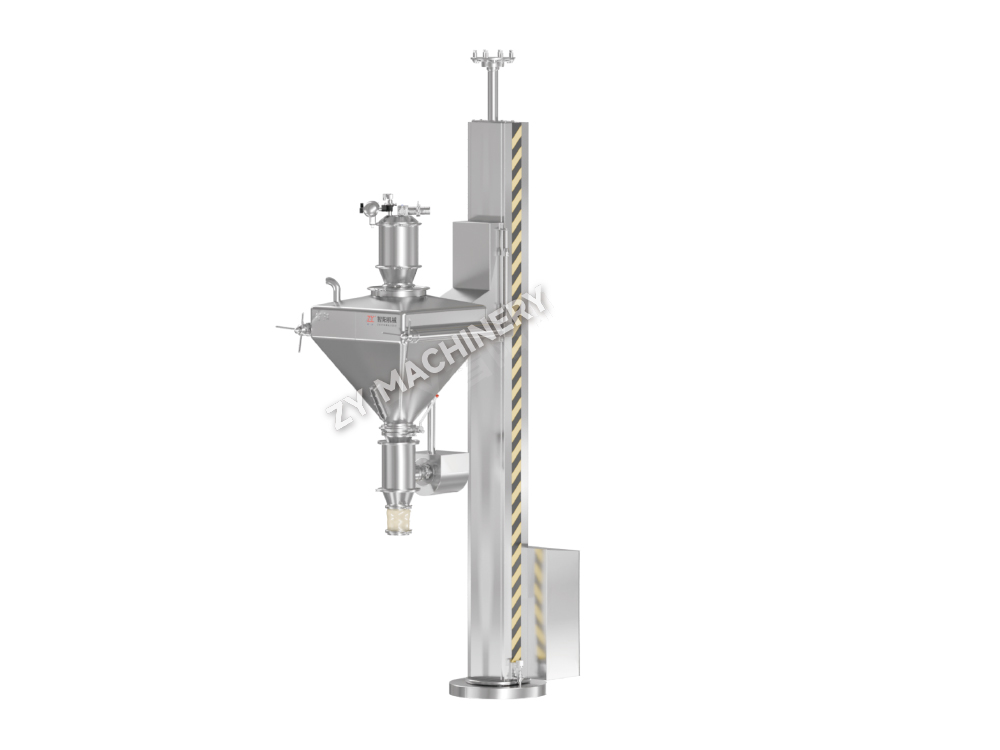
The metered material enters weighing hoppers mounted on an automated guided vehicle, or AGV, mobile cart. The weighing hoppers provide the actual measurement point for each material. The AGV arrangement allows the weighing unit to move as a complete assembly, which can simplify material transfer between the weighing area and the next stage of production.
A mobile weighing platform can offer practical advantages in facilities where several downstream processing areas share the same batching equipment. Instead of transferring weighed material manually from a fixed scale to another container, the complete cart can be directed to the required location. This can reduce unnecessary handling and help preserve the identity and integrity of the batch.
The mobile design also supports more flexible facility planning. Production areas may be reconfigured, multiple lines may require access to the same batching station, or the weighing cart may need to move to a discharge position after the formulation has been completed. The exact AGV navigation method, docking arrangement, and safety controls should be defined during project engineering.
The control system monitors weighing status, feed progress, and the operational sequence. Continuous monitoring is essential because the target weight is determined by the production formula, not by a fixed quantity that is identical for every material. Each ingredient may require a different set point, feeding time, or control strategy.
Intelligent control can coordinate several weighing systems at the same time. This means that multiple materials can be processed according to the requirements of the batch rather than waiting for a single hopper to become available. The system can manage the order of operations, coordinate material availability, monitor the completion of each weighing step, and help prevent unnecessary idle time.
When the control logic is correctly configured, the system can reduce waiting between hoppers. One hopper may be receiving material while another is being prepared for the next ingredient. This parallel operating concept is one of the most important ways that the LCP station can shorten the overall batching cycle.
The first and most important advantage of the LCP station is its focus on accurate dosing. The screw feeder provides controlled material delivery, and the weighing hoppers provide a direct measurement of the quantity added. The control system compares the measured weight with the required formulation value and manages the feeding process accordingly.
Accurate dosing supports content uniformity and helps reduce the risk of rejected batches caused by formulation deviations. It also helps production teams use expensive active ingredients and specialty additives more efficiently. When overfeeding is minimized, material waste can be reduced. When underfeeding is detected promptly, corrective action can be taken before the batch moves to a later process stage.
The stated accuracy class of X(0.1) indicates that the equipment is designed for controlled weighing performance. Actual results will depend on the material, environmental conditions, calibration, hopper design, vibration control, feeding rate, and the operating procedures used by the facility. Even so, the integrated design establishes a stronger technical basis for accuracy than open manual scooping and repeated transfer.
Production efficiency depends not only on the speed of one machine but also on the time required for the complete material preparation cycle. The LCP station improves efficiency by coordinating material transfer, temporary storage, metering, and weighing in one process route.
The temporary silo allows material to be available near the weighing point. The screw feeder provides a controlled supply. Multiple weighing systems can operate simultaneously. Intelligent control reduces waiting between hoppers. Together, these features help increase the number of completed batches within a given production period.
The stated capacity range of 500 to 2,000 kg/h provides a reference for the throughput available from the listed configurations. Actual capacity depends on the number and type of materials, target weights, bulk density, powder flowability, conveying distance, feeding method, cleaning intervals, and the required weighing accuracy.
Powder dust is a concern for product quality, operator safety, equipment cleanliness, and regulatory compliance. Open transfer can cause dust to spread throughout a room, settle on surfaces, and enter areas where it is difficult to remove. Dust can also increase the possibility of cross-contamination between products.
The LCP station uses a fully enclosed process route from feeding through conveying and metering. Although every installation requires appropriate ventilation, filtration, pressure control, and cleaning procedures, the enclosed design provides a significant starting point for dust control. It limits the number of open powder-transfer points and reduces the need for operators to repeatedly lift and empty containers by hand.
A cleaner process environment can also improve maintenance efficiency. When less powder accumulates on external surfaces, routine cleaning may become more manageable, and operators can spend less time removing deposits from floors, frames, and adjacent equipment.
Manual powder handling may require operators to lift heavy bags, repeatedly bend over containers, carry materials across a room, and perform fine weighing under time pressure. These activities can create ergonomic risks and contribute to fatigue.
By using vacuum conveying and an AGV mobile cart, the LCP station reduces the amount of manual carrying required. Operators can focus more on material identification, process supervision, container connection, inspection, and documentation rather than repeatedly transporting and scooping powders.
Better ergonomics can support more consistent work performance. When operators are less fatigued, the risk of handling mistakes, incorrect material selection, and incomplete cleaning may also be reduced. The system therefore contributes not only to automation but also to a more sustainable daily working environment.
Many production formulas contain multiple materials with different target quantities. Some ingredients may be required in large quantities, while others may be needed only in small amounts. A system designed for only one fixed material or one fixed batch size may be inefficient in such circumstances.
The LCP station supports multiple weighing systems and can be configured for different weighing requirements. The listed LCP4-200/5 model combines a larger 200 kg weighing range with a smaller 5 kg range, which can be useful when a formulation includes both major and minor ingredients. The LCP2-300 model provides a larger 300 kg weighing range for applications requiring greater individual weighing capacity.
This flexibility allows the equipment to be considered for a wider variety of formulations and production scales. The correct configuration should be selected after analyzing the complete material list, including the smallest and largest ingredient quantities, required tolerances, discharge behavior, and changeover needs.
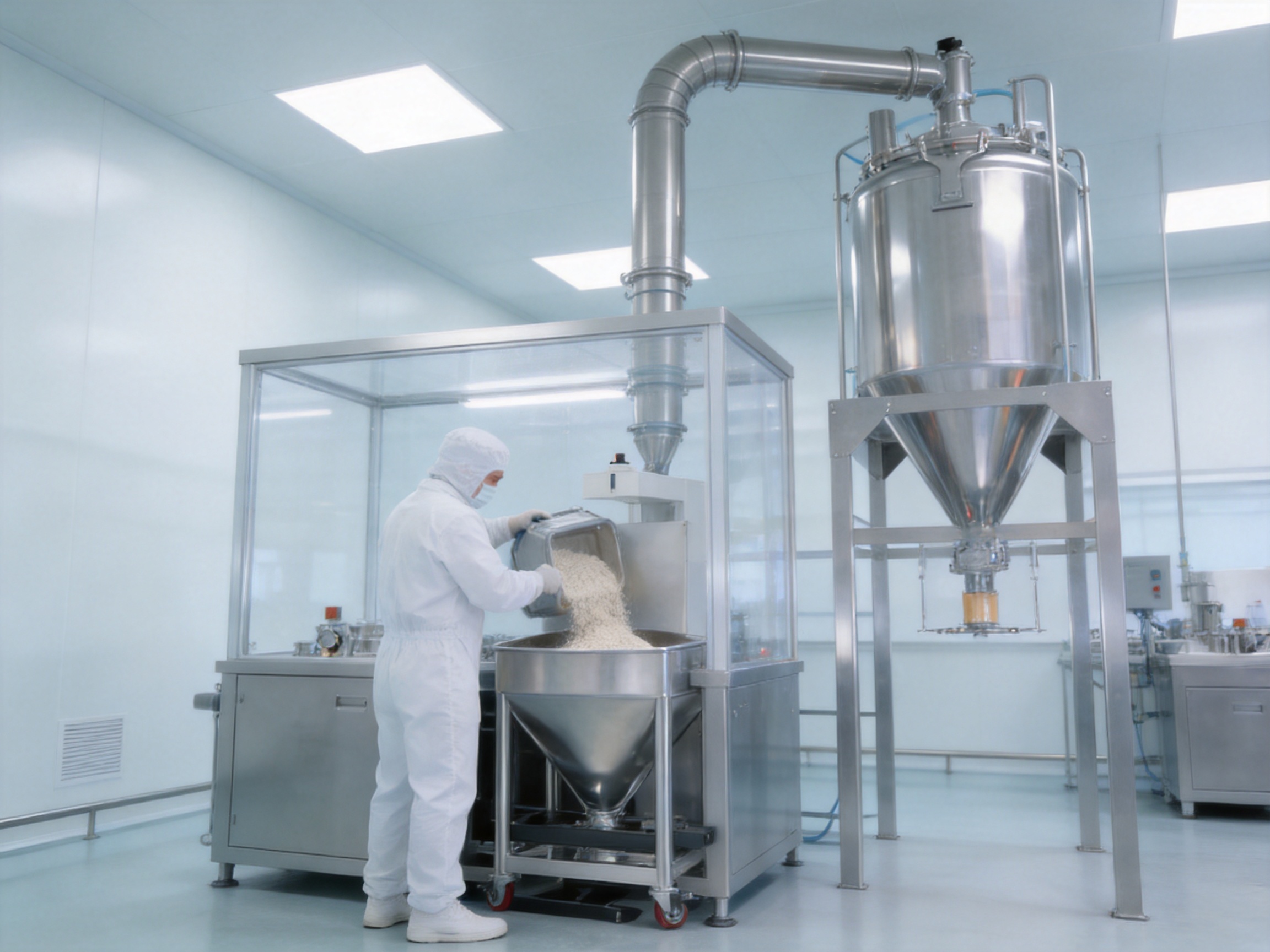
Equipment comparison should be based on the complete process rather than a single component. A competitor may offer a scale, a feeder, or a conveying machine individually, but the practical result depends on how well these elements work together. The LCP station is differentiated by its integrated architecture, combining several functions into a coordinated production unit.
In a fragmented arrangement, the operator may load a material into one machine, manually transfer it to a scale, move the weighed material to a container, and then transport the container to the next process. Each transfer creates a possible source of delay, dust, weighing error, or material identification error.
The LCP station links feeding, vacuum conveying, temporary storage, screw feeding, weighing, and mobile transport. This reduces the number of manual interfaces between process stages. An integrated process also makes it easier to define a common control philosophy and a consistent batch record.
Compared with a collection of stand-alone machines, an integrated station can simplify operation and reduce the engineering effort required to coordinate separate control systems. It can also provide a more organized equipment footprint because the main process functions are designed to operate as a connected solution.
Some conventional systems rely on a single weighing point. Every ingredient must pass through the same location, and the next material cannot be handled until the previous operation is complete. This sequential approach can become a serious bottleneck for formulas with many ingredients.
The LCP station supports simultaneous operation of multiple weighing systems. This allows different materials to be processed in parallel where the formulation and equipment configuration permit. Parallel operation can improve the use of the conveying system, feeding system, and operator time.
The result is not merely a higher theoretical speed. It can also make production scheduling more predictable. When the batching sequence is controlled and waiting time is reduced, planners can estimate the availability of the prepared material more reliably.
Open systems may require several manual connection and transfer steps. These steps can expose the material to the room environment and expose the room to the material. The enclosed path of the LCP station provides an advantage in applications where dust containment and product protection are priorities.
For pharmaceutical and nutraceutical manufacturers, this is particularly important because the same facility may process multiple formulations. A closed process route can help reduce the opportunities for airborne contamination and may simplify the design of cleaning and environmental control procedures.
A fixed weighing unit may require the weighed material to be discharged into separate containers and transported manually. The AGV-mounted weighing hoppers provide another approach: the weighing assembly itself can be moved to a designated location.
This arrangement can reduce intermediate containers, lower the number of transfers, and provide greater flexibility when several process areas share a batching system. It may also be useful in facilities where the process route changes according to product type or production campaign.
A high-quality dosing station is only effective when it matches the material and the process. The manufacturer’s strength lies in combining equipment supply with process understanding. A solution should consider powder behavior, production capacity, room arrangement, operator access, cleaning, maintenance, control requirements, and future expansion.
Changzhou Zhiyang Machinery Equipment Co., Ltd. positions itself as a process-driven equipment manufacturer rather than only a supplier of isolated machines. This approach supports the design of standalone machines, modular systems, and complete production lines. For customers, the value is the possibility of receiving an application-oriented solution rather than a generic catalog configuration.
The manufacturer specializes in powder processing and oral solid dosage equipment. Its product scope includes laboratory equipment, mixing equipment, granulation equipment, drying equipment, coating equipment, auxiliary processing equipment, and transfer and conveying systems.
This broad product range is relevant to the LCP station because weighing and feeding are rarely isolated activities. The dosed materials may later enter a mixer, granulator, dryer, tablet production process, or coating line. A manufacturer familiar with the complete process can better understand the interface requirements between the batching station and downstream equipment.
Experience across laboratory, pilot, and full-scale production also supports equipment selection at different development stages. A customer may begin with laboratory testing, move to pilot production, and later require a commercial-scale line. The ability to understand scale-up considerations can help reduce the risk of selecting equipment that is suitable only for one stage of development.
Powders differ substantially in flowability, cohesiveness, density, moisture sensitivity, electrostatic behavior, particle size, and tendency to segregate. A screw feeder that works well for a free-flowing powder may not perform the same way with a cohesive or aerated material.
The manufacturer’s process-driven approach places material characteristics at the center of equipment planning. This includes evaluating how the powder enters the feeding station, how it moves through vacuum pipelines, how it fills the temporary silo, how it discharges through the screw feeder, and how it behaves inside the weighing hopper.
Material-focused design can improve the reliability of the complete system. It can also help identify potential problems before installation, such as bridging, rat-holing, unstable feeding, excessive dust generation, segregation, or inaccurate final dosing.
Modularity allows the equipment to be adapted to different production capacities and facility layouts. A modular system can include different numbers of weighing points, alternative hopper capacities, different conveying distances, and varied discharge arrangements.
For customers, modularity creates a balance between standardization and customization. Standardized modules can support manufacturing efficiency, spare-parts planning, and service familiarity. At the same time, the system can be adapted to the customer’s process requirements rather than forcing every application into an identical layout.
The LCP4-200/5 and LCP2-300 configurations illustrate how the weighing capacity and number of units can be varied. Further project-specific details should be confirmed through technical consultation, but the principle remains clear: the station can be designed around the formulation and production objective.
The company reports continued investment in research and development, patented technologies, quality system certification, and overseas service capabilities. These efforts are important in a sector where equipment must satisfy increasingly demanding expectations for hygiene, repeatability, data management, and operational efficiency.
Research and development should not be limited to adding features. It should improve practical performance, including stable feeding, easier cleaning, more reliable control, better access for maintenance, and stronger compatibility with the wider production line. For a weighing and feeding station, improvements in sensor integration, software logic, feeding control, and material containment can have a direct effect on batch quality.
Reliable performance begins with disciplined manufacturing. Equipment frames, hoppers, silos, screw feeders, pipelines, valves, sensors, control cabinets, and mobile platforms must be manufactured and assembled according to controlled technical requirements.
Quality management should cover material selection, fabrication, welding, surface treatment, dimensional inspection, component installation, electrical testing, control-system verification, and final performance checks. In hygienic processing applications, surface quality and accessibility are particularly important because difficult-to-clean areas can increase the risk of residue accumulation.
A complete factory acceptance process should confirm that the major functions operate as intended. Depending on the project, testing may include empty running, vacuum conveying checks, screw-feeding tests, weighing verification, alarm testing, control-sequence testing, AGV movement, emergency stop functions, and interface checks with customer utilities and downstream equipment.
The company has delivered equipment and engineering solutions to customers in multiple countries and regions and has developed overseas service capabilities. International experience can help a manufacturer understand the different documentation, installation, training, validation, and communication requirements that may apply to export projects.
For customers purchasing an automated weighing and feeding system, service does not end when the equipment leaves the factory. Installation guidance, commissioning support, operator training, spare-parts planning, preventive maintenance, and troubleshooting are all important parts of the equipment lifecycle.
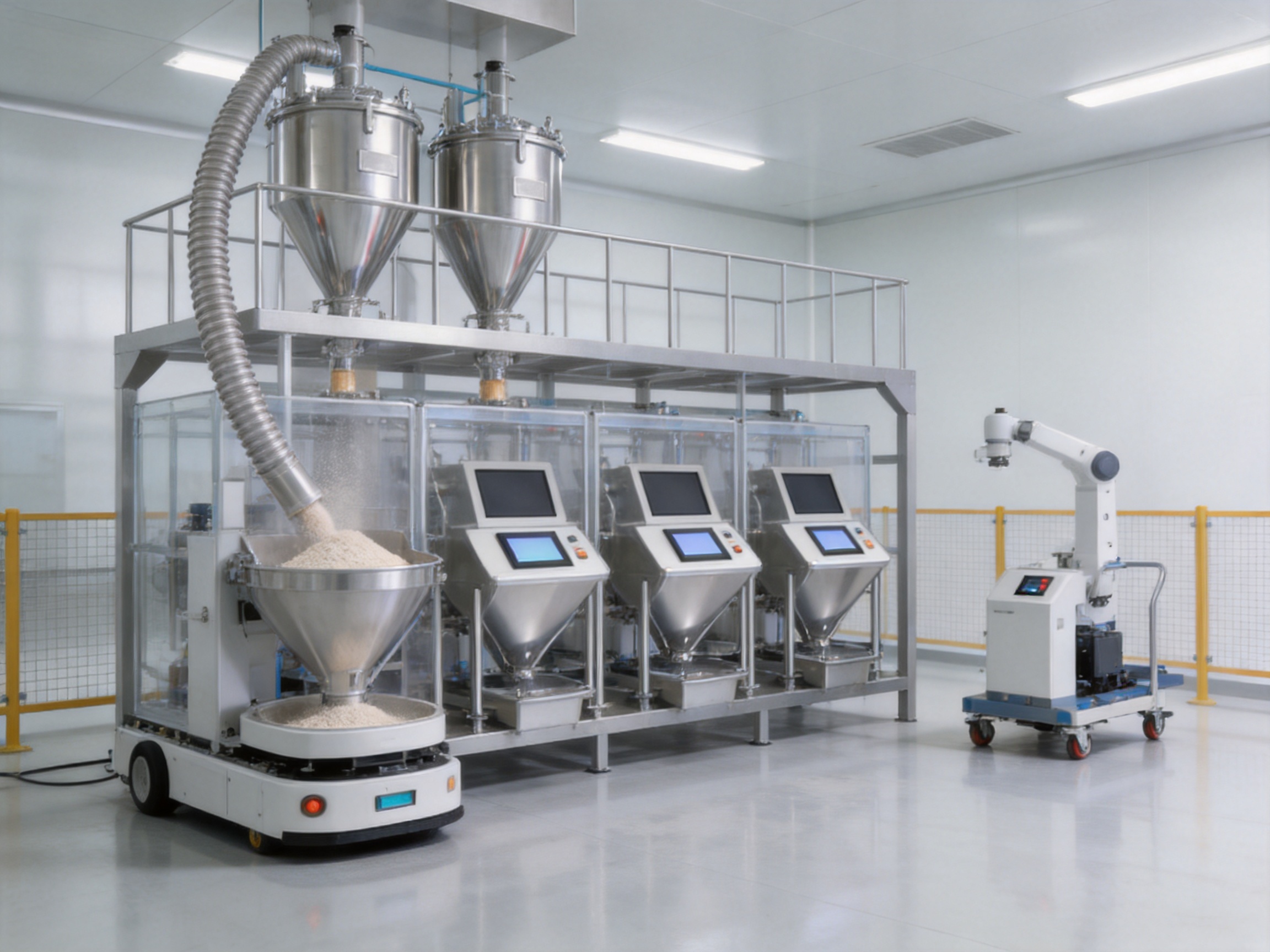
A dust-free and enclosed process route supports the objective of a clean and GMP-compliant manufacturing environment. However, GMP compliance is achieved through the complete system of equipment design, facility control, procedures, documentation, cleaning, validation, and operator training. The LCP station should therefore be integrated into the customer’s overall quality system.
Important design considerations include smooth and accessible product-contact surfaces, minimized dead zones, suitable seals and gaskets, controlled access to internal components, appropriate drainage or dry-cleaning provisions, and a layout that allows inspection and maintenance. The correct surface finish and material selection should be established according to the product, cleaning agents, temperature, and regulatory expectations.
Containment is another key consideration. The feeding station, conveying pipeline, temporary silo, screw feeder, weighing hoppers, and discharge points should be evaluated as one connected containment system. Pressure balance, filtration, connection integrity, and transfer interfaces all influence the actual dust-control performance.
Cross-contamination control may require dedicated product-contact parts, validated cleaning procedures, campaign production, or other site-specific controls. The mobile cart and weighing hoppers should be designed so that they can be inspected and cleaned efficiently between products when required.
Accurate weighing is strengthened when the control system is connected to production orders and approved formulations. The operator should be able to select or receive the correct batch information, confirm material identity, and monitor the target and actual weights for each ingredient.
A well-designed control system can provide status information such as material availability, weighing progress, hopper condition, feed rate, alarm status, and batch completion. It can also help prevent incorrect sequencing, excessive feeding, or operation under unsuitable conditions.
Traceability is especially important in regulated industries. The system may be integrated with the customer’s manufacturing execution system, recipe management system, or electronic batch record platform, depending on the project scope. Even when a full digital integration is not required, the control system should support clear batch documentation and reliable recording of critical weighing results.
Data integrity requires more than recording a number. The system should associate the result with the correct material, batch, time, equipment status, and operator action. Access levels, change control, backup, and audit requirements should be defined according to the customer’s quality and regulatory procedures.
Proper layout planning ensures that the advantages of the LCP station are realized in daily operation. The feeding point should be accessible for material loading, while the elevated temporary silo should have adequate structural support and maintenance access. The vacuum conveying route should be planned to minimize unnecessary bends and provide suitable cleaning and inspection points.
The AGV route must be evaluated carefully. The floor should support the required load, and the route should remain clear of obstructions, spills, hoses, pallets, and unauthorized equipment. Docking positions should be defined for loading, weighing, discharge, cleaning, charging, and maintenance.
Utility requirements may include electrical power, compressed air, vacuum generation, ventilation, dust collection, and network communication. The final utility list depends on the selected configuration and control architecture. Early coordination between the equipment supplier, facility engineer, automation team, and end user can prevent costly changes during installation.
Operator access is equally important. Staff should be able to identify materials, connect containers, inspect seals, view weighing results, remove samples if required, and perform cleaning without unsafe climbing or awkward manual handling. Maintenance access should be provided for screw-feeder components, sensors, valves, filters, and control equipment.
Cleaning requirements should be considered during the initial design rather than after installation. The material path includes the feeding station, vacuum pipeline, temporary silo, screw feeder, weighing hoppers, valves, seals, and discharge interfaces. Each area should have a defined cleaning method and inspection procedure.
For products that require frequent changeover, quick-release connections and accessible product-contact parts can reduce downtime. For campaign production, the system may be cleaned at longer intervals according to a validated schedule. The appropriate strategy depends on the product risk, powder characteristics, facility procedures, and regulatory requirements.
Preventive maintenance should include inspection of screw-feeder components, drive units, bearings, seals, load cells, sensors, filters, vacuum equipment, AGV wheels, batteries, navigation components, and safety devices. Calibration and verification of the weighing system should be performed according to the site’s quality program.
Reliability is improved when operators receive practical training. They should understand how to load materials, confirm connections, respond to alarms, identify abnormal feeding, protect weighing accuracy, clean the equipment, and report deviations. Clear operating procedures help convert the equipment’s technical capabilities into repeatable production performance.
In pharmaceutical production, the LCP station can support the preparation of powder formulations for mixing, wet or dry granulation, drying, tablet production, capsule filling, or other oral solid dosage processes. The enclosed design and accurate dosing are particularly relevant where active ingredients must be handled carefully and formulation uniformity is critical.
The selected weighing range should match the quantity of each active ingredient and excipient. Small-dose materials may benefit from a smaller weighing range, while high-volume excipients may require larger hoppers and higher throughput. A combined configuration such as LCP4-200/5 can support formulations containing both major and minor components, subject to project confirmation.
Nutraceutical formulations often contain multiple powders, extracts, minerals, vitamins, carriers, and flavoring materials. The LCP system can help organize these ingredients into a controlled batch before blending or further processing.
Reducing manual transfer can improve consistency and help protect sensitive ingredients from unnecessary exposure. The system can also support production environments where cleanability, product identification, and reliable batch records are important.
Veterinary powders may include active ingredients and carriers with different flow characteristics. Accurate dosing is important because the final product may be administered according to animal weight, dosage schedule, or species-specific formulation requirements.
The enclosed process route can also be useful when the facility produces multiple products and must manage cross-contamination risks carefully. The final cleaning and containment strategy should be determined according to the product hazard and site procedures.
Specialty chemical manufacturers often process powders that require controlled ratios, stable feeding, and careful dust management. The LCP station can be adapted to material preparation operations where the feed rate, batch quantity, and product identity must be controlled consistently.
Material testing is particularly important in chemical applications because powders may vary widely in density, particle size, abrasiveness, moisture sensitivity, and electrostatic behavior. These properties influence the selection of screw geometry, conveying conditions, seals, and contact materials.
Choosing between different LCP configurations should begin with the production formula rather than the equipment model number. The customer should prepare a complete list of ingredients, including minimum and maximum quantities, bulk density, flowability, particle size, moisture sensitivity, dust behavior, and cleaning requirements.
The required capacity should be calculated from the desired batch size and production schedule. A stated capacity of 500 to 2,000 kg/h may be suitable for many applications, but actual performance can vary. If high accuracy is required at a low target weight, the feeding process may need to operate more slowly during the final dosing stage.
The number of weighing systems should be selected according to the number of ingredients and the desired level of parallel operation. More weighing points may shorten the batching cycle, but they may also increase the equipment footprint, control complexity, cleaning scope, and investment cost.
The mobile cart arrangement should be evaluated against the downstream process. The customer should determine where the weighed material will be discharged, how the AGV will travel, how the cart will be cleaned or recharged, and whether multiple production areas need access to the same unit.
Finally, the system should be reviewed as part of the complete process line. The weighing station must communicate effectively with upstream material storage and downstream mixing, granulation, drying, or other equipment. A properly engineered interface is essential for achieving the expected efficiency and reliability.
The purchase price of a weighing station is only one part of its economic value. A system that reduces labor, material loss, cleaning time, batch errors, dust-control problems, and production waiting may deliver greater long-term value than a lower-cost machine with limited integration.
Accurate dosing can reduce the use of excess active ingredients and minimize rejected or reworked batches. Faster batching can increase equipment utilization and help the facility meet production schedules. Enclosed transfer can reduce cleaning labor and improve the working environment. Automated movement can reduce the need for manual handling and intermediate containers.
Total cost of ownership should also include energy consumption, spare parts, calibration, maintenance, software support, operator training, and future expansion. A modular system may provide a better long-term investment if it can be upgraded as production volume grows or new formulations are introduced.
Changzhou Zhiyang Machinery Equipment Co., Ltd. supports customers with standalone equipment, modular systems, and complete production-line solutions. This range allows the customer to select a solution that matches present needs while preserving the possibility of future process integration.
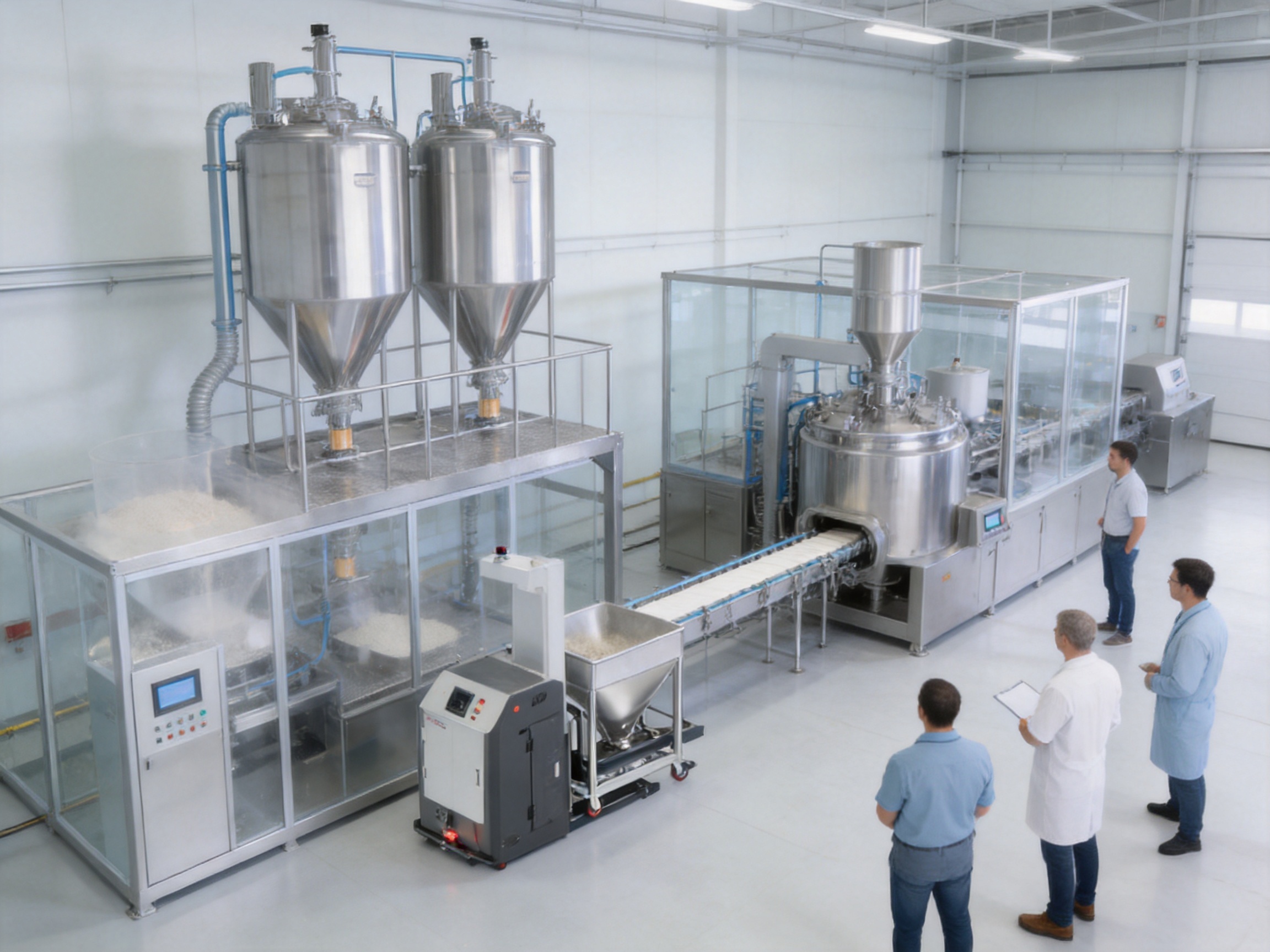
The first stage is to collect detailed information about the materials, formulas, target batches, production schedule, room dimensions, cleaning procedures, and regulatory requirements. Accurate process information allows the supplier to recommend a realistic configuration.
Representative material testing may be required to confirm conveying behavior, screw-feeding stability, dust generation, hopper discharge, and weighing repeatability. Testing is particularly valuable for cohesive, low-density, fragile, abrasive, or highly electrostatic powders.
The supplier and customer should develop a preliminary process flow, equipment layout, utility list, control concept, AGV route, cleaning strategy, and interface plan. Potential risks should be identified before detailed fabrication begins.
After the configuration is approved, detailed mechanical, electrical, automation, and documentation work can proceed. Manufacturing should be performed under controlled quality procedures, with inspections at critical stages.
Factory testing verifies basic functionality before shipment. Site installation and commissioning then confirm that the system performs correctly under the customer’s actual operating conditions. Training should cover normal operation, cleaning, maintenance, alarm response, and safety.
After commissioning, the customer should review weighing accuracy, batching time, dust-control performance, cleaning duration, operator workload, and equipment availability. This review can identify optimization opportunities and establish a baseline for preventive maintenance and continuous improvement.
The primary purpose is to accurately dose multiple materials according to production orders and formulations. It combines enclosed feeding, vacuum conveying, temporary storage, screw metering, precision weighing, and mobile transfer in one coordinated process.
The main material path is enclosed from the feeding station through vacuum conveying, temporary storage, screw feeding, and weighing. This reduces open transfer points and limits the escape of powder into the production room. The complete dust-control result also depends on facility ventilation, filtration, seals, operating procedures, and maintenance.
The temporary silo acts as a buffer between material loading and precision dosing. It stores material near the weighing system and provides a more stable supply to the screw feeder, helping prevent interruptions caused by variations in upstream loading.
A screw feeder provides controlled and adjustable material delivery. It can support a high initial feeding rate and a slower final feed rate, allowing the system to approach the target weight efficiently while reducing the risk of overfeeding.
The AGV cart allows the weighing assembly to move between designated process locations. This can reduce manual transport, limit intermediate handling, and provide flexibility when multiple production areas share the same batching equipment.
Yes. The system is designed to support simultaneous operation of multiple weighing systems, subject to the selected configuration and process requirements. Parallel operation can reduce waiting time and shorten the overall batching cycle.
The supplied data lists LCP4-200/5 with weighing capacities of 200 kg and 5 kg, and LCP2-300 with a weighing capacity of 300 kg. Both are listed with an accuracy class of X(0.1) and a capacity range of 500 to 2,000 kg/h. Final performance should be confirmed for the specific material and application.
It is designed for applications requiring controlled powder dosing and dust-free handling, including pharmaceutical and oral solid dosage production. Suitability for a particular product depends on material properties, containment requirements, cleaning validation, documentation, and the customer’s GMP system.
Yes. The station can be engineered as part of a wider process line. It may interface with mixing, granulation, drying, coating, or other downstream equipment. The exact mechanical, electrical, automation, and data interfaces should be defined during project design.
The customer should provide the ingredient list, target batch size, required weighing accuracy, material properties, production capacity, number of formulations, cleaning requirements, room layout, downstream equipment, utility conditions, and any documentation or validation expectations.
Maintenance should include routine inspection of feeders, drives, bearings, seals, load cells, sensors, filters, vacuum equipment, AGV components, batteries, and safety devices. Calibration and verification should be performed according to the customer’s quality and maintenance procedures.
A basic weighing machine measures material at one point. The LCP station integrates material loading, enclosed conveying, temporary storage, controlled feeding, weighing, intelligent sequencing, and mobile transport. Its value lies in the complete process integration and reduction of manual handling.
The LCP Weighing and Feeding Station provides an integrated approach to powder batching. By combining dust-free feeding, vacuum conveying, temporary storage, screw metering, precision weighing, AGV mobility, and intelligent control, it addresses several common weaknesses of manual or disconnected dosing operations.
Its main benefits include improved formulation accuracy, reduced powder exposure, higher batching efficiency, better operator ergonomics, flexible multi-material handling, and stronger integration with modern pharmaceutical and powder-processing lines. The ability to support multiple weighing systems and parallel operation helps reduce bottlenecks, while the enclosed design contributes to a cleaner and more controlled production environment.
The system is also supported by the broader capabilities of Changzhou Zhiyang Machinery Equipment Co., Ltd., including powder-processing expertise, oral solid dosage equipment, modular engineering, process integration, research and development, quality management, and overseas service support. These capabilities are important because the most effective weighing solution is not simply a machine selected from a catalog. It is a process-engineered system designed around the material, formula, capacity, facility, cleaning strategy, and long-term production objectives.
For manufacturers seeking to improve dosing reliability and upgrade their powder-handling process, the LCP station offers a practical foundation for automated and hygienic batching. With appropriate material testing, configuration selection, layout planning, control integration, commissioning, and maintenance, it can support consistent production from pilot-scale development through full-scale manufacturing.
1. Changzhou Zhiyang Machinery Equipment Co., Ltd. Product information for the LCP Weighing and Feeding Station.
2. Changzhou Zhiyang Machinery Equipment Co., Ltd. Technical information on powder processing, oral solid dosage equipment, conveying systems, and process integration.
3. General principles of pharmaceutical powder handling, batching, weighing accuracy, and dust containment.
4. Good Manufacturing Practice principles for pharmaceutical production facilities and equipment design.
5. General engineering practices for vacuum conveying, screw feeding, industrial weighing, automated guided vehicles, and hygienic process equipment.
6. General principles of equipment qualification, calibration, cleaning validation, preventive maintenance, and batch traceability in regulated manufacturing.
Want to stay up to date?
Contact us via the email address below.
Don't worry about spam. We hate it too!
Mobile Client

Video Account
Phone:+86-15161130178
Tel:+86-519-88674267
Email:czzy188@163.com
Phone:+86-15161132798
Email:zy@zy-drying.com

WeChat ID

Copyright 2026 Changzhou Zhiyang Machinery Equipment Co., Ltd. All Rights Reserved  Oral Solid Dosage Equipment Manufacturer