 English
 Español
 русский
 中文简体
中文简体
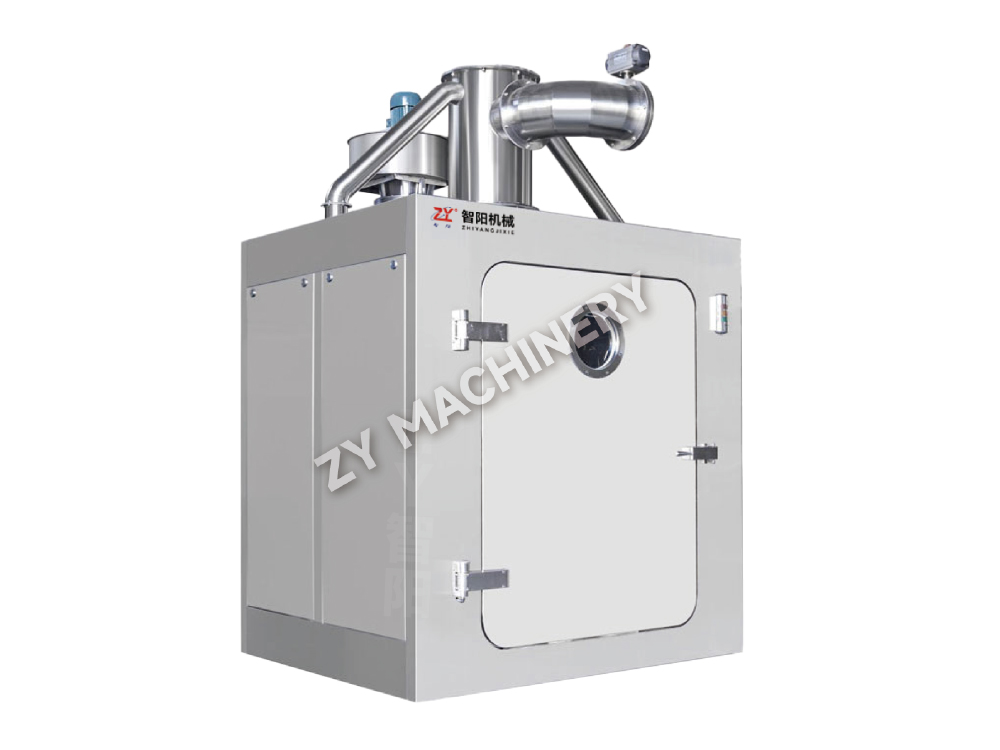
NTQW Semi-Automatic Bin Washing Machine
The NTQW Semi-Automatic Bin Washing Machine is used for cleaning intermedia.....

Content
Cleaning intermediate transfer bins is an essential part of solid dosage manufacturing. Bins transport powders, granules, tablets, and other products between processing stages, and their internal and external surfaces must be cleaned thoroughly before the next production campaign. Inadequate cleaning can create risks related to cross-contamination, product buildup, microbial control, operator safety, and production efficiency. At the same time, a washing system must be practical for different bin sizes, easy to operate, and suitable for the hygiene requirements of pharmaceutical, chemical, food, and related manufacturing environments.
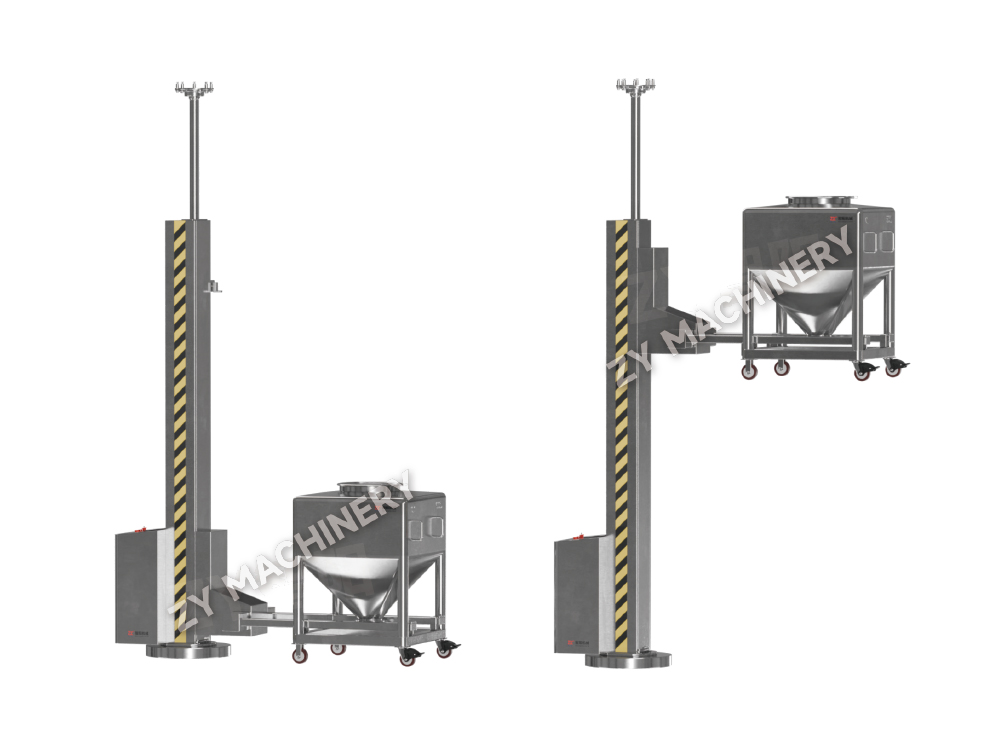
The NTQW Semi-Automatic Bin Washing Machine is designed for this specific purpose. It combines automatic internal washing with manual external washing in one integrated station. A rotating spray ball cleans the inner surface of the transfer bin, while an operator uses a water gun to wash the outside. A lifting mechanism raises or lowers the spray ball so that the machine can accommodate bins with different specifications.
This combination gives manufacturers a balance between automation, flexibility, accessibility, and investment control. Instead of requiring a fully enclosed and highly complex automated washing system for every application, the NTQW configuration automates the most repetitive and difficult internal cleaning operation while retaining direct operator control over the external surface. The result is a practical cleaning solution for pharmaceutical production lines and other industries that use mobile or intermediate transfer bins.
Intermediate bins are exposed to product residues throughout the manufacturing process. During powder transfer, granulation, blending, drying, or material staging, fine particles may adhere to walls, corners, discharge areas, covers, and fittings. Some materials are easy to remove with water, while others may form compact deposits or require a controlled cleaning cycle. The design of a cleaning machine must therefore provide sufficient water coverage, adequate pressure, repeatable movement, and convenient access for inspection.
Manual cleaning alone can be time-consuming and inconsistent. Operators may use hoses, hand-held spray devices, brushes, or cloths to clean the internal surface. This method depends heavily on individual technique. Areas that are difficult to reach may receive less attention, and cleaning time can vary from one operator to another. Manual work also increases the need for personnel to enter awkward working positions or handle heavy equipment during the cleaning process.
A dedicated bin washing machine addresses these issues by creating a defined cleaning area and using a rotating spray ball for internal washing. The spray ball distributes water around the inner surface while the lifting mechanism positions it according to the height and geometry of the bin. This makes the washing process more systematic and reduces the dependence on manual handling for the most important internal cleaning stage.
The external surface presents a different challenge. Bins may have frames, wheels, handles, clamps, support structures, and other features that vary according to the application. Manual washing with a water gun allows the operator to direct water toward these details. It also enables the operator to respond to visible contamination and focus on areas that require additional attention. The semi-automatic design therefore combines process repeatability with practical adaptability.
The NTQW Semi-Automatic Bin Washing Machine uses two coordinated cleaning methods. The internal surface is washed automatically by a rotating spray ball, and the external surface is washed manually with a water gun. The operator positions the bin in the cleaning area, adjusts the spray ball through the lifting mechanism, selects or confirms the required cleaning parameters, and starts the internal washing cycle. During or after the automatic internal cycle, the operator cleans the outside of the bin using the external water gun.
The rotating spray ball is a central component of the system. As water flows through the spray ball, the device rotates and directs washing water across the interior. This movement provides more uniform coverage than a stationary nozzle aimed in one direction. The position of the spray ball can be raised or lowered to match the bin being processed. This is important because transfer bins may differ in height, internal volume, and structural design.
The lifting mechanism is powered by a 0.75 kW lifting motor across the listed NTQW-5, NTQW-10, and NTQW-15 models. By adjusting the spray ball position, the system can bring the cleaning device into a suitable relationship with the interior of the bin. Correct positioning helps improve water distribution and allows the same basic equipment concept to support multiple bin specifications.
The cleaning water is discharged through a grated floor drain. This arrangement helps remove wastewater from the washing area and supports orderly operation. The floor drain also provides a defined route for water drainage, helping prevent uncontrolled pooling around the equipment. Site drainage capacity, wastewater treatment, and local environmental requirements should be evaluated during installation and project design.
Although the machine is semi-automatic, the internal cleaning sequence can be managed through a touchscreen and PLC control system. Operators can select process recipes, configure parameters, monitor operation, and respond to alarms. The external washing step remains manual because direct operator control is useful for cleaning complex external structures and addressing visible contamination.
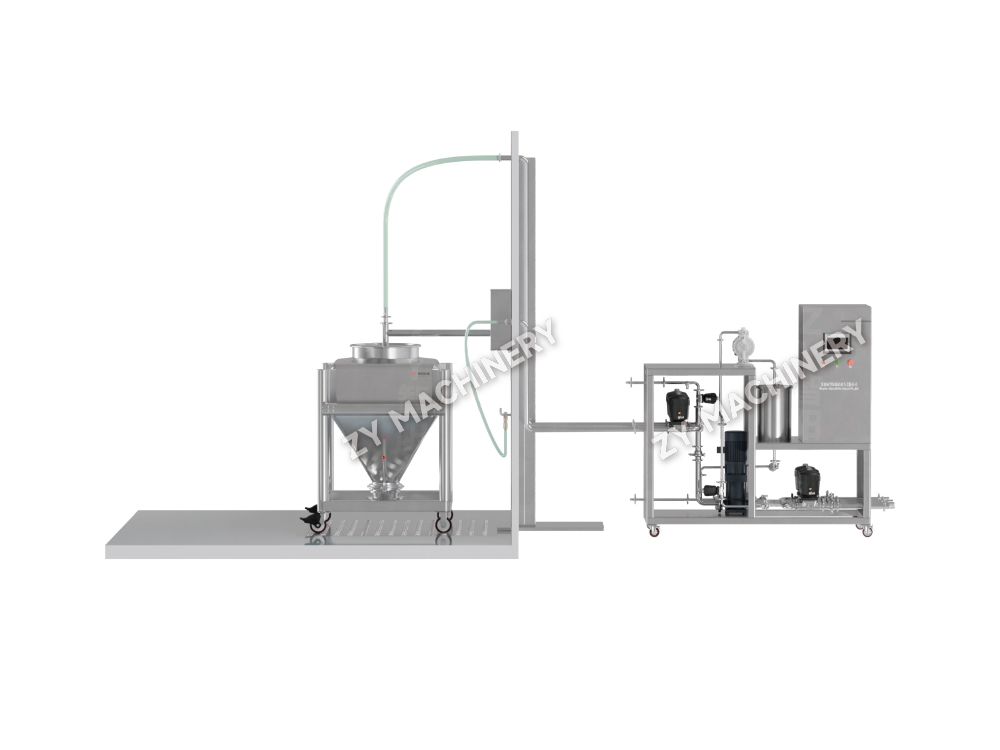
NTQW Semi-Automatic Bin Washing Machine
The most important advantage of the machine is the automatic internal cleaning method. Manual washing of the inside of a large or deep bin can leave uneven coverage, particularly near the upper wall, lower corners, welds, outlet areas, and other difficult-to-reach locations. A rotating spray ball provides a repeatable spray pattern and allows the equipment to perform the same basic washing action each time a defined recipe is selected.
Consistency is valuable in pharmaceutical production because cleaning procedures should be repeatable and documented. While the final cleaning validation strategy must be established by the user according to the product, equipment, detergents, water quality, and regulatory requirements, a controlled automatic washing cycle can provide a stronger process foundation than an entirely manual procedure.
Manual cleaning quality can vary because of differences in operator experience, working speed, physical reach, and interpretation of cleaning instructions. The NTQW system reduces this variation for internal washing by using a PLC-controlled sequence and a mechanically positioned spray ball. Operators still supervise the process and perform external washing, but the most repetitive internal operation is guided by the machine.
This approach can support the development of standard operating procedures. A company may define cleaning recipes for different bin types, specify water pressure and duration, and establish inspection requirements after the cycle. The machine does not eliminate the need for trained personnel, but it helps make the work more structured and easier to repeat.
A fixed spray device may be suitable for only one bin configuration. If a production site uses multiple transfer bins, separate washing stations or extensive manual adjustment may be required. The NTQW lifting mechanism allows the spray ball to be raised or lowered for different bin specifications. This flexibility can be particularly useful for facilities that operate several production capacities or use bins from different process stages.
The three listed models provide different water flow capacities, allowing users to select a configuration that aligns with the required cleaning scale. Final suitability depends on bin dimensions, residue characteristics, cleaning chemistry, utility availability, and the intended cycle time. The lifting adjustment and model selection should be confirmed during technical consultation and equipment planning.
Fully automatic external washing can require complex mechanical systems because the outside of a bin may include wheels, frames, handles, clamps, support legs, discharge valves, and irregular surfaces. The NTQW machine uses a manual water gun for this stage. This keeps the external cleaning process flexible and gives the operator direct control over spray direction.
The manual water gun is not simply a compromise. In many manufacturing environments, it is a practical solution for dealing with changing bin designs and localized contamination. The operator can focus on areas that need more attention without requiring a dedicated automated movement system for every possible bin geometry.
Using a dedicated washing station helps separate cleaning activities from general production areas. The grated floor drain provides a defined wastewater outlet, while the equipment establishes a clear location for bin washing. Better organization can support housekeeping, reduce uncontrolled water discharge, and simplify the movement of bins through the cleaning process.
The installation layout should be designed around operator access, bin handling, water supply, drainage, electrical services, ventilation, and post-cleaning transfer. A well-planned installation can improve workflow and reduce the unnecessary movement of wet or contaminated bins through unrelated areas.
The touchscreen interface and PLC control system provide a modern operating platform. Operators can interact with the machine through a visual interface rather than relying only on manual valves and switches. The control system can manage the automatic internal washing sequence, display operating information, issue fault alarms, and support recipe-based parameter management.
Multi-level password management helps control access to operating data and machine functions. Different user levels may be assigned according to the facility’s internal procedures. For example, operators may be permitted to run approved recipes, while supervisors or authorized technical personnel may manage parameters and system settings. The exact access structure should be configured according to the customer’s quality and data-management requirements.
Cleaning requirements may vary depending on the bin type, previous product, soil load, detergent, temperature, water pressure, and required cleaning time. Recipe-based management allows the user to store and retrieve defined process parameters. This can reduce setup errors and make it easier to establish repeatable cleaning programs.
The system also includes functions for data storage, fault alarms, and data printing. These functions can support production records, maintenance review, troubleshooting, and internal quality procedures. The machine’s data functions should be integrated into the user’s broader documentation system so that records remain accurate, traceable, and appropriately controlled.
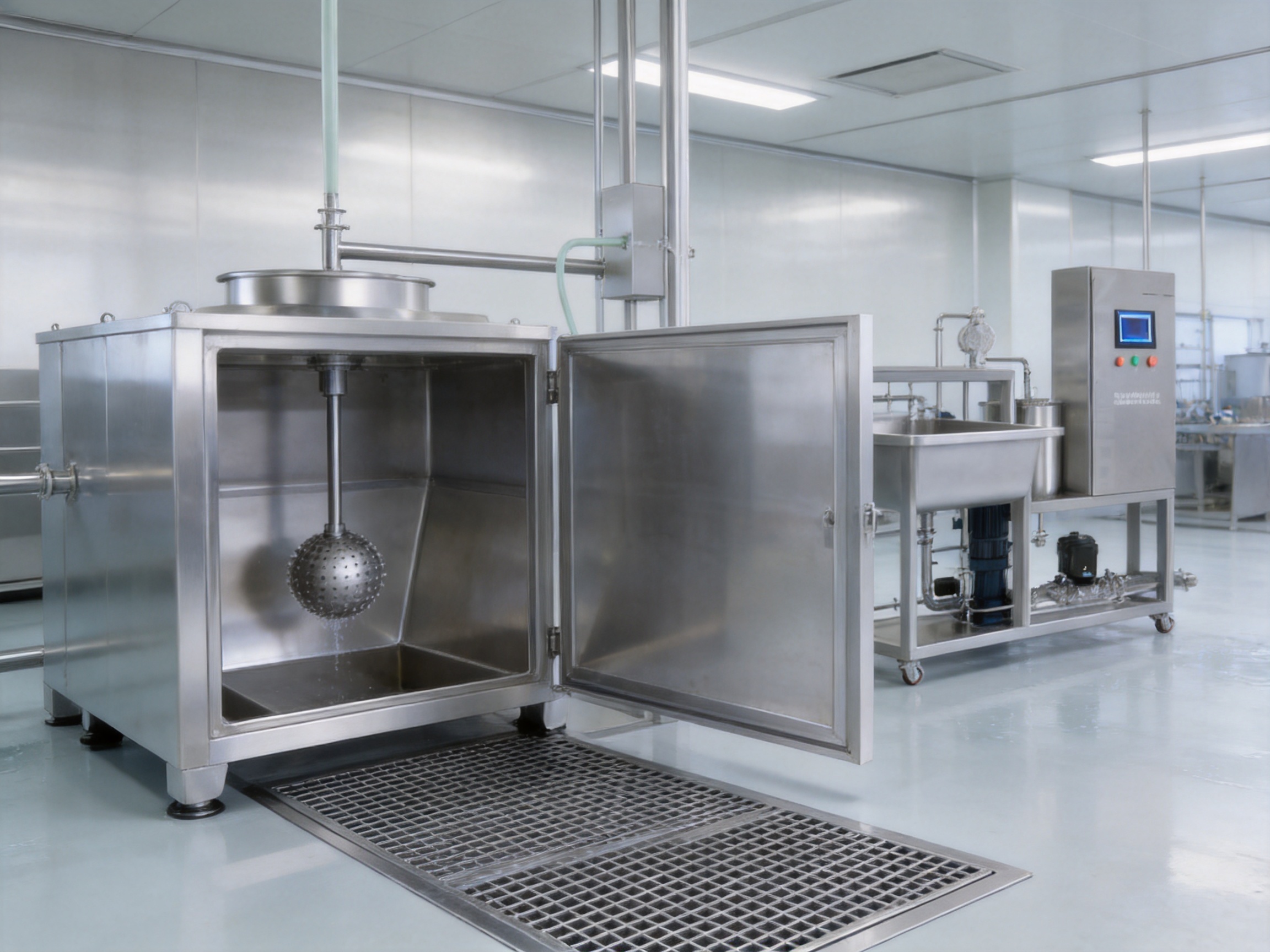
The NTQW series includes three listed configurations: NTQW-5, NTQW-10, and NTQW-15. The model numbers correspond to different nominal water-flow capacities of approximately 5, 10, and 15 cubic meters per hour. Water pressure for all three models is specified at 2 to 7 bar. The available flow and pressure range gives users options for matching the washing system to the required internal cleaning intensity and facility water utilities.
| Parameter | Unit | NTQW-5 | NTQW-10 | NTQW-15 |
| Lifting power | kW | 0.75 | 0.75 | 0.75 |
| Water pump power | kW | 2.2 | 3.0 | 5.5 |
| Water flow | m³/h | 5 | 10 | 15 |
| Water pressure | bar | 2–7 | 2–7 | 2–7 |
| Reference installation length L | mm | 2200 | 2440 | 2940 |
| Reference installation length L2 | mm | 1600 | 1600 | 1600 |
| Reference installation width W1 | mm | 1500 | 1800 | 2200 |
| Reference installation width W2 | mm | 700 | 700 | 700 |
| Reference installation height H1 | mm | 1500 | 1900 | 2500 |
| Reference installation height H2 | mm | 2800 | 3500 | 3500 |
| Reference installation height H3 | mm | 1700 | 1700 | 1700 |
The NTQW-5 model has a 2.2 kW water pump and a nominal flow of 5 m³/h. It may be appropriate for smaller bins, lower throughput requirements, or facilities where utility consumption and installation footprint are important considerations. Its reference installation dimensions are also the smallest of the three listed configurations.
The NTQW-10 model uses a 3.0 kW water pump and provides a nominal flow of 10 m³/h. It offers a middle configuration for facilities that need greater washing capacity while maintaining a moderate installation size. This type of model may suit general-purpose pharmaceutical production areas with several intermediate bin sizes.
The NTQW-15 model uses a 5.5 kW water pump and provides a nominal flow of 15 m³/h. It is the largest listed configuration and has the greatest reference width and length. It may be selected when higher water delivery is required or when the facility handles larger bins and more demanding cleaning workloads.
These values are reference parameters rather than a substitute for application engineering. A final model recommendation should consider the bin’s internal dimensions, inlet and outlet arrangement, residue type, cleaning agent, required water consumption, cycle time, drain capacity, and the available utilities at the installation site.
Pharmaceutical cleaning equipment must be incorporated into a hygienic production environment. The washing area should allow operators to load and unload bins without unnecessary contact with surrounding structures. Surfaces exposed to water should be suitable for the intended environment, and the layout should minimize locations where standing water or product residues can accumulate.
The grated floor drain is an important part of the washing area, but drainage design must be coordinated with the building and wastewater system. The drain should have sufficient capacity for the selected model and expected cleaning cycle. The facility should also consider the temperature, chemical composition, and solids content of the wastewater before connecting the machine to the site drainage network.
Materials of construction, weld quality, surface finish, seals, pipework, and spray components should be selected according to the product and cleaning environment. Stainless steel is commonly used in pharmaceutical equipment because of its durability, cleanability, and resistance to many process conditions. The precise material grade and finish should be confirmed in the technical specification for each project.
Areas that contact wash water should be designed to support cleaning and inspection. Smooth, accessible surfaces are generally easier to maintain than rough or highly irregular surfaces. The machine’s internal water path should also be considered during maintenance planning, especially when detergents, purified water, or other specialized cleaning fluids are used.
The NTQW machine can provide a controlled mechanical cleaning process, but validation remains the responsibility of the manufacturing organization and its quality system. Cleaning validation may involve risk assessment, selection of worst-case products, residue limits, sampling methods, analytical testing, visual inspection, and documented acceptance criteria.
Automatic spray coverage is one element of the overall cleaning strategy. Other factors include the type and concentration of cleaning agent, temperature, contact time, mechanical action, water quality, drainage, drying, and the design of the bin itself. The equipment should be tested with representative bins and residues so that the user can establish suitable operating recipes.
Recipe storage, data printing, alarms, and password management can support the documentation of cleaning operations. However, the final data-integrity approach should be defined by the user. Access privileges, record retention, review procedures, backup methods, and change control should be addressed in accordance with the company’s quality management practices.
Cleaning operations involve water, pressure, electrical systems, moving mechanisms, and potentially hazardous residues. Operators should receive training in machine operation, personal protective equipment, emergency procedures, chemical handling, and the safe use of the external water gun. The lifting mechanism should be operated only through the approved controls, and personnel should avoid contact with moving parts while the machine is running.
Ergonomic planning is also important. The operator should be able to position the bin, reach the controls, use the water gun, and inspect the equipment without excessive bending, stretching, or lifting. The installation should provide adequate working space around the machine and a suitable route for moving cleaned bins to the next stage.
Changzhou Zhiyang Machinery Equipment Co., Ltd. specializes in powder processing and oral solid dosage equipment. Founded in 2010 and located in Changzhou, China, the company develops standalone machines, modular systems, and complete production lines for pharmaceutical, biopharmaceutical, biotechnology, nutraceutical, veterinary, additives, and related industries.
The company’s strength is based on process-oriented equipment development rather than isolated machine supply. A bin washing machine must work as part of a broader manufacturing route. Its value depends on how well it connects with material transfer, granulation, drying, blending, compression, coating, storage, and cleaning procedures. By considering material characteristics, capacity requirements, and site conditions, the manufacturer can help customers select equipment that fits the entire process instead of treating the washing station as an independent purchase.
Different products create different cleaning challenges. Fine powders may spread across a large area, sticky materials may form deposits, and granules may collect near discharge points or structural joints. The company’s process-based approach enables technical discussions to focus on these actual operating conditions. Important questions include the type of residue, the bin geometry, the required cleaning frequency, the available water supply, the wastewater route, and the desired degree of automation.
This engineering approach is an advantage over suppliers that offer only standardized equipment without sufficient application analysis. A standard model can be a strong starting point, but correct configuration is necessary for reliable performance. The manufacturer can evaluate the relationship between pump flow, water pressure, spray coverage, lifting range, installation dimensions, and production requirements.
Because the company produces equipment for powder processing and oral solid dosage applications, it understands that cleaning is connected to material handling and cross-contamination control. Equipment used for mixing, granulation, drying, coating, transfer, and conveying must be designed with cleaning and changeover in mind. This broader product knowledge can support a more coordinated solution for facilities that need several types of process equipment.
The product scope includes laboratory equipment, mixing equipment, granulation equipment, drying equipment, coating equipment, auxiliary processing equipment, and transfer and conveying systems. This range allows the manufacturer to discuss the bin washing machine in relation to upstream and downstream equipment, material flow, and production capacity.
Some customers need a single washing machine to improve an existing process. Others may be planning a new production line or expanding an established plant. The ability to provide standalone machines, modular systems, and complete production lines gives the company flexibility in project scale.
For a standalone project, the focus may be on equipment dimensions, utilities, operation, training, and installation. For a modular project, the bin washing machine may be integrated with transfer systems, storage arrangements, and production scheduling. For a complete line, cleaning equipment can be considered alongside the full process route, material containment strategy, and plant layout.
The company has expanded its product portfolio, strengthened research and development capabilities, developed patented technologies, and obtained quality system certification. These activities support the continuing improvement of equipment design, manufacturing consistency, and application performance.
Advanced manufacturing is not limited to the use of modern machinery in a workshop. It also includes controlled engineering documentation, component selection, fabrication accuracy, quality inspection, assembly discipline, testing, and after-sales support. For a washing machine, these elements influence the reliability of the pump, lifting assembly, spray device, control panel, drainage arrangement, and safety functions.
A dependable equipment supplier should be able to translate process requirements into drawings, technical specifications, operating instructions, inspection procedures, and commissioning support. This documentation helps customers review the equipment before manufacture and prepare their own installation and validation activities.
Quality system certification, manufacturing experience, and overseas service capabilities can be important when purchasing equipment for regulated production. Customers may require factory testing, technical files, spare-parts support, installation guidance, operator training, and troubleshooting assistance. A manufacturer with international project experience is better positioned to coordinate these activities across different plant locations and customer organizations.
The company has delivered equipment and engineering solutions to customers in multiple countries and regions. This international experience can support communication about different utility standards, documentation expectations, production practices, and project schedules. Final requirements should always be agreed in the purchase specification so that responsibilities are clear for both the manufacturer and the customer.
Fully automatic bin washing systems can provide extensive automation, enclosed operation, automatic loading, automated detergent management, automatic rinsing, drying, and advanced data integration. They may be appropriate for high-throughput facilities with tightly defined bin geometries and significant automation budgets. However, they can also involve higher capital cost, more complex maintenance, greater installation requirements, and less flexibility when bin designs change.
The NTQW semi-automatic configuration offers a different value proposition. It automates internal washing, which is the central repetitive cleaning action, while retaining manual control of the external surface. This arrangement may reduce system complexity and make the machine easier to adapt to different bin structures. It is especially suitable for facilities that want to improve cleaning consistency without investing immediately in a fully automated washing and handling line.
The semi-automatic approach can also make sense where production volumes are moderate, where operators already handle bins manually, or where external surface conditions vary from one bin to another. By allowing an operator to direct the water gun, the machine can address unusual external features without requiring additional robotic mechanisms or custom tooling.
Compared with basic manual washing, the NTQW machine improves internal process control. Compared with a fully automatic system, it may offer a simpler operating model and lower integration burden. The most suitable choice depends on throughput, labor strategy, cleaning validation requirements, available space, budget, and the customer’s long-term automation plan.
Before washing, the operator should verify that the bin is approved for cleaning, remove loose material where required by the site procedure, and confirm that the machine is ready for operation. The operator should inspect the spray ball, water gun, drain area, control interface, and visible machine surfaces. The selected recipe should correspond to the bin type and cleaning requirement.
The bin should be moved into the designated washing position according to the equipment layout. It must be stable and correctly aligned so that the internal spray device can operate safely. Any covers, fittings, or detachable components should be handled according to the approved cleaning procedure.
The lifting mechanism is used to raise or lower the spray ball. The correct position depends on the bin’s size and internal configuration. The operator should confirm that the spray ball can move without obstruction and that the selected height is appropriate for the intended spray coverage.
After the operator confirms the settings, the internal cleaning cycle is started through the touchscreen. The PLC controls the programmed sequence, while the rotating spray ball distributes water across the inner surface. The operator should monitor the cycle and respond to any alarm or abnormal condition according to the operating procedure.
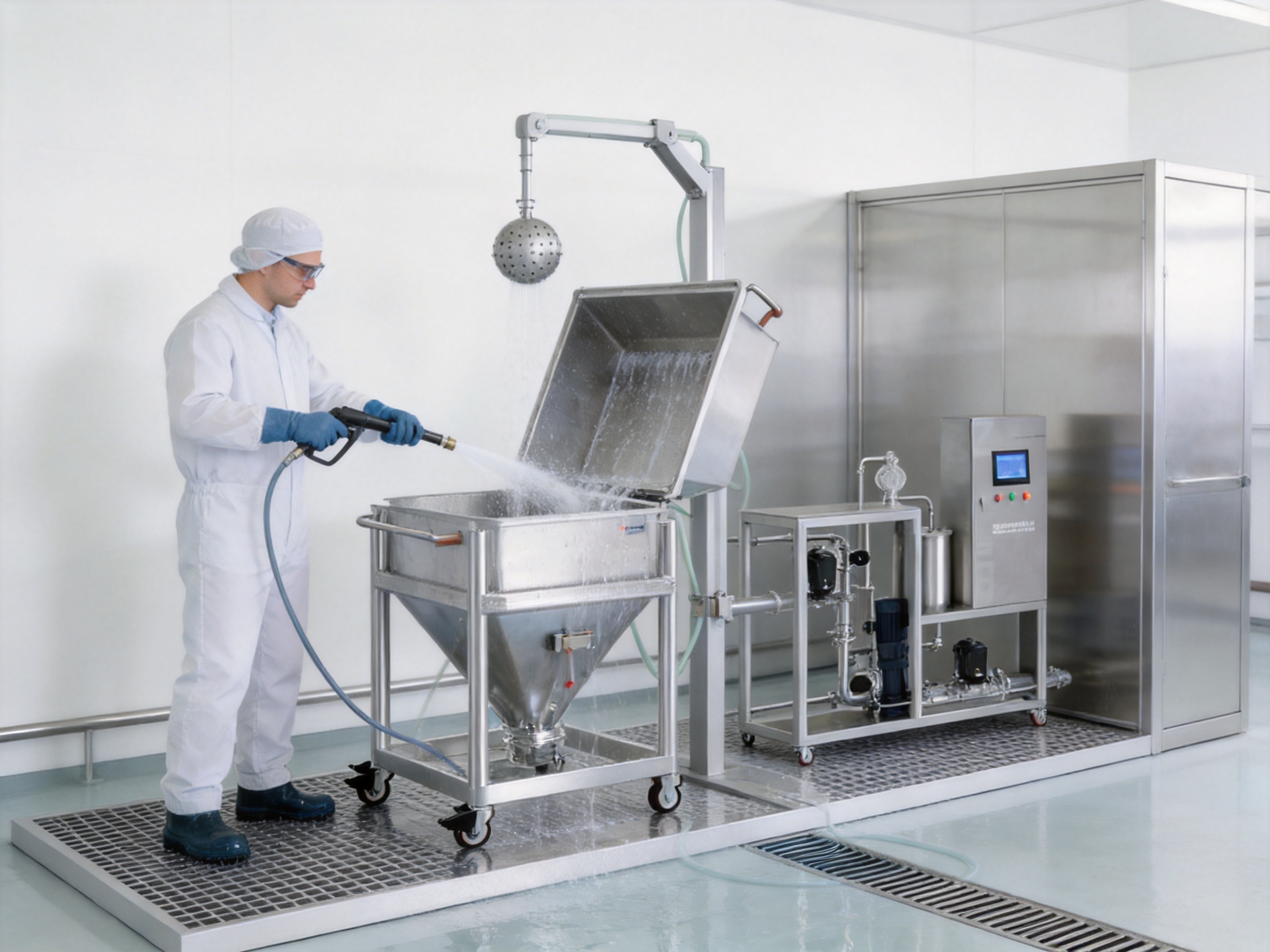
The operator uses the water gun to clean the external surface. Attention should be given to wheels, frames, handles, clamps, weld areas, outlet assemblies, and any visible product residue. Manual operation permits the operator to vary the spray direction and duration according to the external condition of the bin.
Wastewater flows through the grated floor drain. After the washing cycle, the bin should be inspected according to the site’s visual and analytical verification procedures. If residues remain, an additional cleaning step may be required. The machine and surrounding area should also be checked for cleanliness, standing water, or unusual conditions.
Cleaning records should be completed using the facility’s approved documentation system. The recipe, operator, date, bin identification, alarm status, and inspection result may be recorded where required. The data storage and printing functions of the control system can support this process, subject to the customer’s configuration and quality procedures.
Installation dimensions differ by model. The listed reference length L is 2200 mm for NTQW-5, 2440 mm for NTQW-10, and 2940 mm for NTQW-15. The reference width W1 is 1500 mm, 1800 mm, and 2200 mm respectively. Reference height H1 is 1500 mm, 1900 mm, and 2500 mm, while H2 is 2800 mm for NTQW-5 and 3500 mm for both NTQW-10 and NTQW-15.
These dimensions should be used during preliminary layout planning, but the final installation drawing should be confirmed before construction or equipment delivery. Space is required not only for the machine body but also for bin access, operator movement, maintenance, electrical connections, water piping, drainage, and the movement of cleaned equipment.
The facility should provide a water supply that can deliver the required flow and pressure. The listed operating pressure range is 2 to 7 bar, but actual performance depends on the selected model and site conditions. Pressure losses in piping, filters, valves, and other components should be considered during utility design.
Electrical requirements should be confirmed for the lifting motor, water pump, PLC, touchscreen, alarms, and other controls. The 0.75 kW lifting power is common to the listed models, while water pump power increases from 2.2 kW to 5.5 kW across the series. The customer and manufacturer should agree on voltage, frequency, protection, grounding, control-panel requirements, and applicable electrical standards.
Drainage is equally important. The floor drain should be sized for the maximum expected discharge and positioned to avoid water accumulation. If detergents or contaminated residues are involved, the wastewater route may require collection, treatment, or segregation. These factors should be reviewed by the facility’s engineering, environmental, and safety teams.
Regular maintenance helps preserve cleaning performance and reduce unexpected downtime. Operators should inspect the spray ball for blockage, wear, or poor rotation. Water filters, pump components, seals, hoses, valves, and the external water gun should be checked according to a preventive maintenance schedule.
The lifting mechanism should be inspected for smooth movement, abnormal noise, looseness, or visible damage. The lifting travel should remain within the approved range, and the spray ball should be positioned securely during operation. Any unusual movement should be investigated before continued use.
The water pump should be protected from conditions that could cause cavitation, blockage, or excessive wear. Adequate water supply, clean filters, and correct valve operation are important. If the machine uses cleaning chemicals, compatibility with pump materials, seals, hoses, and spray components should be confirmed in advance.
The touchscreen and PLC system should be maintained as part of the equipment’s control system. Passwords should be managed responsibly, recipes should be protected from unauthorized changes, and alarm records should be reviewed when faults occur. Backup and change-control procedures should be established by the user’s engineering and quality departments.
Preventive maintenance records can help identify recurring problems. For example, a gradual reduction in spray performance may indicate a blocked nozzle or filter, while longer lifting times may point to mechanical wear or a drive issue. Early detection can reduce the risk of incomplete cleaning cycles and unplanned production interruptions.
The primary application of the NTQW machine is the cleaning of intermediate transfer bins used in solid dosage production. These bins may carry powders, granules, blends, and other materials between process stages. The automatic internal spray system is valuable where product changeovers and repeatable cleaning are important.
In the pharmaceutical industry, the machine can support cleaning operations associated with granulation, drying, blending, tablet production, capsule production, and material transfer. Its recipe management and PLC control functions may be integrated into the site’s cleaning and production procedures.
In the chemical industry, transfer bins may contain powders, additives, pigments, catalysts, or other materials. The correct cleaning method depends on the chemical properties of the residues and the compatibility of the machine’s materials and seals. A technical review is recommended before processing corrosive, hazardous, reactive, or solvent-containing materials.
In the food industry, bins may be used for powders, ingredients, premixes, or dry blends. The washing process should be evaluated with respect to food-contact requirements, hygiene procedures, water quality, detergent selection, drying, and the prevention of microbial growth.
The machine may also be relevant to nutraceutical, veterinary, and specialty additive production. In each case, the cleaning cycle should be developed around the actual material, bin design, production schedule, and quality requirements rather than relying solely on a generic time setting.
Bin washing equipment frequently requires project-specific engineering. Important variables include the maximum and minimum bin dimensions, bin weight, internal volume, outlet configuration, support frame, wheel arrangement, cleaning agent, water temperature, utility conditions, and required throughput.
The manufacturer can review these factors when preparing a technical proposal. The lifting range may need to be evaluated against the actual bin height. The pump model and water flow may need to be matched to the required spray coverage. The installation layout may need to account for doors, walls, columns, drainage channels, and the route used to move bins through the facility.
Control-system customization may include recipe naming, alarm configuration, user-level permissions, data-printing formats, language selection, and communication with other plant systems where applicable. Any requested functions should be defined clearly in the technical agreement so that the final scope is understood before manufacturing begins.
For customers purchasing several types of process equipment, the company’s broader product range can support coordinated engineering. Mixing, granulation, drying, coating, transfer, conveying, and auxiliary equipment may be considered together. This can help reduce interface problems and create a more logical material flow across the production line.
Equipment performance depends on more than the machine itself. Technical communication before purchase, accurate manufacturing, proper installation, operator training, and timely service all contribute to the final result. A supplier that understands the customer’s process can provide more useful recommendations than a supplier focused only on standard specifications.
Changzhou Zhiyang Machinery Equipment Co., Ltd. emphasizes product quality, customer reputation, research and development, innovation, and responsive service. Its overseas service capabilities support customers outside China and help address the practical requirements of international projects. The exact service package should be agreed according to the project, location, and customer needs.
Pre-delivery inspection may include verification of dimensions, control functions, lifting movement, pump operation, spray performance, alarms, and basic safety features. Depending on the project, customers may request factory acceptance testing, documentation review, installation supervision, site acceptance testing, or commissioning assistance.
After installation, training should cover normal operation, recipe selection, external washing, inspection, emergency response, sanitation, troubleshooting, and preventive maintenance. Well-trained operators are more likely to use the equipment consistently and identify problems before they affect production.
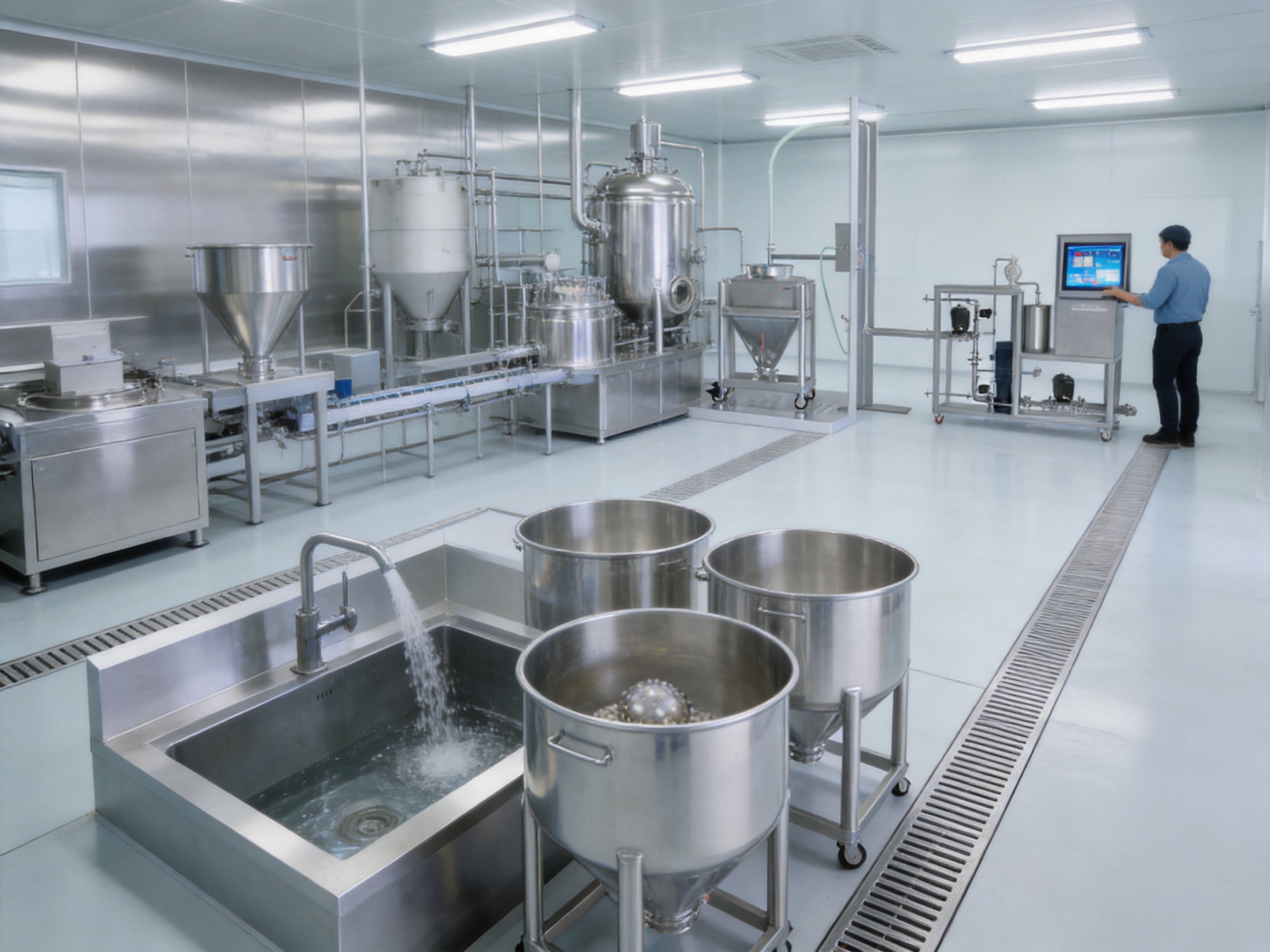
It is a dedicated washing machine for intermediate transfer bins used in solid dosage and other powder-handling processes. It automatically cleans the internal surface with a rotating spray ball and allows the operator to clean the external surface manually with a water gun.
No. It is semi-automatic. The internal washing process is controlled through the spray ball, PLC, touchscreen, and selected recipe. The external surface is cleaned manually by the operator with a water gun. This configuration combines automatic internal cleaning with flexible external cleaning.
Yes. The spray ball can be raised or lowered through the lifting mechanism to accommodate bins with different specifications. The acceptable size range depends on the actual machine configuration and should be confirmed against the customer’s bin drawings before ordering.
The listed models are NTQW-5, NTQW-10, and NTQW-15. Their nominal water-flow capacities are 5, 10, and 15 m³/h respectively. The water pump powers are 2.2, 3.0, and 5.5 kW, while the lifting power is 0.75 kW for all three listed models.
The specified water pressure range is 2 to 7 bar for the three listed models. Actual utility requirements should be checked during project engineering, including piping losses, filtration, water temperature, cleaning chemistry, and site supply stability.
Cleaning wastewater is discharged through a grated floor drain. The site must provide suitable drainage capacity and confirm whether wastewater treatment, collection, or segregation is required for the materials and cleaning agents used.
Yes. The control system supports recipe-based process parameter management. It also includes data storage, fault alarms, and data-printing functions. The customer should define recipe control, data retention, review, and change-management procedures according to its quality system.
The control system uses multi-level password management to protect operational data and limit access to selected functions. The exact user levels and permissions can be configured according to the customer’s operating and quality requirements.
It is designed for cleaning intermediate transfer bins used in solid dosage production processes and can be applied in pharmaceutical manufacturing. However, every customer must assess the machine against its own cleaning validation, material compatibility, hygiene, documentation, and regulatory requirements.
The machine provides more repeatable internal spray coverage, reduces dependence on operator technique for internal cleaning, supports multiple bin specifications through spray-ball adjustment, and provides PLC-controlled operation with recipes and alarms. It also creates a dedicated washing area with defined wastewater drainage.
A fully automatic system may be suitable for high-volume facilities with standardized bins and extensive automation requirements. The semi-automatic NTQW system may be more practical when the facility needs internal cleaning automation but still wants operator flexibility for different external structures, moderate production volumes, simpler maintenance, or controlled investment.
Useful information includes bin drawings, internal and external dimensions, weight, material of construction, residue type, cleaning agent, required cycle time, cleaning frequency, water supply, drainage capacity, available floor space, electrical standards, and the desired level of data management.
Yes. The company provides equipment and systems for laboratory processing, mixing, granulation, drying, coating, auxiliary processing, transfer, and conveying. It can offer standalone machines, modular systems, and complete production-line solutions according to project requirements.
Operators should follow the site-approved inspection procedure. Typical checks may include visual cleanliness, difficult-to-reach areas, outlet assemblies, frames, wheels, seals, and any locations identified through cleaning validation. The washing area and drain should also be checked for standing water or residue.
Project-specific engineering may be available for bin dimensions, lifting range, water-flow selection, control functions, recipes, installation layout, documentation, and service requirements. Customization should be confirmed during technical review and included in the final equipment specification.
The NTQW Semi-Automatic Bin Washing Machine provides a practical solution for cleaning intermediate transfer bins in pharmaceutical, chemical, food, nutraceutical, veterinary, and related production environments. Its core design combines automatic internal washing through a rotating spray ball with manual external washing through a water gun. This arrangement improves internal cleaning consistency while preserving the flexibility needed for different external bin structures.
The adjustable lifting mechanism allows the spray ball to be positioned for different bin specifications. PLC and touchscreen control support recipe-based operation, data storage, fault alarms, data printing, and multi-level password management. The three available configurations provide different water-flow capacities, pump powers, and installation dimensions for varying production needs.
Compared with completely manual washing, the machine offers greater process structure and repeatability. Compared with fully automatic systems, its semi-automatic design can reduce complexity and maintain operator adaptability. The best results are achieved when the machine is selected through a complete engineering review that includes bin geometry, residue characteristics, water utilities, drainage, site layout, cleaning validation, and operator procedures.
Supported by Changzhou Zhiyang Machinery Equipment Co., Ltd.’s experience in powder processing, oral solid dosage equipment, modular systems, and complete production lines, the NTQW series can serve as part of a broader process solution. The company’s process-oriented engineering, research and development capabilities, manufacturing experience, quality focus, and overseas service support provide a foundation for customers seeking reliable and scalable cleaning equipment.
1. Changzhou Zhiyang Machinery Equipment Co., Ltd. Product information for the NTQW Semi-Automatic Bin Washing Machine.
2. Changzhou Zhiyang Machinery Equipment Co., Ltd. Technical information for powder processing and oral solid dosage equipment.
3. General principles of pharmaceutical equipment cleaning, cleaning validation, and contamination-control practices.
4. General engineering principles for hygienic equipment design, industrial drainage, water-pressure selection, and preventive maintenance.
5. General operating principles for PLC-controlled process equipment, recipe management, alarm handling, and controlled user access.
Want to stay up to date?
Contact us via the email address below.
Don't worry about spam. We hate it too!
Mobile Client

Video Account
Phone:+86-15161130178
Tel:+86-519-88674267
Email:czzy188@163.com
Phone:+86-15161132798
Email:zy@zy-drying.com

WeChat ID

Copyright 2026 Changzhou Zhiyang Machinery Equipment Co., Ltd. All Rights Reserved  Oral Solid Dosage Equipment Manufacturer