 English
 Español
 русский
 中文简体

NTD Bin Lifting and Feeding Machine
The NTD Bin Lifting and Feeding Machine is used for conveying and feeding s.....

Content
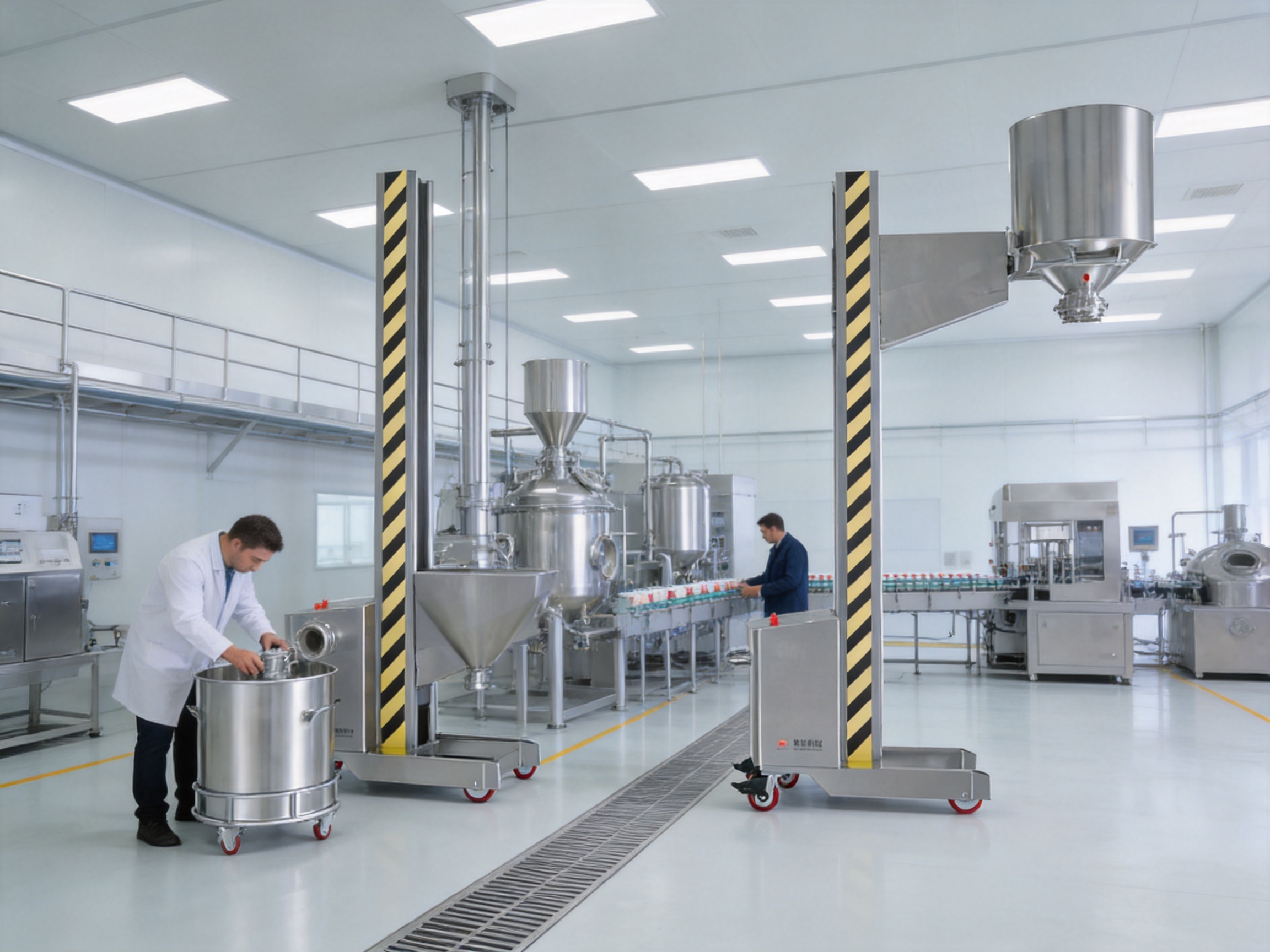
Modern pharmaceutical manufacturing depends on the controlled movement of powders, granules, pellets, and other solid materials between successive processing stages. Although mixing, granulation, drying, coating, tableting, and capsule filling receive significant attention, material transfer is equally important to overall product quality. An inefficient transfer method can create dust, cause material loss, increase manual handling, introduce contamination risks, and reduce the consistency of the finished dosage form.
The NTY Mobile Lifting Feeding Machine is designed to address these challenges through a mobile, height-adjustable, and enclosed transfer system. It is intended for pharmaceutical production lines in which solid materials must be raised, aligned, and discharged into downstream equipment. The machine can be integrated with mixers, granulators, tablet presses, coating machines, capsule filling machines, and other process units. It is also suitable for chemical and food-processing applications that require hygienic operation and effective dust control.
Unlike simple fixed conveyors or manually operated lifting devices, the NTY system combines mobility, vertical lifting, container tilting, and enclosed discharge in one coordinated machine. This allows one unit to serve several processing positions while helping manufacturers simplify material handling and improve process continuity.
Solid materials used in oral solid dosage production often have different flow properties, bulk densities, moisture levels, particle sizes, and sensitivities to mechanical stress. A transfer system must therefore do more than move material from one location to another. It must preserve the physical characteristics of the product, prevent unnecessary exposure, and connect accurately with equipment located at different heights.
In many conventional production arrangements, operators manually move containers, bags, bins, or intermediate bulk containers between processing machines. This approach can be labor-intensive and may require repeated lifting, pushing, opening, closing, and repositioning. Each manual intervention creates an opportunity for spillage, dust release, product mix-up, or contamination. It may also make batch-to-batch cleaning and documentation more difficult.
Fixed conveying equipment can reduce some manual work, but it is not always flexible enough for a facility with several processing routes. A fixed conveyor may be dedicated to one line or one height. If the production layout changes, the conveyor may require costly modification. Some conveying methods can also generate dust or apply excessive mechanical force to fragile granules.
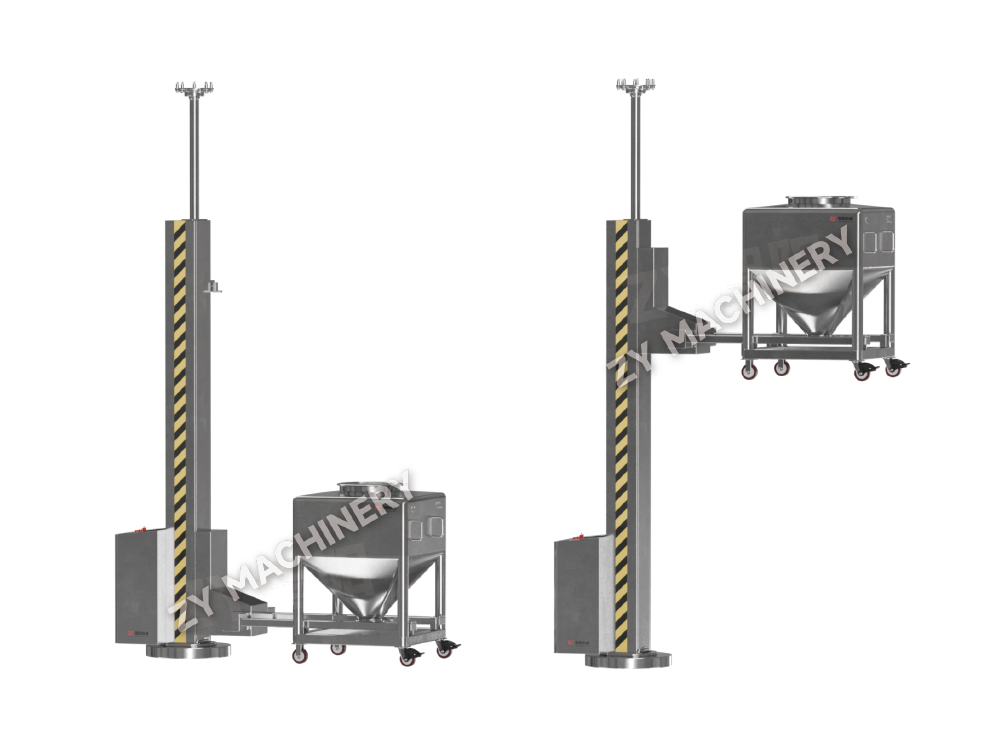
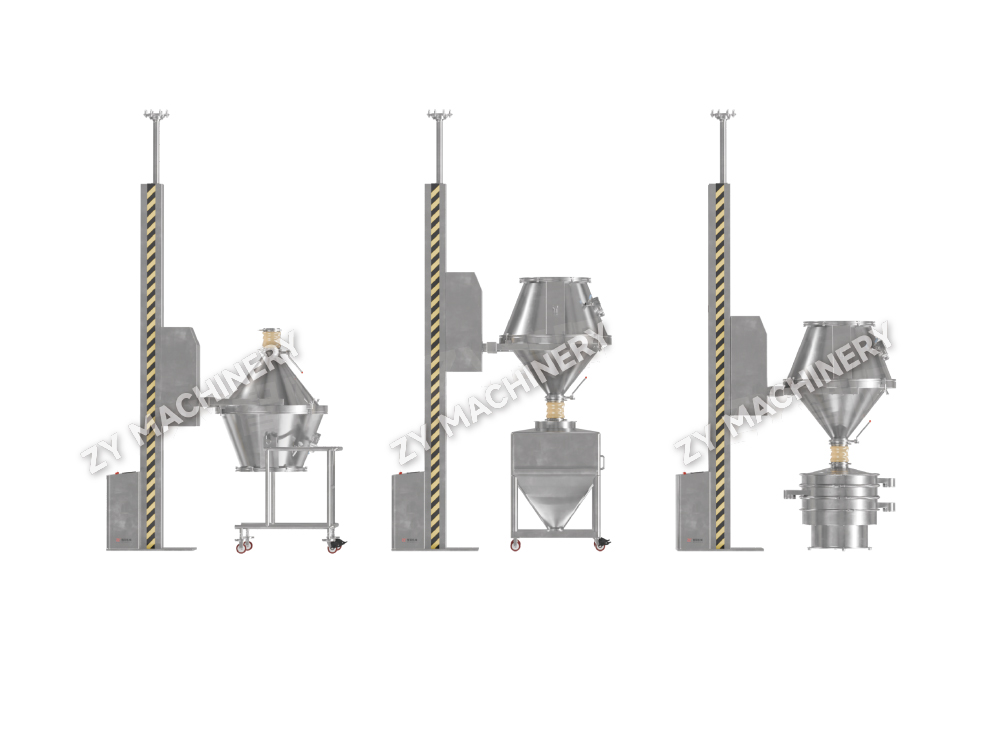
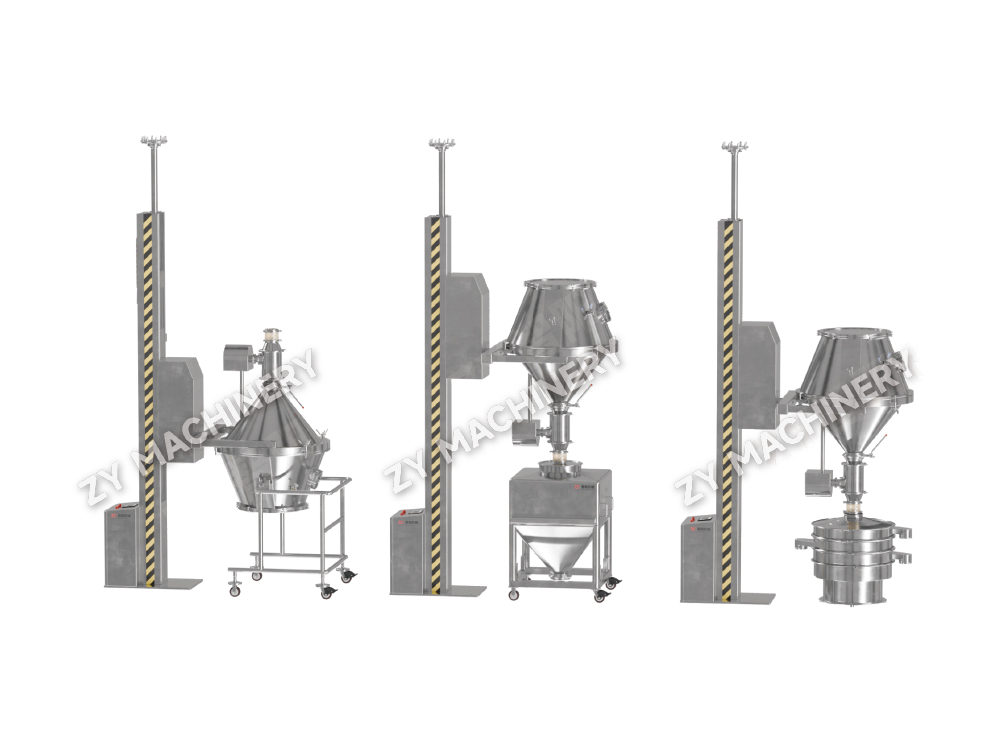
The NTY Mobile Lifting Feeding Machine provides a different approach. It is designed around the use of a conical material container that can be raised to a required process height, moved into alignment with a receiving machine, and rotated into a discharge position. The final transfer occurs through a butterfly valve, enabling a more enclosed route between the container and the downstream equipment.
This configuration is particularly valuable where several production stages use different inlet elevations. Instead of installing a separate lifting structure for every machine, a mobile unit can be positioned where it is needed. The result is a more adaptable material-handling arrangement that can support both routine production and changing manufacturing requirements.
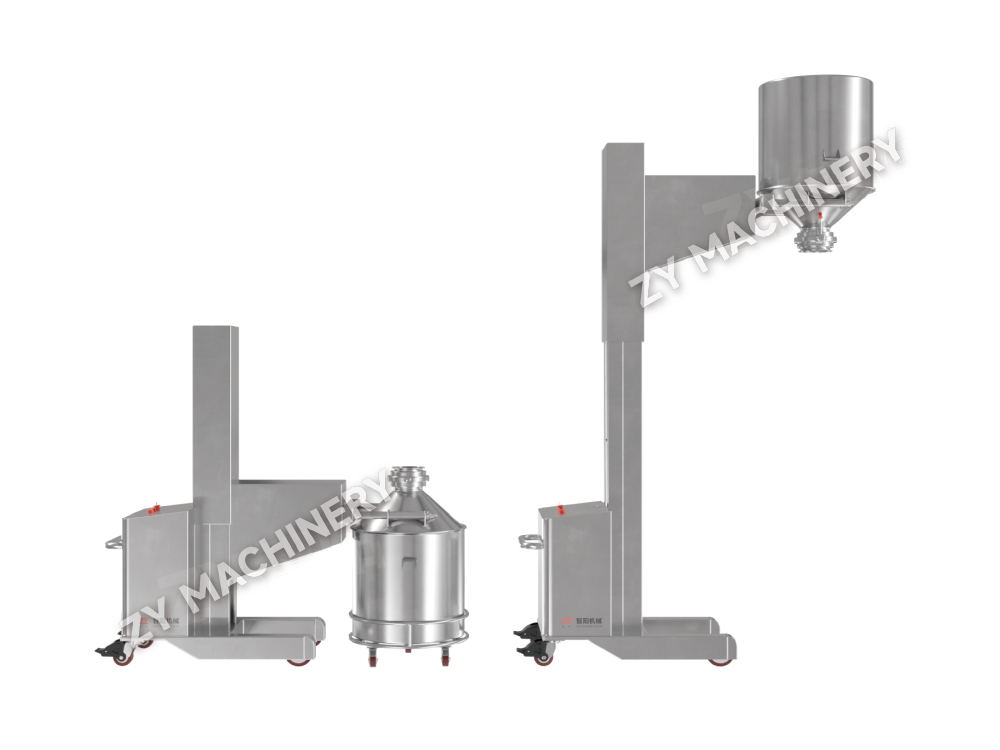
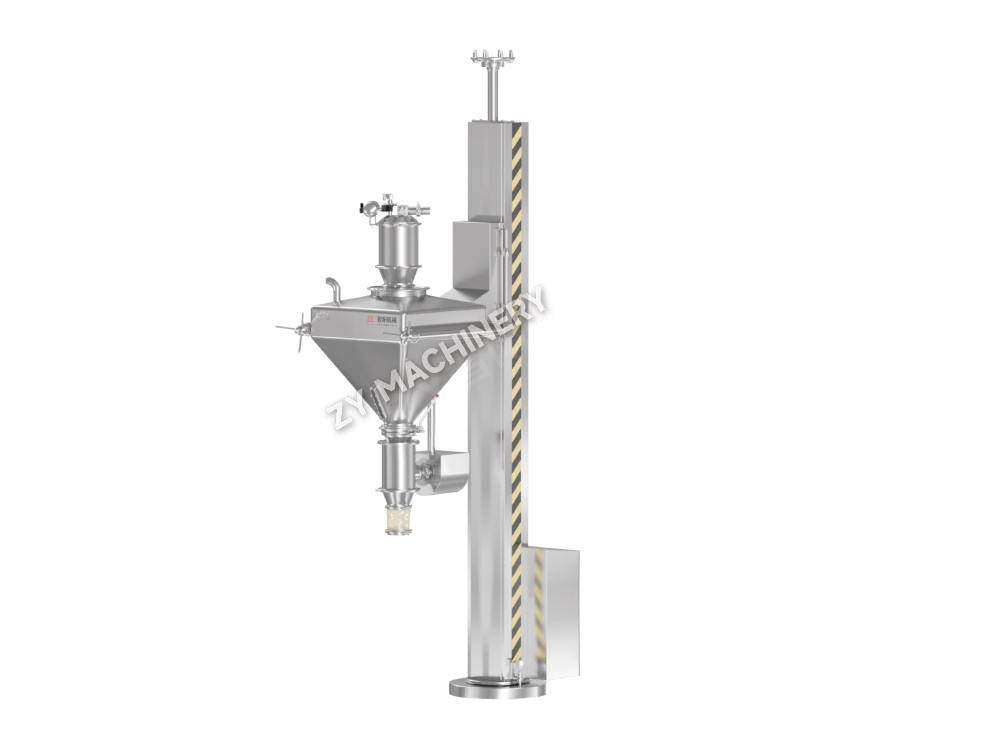
The NTY Mobile Lifting Feeding Machine is a solid-material transfer and feeding system for pharmaceutical, chemical, and food-processing applications. Its main assemblies include a mobile base, a telescopic lifting system, a vertical lifting mechanism, and a tilting assembly. Together, these components allow a conical bin or material container to be raised, positioned, and tilted for controlled discharge.
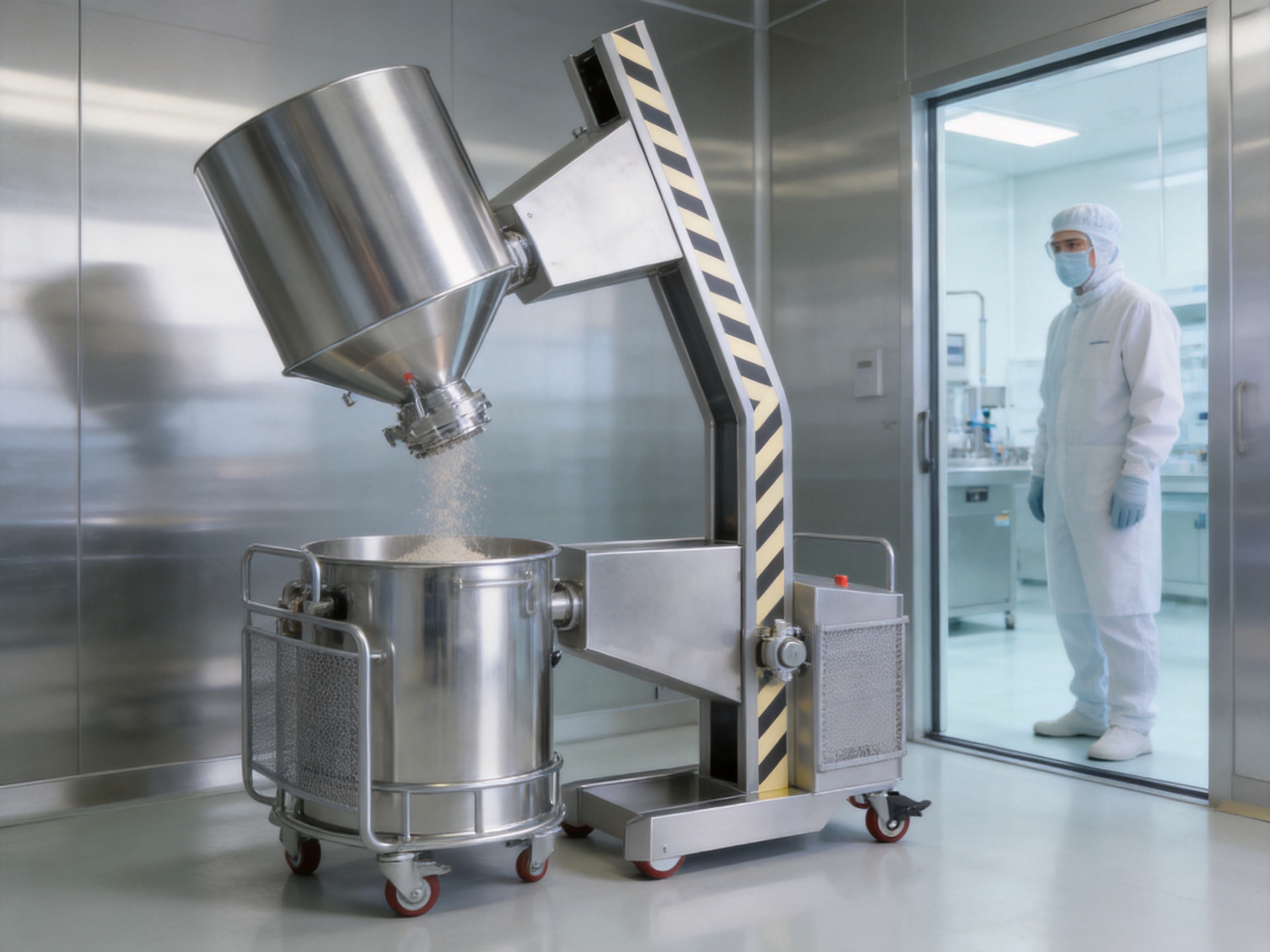
During operation, the container is connected to the machine and lifted to the required height. The mobile base enables the operator to move the unit toward the inlet of the next process machine. Once aligned, the tilting assembly rotates the container through 180 degrees. The discharge butterfly valve can then be opened to release the material into the receiving equipment.
The operating concept is straightforward, but its value lies in the integration of several functions. Lifting, positioning, alignment, tilting, and feeding are managed by one compact system rather than by separate handling devices. This can help reduce unnecessary transfers and provide a cleaner, more organized production route.
The equipment is suitable for transferring solid pharmaceutical materials after mixing, granulation, or drying. Depending on the production arrangement, it may also be used to feed material into tablet presses, coating systems, capsule filling machines, or intermediate storage and processing units.
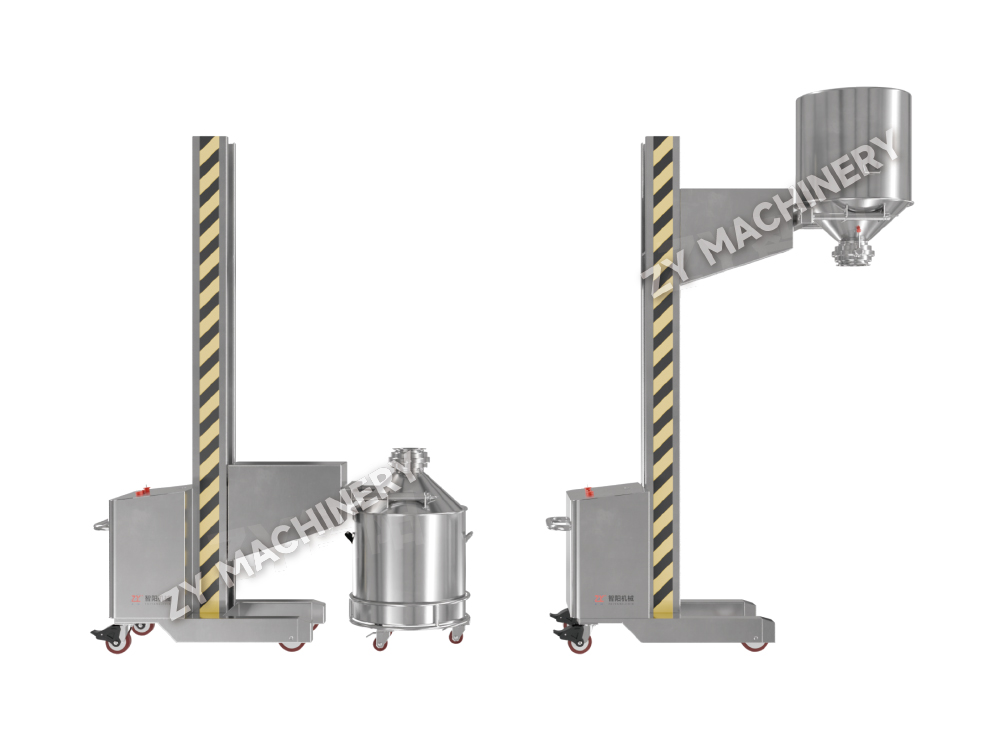
NTY Mobile Lifting Feeding Machine
A major advantage of the NTY machine is its ability to connect different process stages without being permanently dedicated to one receiving machine. Pharmaceutical facilities frequently contain equipment with different inlet heights and layouts. A transfer machine that can be moved and adjusted provides greater flexibility than a fixed-height device.
The mobile base allows the machine to be aligned with the downstream inlet. This is important when equipment positions vary between production rooms or when a single transfer unit is used for multiple manufacturing lines. Mobility can also support maintenance activities, cleaning access, and the reconfiguration of production areas.
The telescopic and vertical lifting arrangements allow the material container to reach different process elevations. The machine is not limited to a single discharge height. This reduces the need for operators to manually raise containers or use temporary platforms. It also allows the transfer point to be positioned closer to the receiving machine, reducing the distance over which material is exposed to the surrounding environment.
The tilting assembly provides an additional level of process control. After the container has been moved into position, it is rotated 180 degrees so that the discharge outlet can face the inlet of the downstream machine. This design can support gravity-assisted transfer while avoiding the need for separate pneumatic or mechanical conveying equipment in applications where the material can flow appropriately.
For manufacturers, flexibility has practical economic value. A mobile machine can be used across different products, batches, and production stages. It may reduce the number of dedicated transfer devices required in a plant, especially where several process units are located within a compatible working area.
Dust control is one of the most important considerations in powder and granule handling. Airborne particles can affect operator comfort, create housekeeping problems, reduce material recovery, and increase the risk of cross-contamination. In some environments, dust may also present an occupational or combustible-dust hazard if it is not properly controlled according to the characteristics of the material.
The NTY machine is designed for enclosed material transfer. The conical container is connected to the receiving equipment, and discharge takes place through the butterfly valve rather than through an open manual dumping operation. This arrangement helps limit the exposure of the product to the surrounding environment during the transfer stage.
Enclosed transfer does not eliminate the need for appropriate facility ventilation, containment procedures, cleaning protocols, or risk assessment. However, it can reduce the number of open handling steps and provide a more controlled route between process machines. This is especially useful for fine powders, potent materials, moisture-sensitive ingredients, and products that must be protected from environmental contamination.
By reducing uncontrolled product movement, the machine may also help improve material yield. Less material is likely to be lost through spillage, container overturning, or repeated manual scooping. The extent of yield improvement will depend on the material, batch size, container design, operating method, and the overall production system.
The enclosed approach is also beneficial from a housekeeping perspective. When material remains within the container and connected discharge route, fewer particles are released onto floors, equipment surfaces, and surrounding structures. This can support more efficient cleaning and help maintain an orderly production environment.
Pharmaceutical equipment must be designed with cleaning and inspection in mind. Crevices, dead corners, exposed fasteners, rough surfaces, and inaccessible spaces can retain powder residues and complicate cleaning validation. The NTY machine addresses these concerns through a robust and compact structure with smooth surfaces, no dead corners, and no exposed fasteners in the relevant equipment areas.
Smooth surfaces help operators visually inspect the machine and remove residual product. A structure without unnecessary recesses can reduce the locations where powder accumulates. The absence of exposed fasteners also supports a cleaner exterior and reduces the possibility of loose components or residue retention around connection points.
Hygienic design is not limited to the external frame. Product-contact components, container connections, valves, gaskets, and discharge interfaces must all be considered within the cleaning strategy. The removable butterfly valve supports access for maintenance and cleaning. This feature can be particularly useful when the same machine is used for different formulations or when product changeover time is important.
The machine’s design is intended to support pharmaceutical GMP requirements. Actual GMP compliance depends on the complete equipment specification, the selected materials, surface finishes, documentation, validation activities, operating procedures, and the customer’s facility standards. Nevertheless, the hygienic construction principles incorporated into the NTY system provide a suitable foundation for controlled pharmaceutical production.
Manufacturers should define product-contact material requirements, cleaning methods, gasket materials, surface roughness, electrical classifications, and containment expectations before final equipment selection. These details can be adapted according to the formulation and regulatory requirements of the intended application.
Material transfer equipment must protect both the product and the operator. The NTY butterfly valve includes a safety design intended to help prevent misoperation. This is important because premature valve opening can result in accidental discharge, product loss, or unsafe exposure to powder.
A controlled valve sequence can help ensure that the container is correctly positioned before discharge begins. Operators should still follow the site’s standard operating procedures and verify that the receiving machine is ready to accept material. Interlocks, guards, emergency-stop devices, and other safety provisions should be specified according to the final configuration and applicable regulations.
The mobile base also requires safe handling procedures. Before lifting or tilting, the unit should be positioned on a suitable floor surface, secured according to the operating instructions, and checked for obstructions. Personnel should remain clear of moving assemblies and should not attempt to adjust the container manually while the lifting or tilting mechanisms are active.
Because the equipment may be used with different materials and container loads, the permitted working load, lifting range, center of gravity, and operating speed must be considered during installation and commissioning. Proper operator training is essential for safe and reliable use.
The removable valve design contributes to maintenance safety as well. A valve that can be removed in a controlled manner is easier to inspect, clean, and replace than a permanently inaccessible assembly. Maintenance procedures should include isolation of power, confirmation that the container is empty, inspection of moving components, and verification of valve operation before production resumes.
The process begins when the conical bin or material container is connected to the lifting and feeding machine. The connection should be checked to confirm that the container is properly seated and secured. Correct connection helps maintain mechanical stability and supports the enclosed transfer route.
The vertical lifting mechanism raises the container to the required elevation. The telescopic lifting system provides flexibility in positioning the container at different process heights. This allows the discharge outlet to match the inlet of a downstream mixer, granulator, tablet press, coating machine, capsule filling machine, or another process unit.
Once the appropriate height has been reached, the mobile base is used to align the container with the receiving inlet. Accurate alignment helps reduce the risk of spillage and makes it easier to establish a sealed or controlled connection between the container and downstream equipment.
The tilting assembly rotates the container through 180 degrees. This places the discharge outlet in the correct orientation for gravity-assisted material flow. The rotation sequence should be performed only after the container is secured and the receiving equipment is ready.
Opening the butterfly valve allows the material to move from the container into the next process stage. Because the discharge is carried out through a dedicated valve and connected route, the transfer can be more contained than open manual dumping. The receiving machine may be operated at the same time if the process requires controlled feeding.
After discharge, the valve can be closed, the container returned to its original orientation, and the mobile machine moved away from the downstream equipment. The container and valve can then be inspected or cleaned according to the batch changeover procedure.
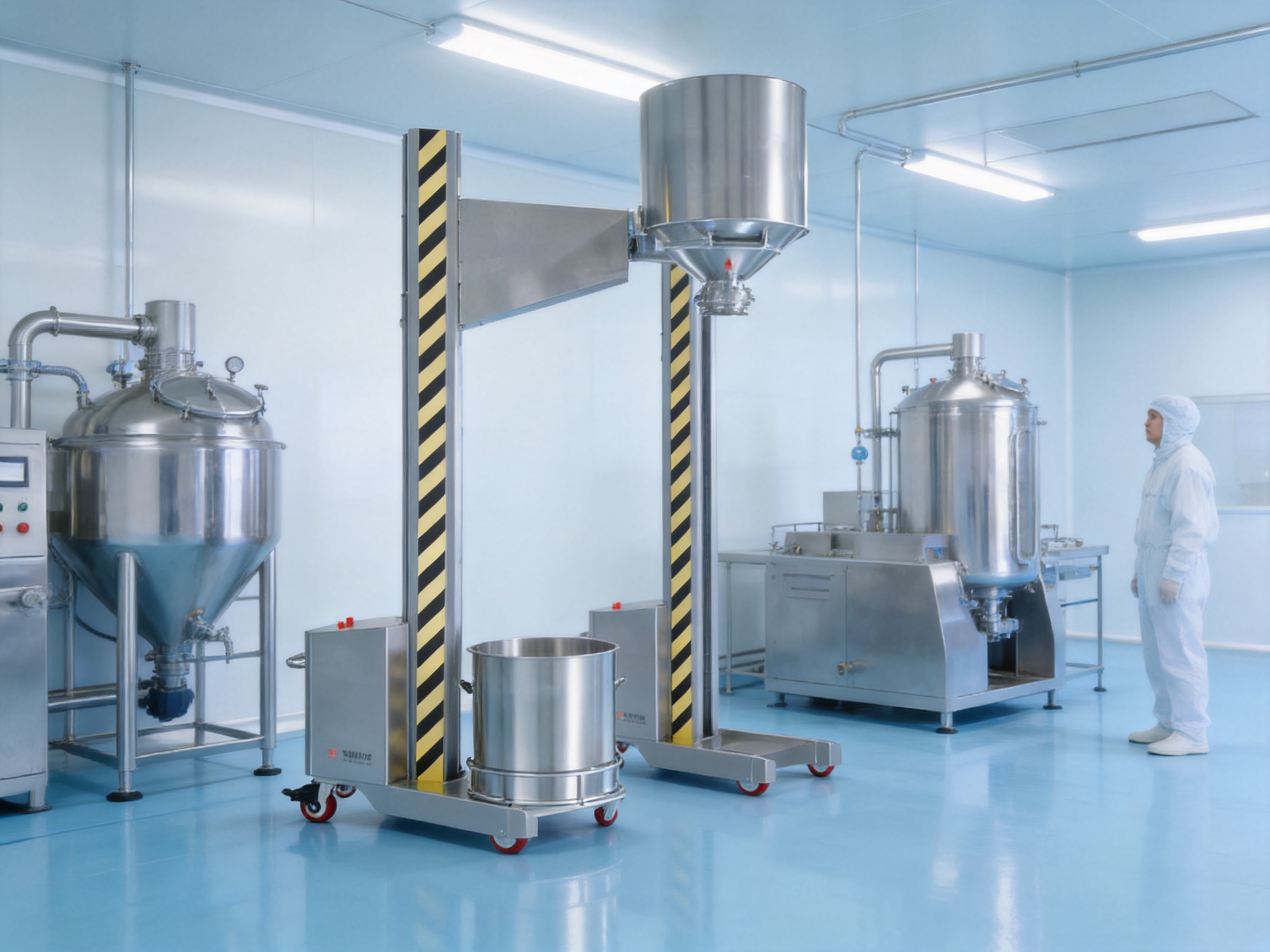
Fixed conveyors are useful when a facility has a stable layout and a single transfer route. However, they may be less suitable for plants that manufacture several products or operate multiple process configurations. The NTY mobile base allows the machine to move between compatible process positions, providing a level of flexibility that a permanently installed conveyor may not offer.
Manual transfer often requires operators to lift, push, carry, or empty containers. These activities can consume time and expose personnel to ergonomic strain. The lifting mechanism takes over the primary elevation task, while the tilting assembly supports controlled discharge. This can reduce the physical effort required during routine operation.
Open transfer exposes material to the room environment. The enclosed connection and butterfly-valve discharge of the NTY machine are intended to reduce uncontrolled dust release. This provides an advantage over simple open-bin or bag-dumping methods, particularly for fine powders.
When operators align containers manually, the quality of the connection may vary from batch to batch. A machine designed for repeatable lifting, alignment, and tilting can help establish a more consistent transfer sequence. Consistency is valuable in regulated production because it supports repeatable operating procedures and easier process documentation.
Cross-contamination can occur when residual material remains in transfer equipment or when products are exposed during movement. The smooth construction, lack of dead corners, removable valve, and enclosed transfer concept help support a more controlled cleaning and changeover strategy. The machine does not replace validated cleaning procedures, but it can make those procedures more practical.
A compact mobile unit can be advantageous in facilities where floor space is limited. Rather than installing separate lifting structures for each process machine, one unit may serve multiple compatible locations. The final choice depends on production capacity, cleaning requirements, room classification, and the number of transfer operations required per shift.
Different equipment types rarely share exactly the same inlet elevation. The adjustable lifting system enables the conical bin to be positioned at different heights. This is a significant advantage over fixed-height feeding equipment and can simplify integration with existing production machinery.
Oral solid dosage production typically involves a sequence of material-processing stages. Powders may be dispensed and mixed before being granulated, dried, lubricated, compressed, coated, or filled into capsules. At each stage, material must be transferred without compromising blend uniformity, granule quality, or cleanliness.
After mixing, the material may need to be delivered to a granulator. Following wet or dry granulation, the granules may be transferred to a dryer or sizing unit. Dried granules can then be conveyed to a final blending system or tablet press. Tablets may proceed to a coating machine, while powder blends may be directed to a capsule filling machine.
The NTY Mobile Lifting Feeding Machine can serve as an intermediate connection between these process stages. Its lifting capability is useful where the outlet of one container must meet the inlet of a machine positioned at a higher elevation. Its mobile design is useful where the same transfer point changes according to the product or batch route.
For tablet production, enclosed transfer can help protect the blend before compression. For capsule production, it can help reduce exposure during the movement of powder into the filling system. For coating operations, the machine can assist with the movement of tablets or related solid materials where the container and discharge configuration are suitable.
In each application, process engineers should evaluate flowability, particle size distribution, moisture content, segregation tendency, bulk density, and the sensitivity of the formulation to mechanical movement. Some materials may require special discharge aids or carefully controlled flow rates. These requirements should be addressed during technical specification and factory testing.
The machine is also suitable for chemical and food industries that require hygienic solid-material handling. Chemical applications may include the transfer of powders, granules, additives, or intermediates between production stages. Food applications may include ingredients and dry blends that must be moved in a controlled and clean manner.
Different industries may have different requirements for materials of construction, surface finish, sealing, electrical protection, cleaning agents, and documentation. The basic lifting, mobile alignment, tilting, and enclosed discharge concept can be adapted to those requirements when the material and process conditions are properly assessed.
In nutraceutical and veterinary production, the machine may support processes similar to pharmaceutical manufacturing, including powder blending, granulation, drying, and encapsulation. It can be considered for pilot-scale, medium-scale, or full-scale production depending on the selected container size and the overall process design.
The manufacturer behind the NTY series specializes in powder processing and oral solid dosage equipment. Its capabilities cover standalone machines, modular systems, and complete production lines. This broader product scope is valuable because a transfer machine must work effectively as part of a complete process rather than as an isolated piece of equipment.
Engineering begins with an understanding of material characteristics, capacity requirements, production sequence, and site conditions. A transfer system that is suitable for one powder may not be suitable for another. By considering the complete process route, the manufacturer can help determine the required lifting range, container configuration, discharge arrangement, and connection method.
The company was founded in 2010 and is based in Changzhou, China. Its product portfolio includes laboratory equipment, mixing equipment, granulation equipment, drying equipment, coating equipment, auxiliary processing equipment, and transfer and conveying systems. This range supports the development of integrated solutions for pharmaceutical, biopharmaceutical, biotechnology, nutraceutical, veterinary, additives, chemical, and related industries.
One strength of this approach is process integration. Customers may require more than a single machine; they may need a coordinated route from powder charging through final dosage production. A supplier with experience across several equipment categories can better understand how mixing, granulation, drying, coating, and transfer affect one another.
The manufacturer also emphasizes localized engineering adaptations based on international design concepts. This means the equipment is developed with attention to widely recognized hygienic and process principles while being adapted to practical manufacturing, installation, and service conditions.
Research and development, patented technologies, quality system certification, and overseas service capabilities further support the company’s equipment program. These resources can help customers with technical communication, customization, commissioning, troubleshooting, and long-term equipment support.
For international buyers, supplier responsiveness is an important part of equipment value. Clear documentation, spare-parts support, remote technical communication, and service coordination can influence the total cost of ownership as much as the initial purchase price. A manufacturer with overseas project experience is better positioned to support these requirements.
Producing a reliable mobile lifting machine requires coordination between structural fabrication, mechanical assembly, control-system integration, surface treatment, and final inspection. The frame must support the lifting load while remaining stable during movement and tilting. The lifting system must operate smoothly and consistently across its working range. The tilting mechanism must maintain the container securely during rotation.
Surface quality is particularly important for equipment used in hygienic processing. Welded areas, corners, joints, and product-contact components should be finished in a way that supports inspection and cleaning. The final specification should identify the required surface finish and any applicable documentation for product-contact materials.
Assembly accuracy affects the alignment of the container, valve, and downstream connection. Poor alignment can increase mechanical stress, cause leakage, or make discharge less predictable. Careful fabrication and assembly help ensure that the mobile unit performs consistently during repeated production cycles.
Factory testing should verify lifting movement, tilting movement, valve operation, safety functions, mobility, and dimensional compatibility. Where required, the customer can provide interface drawings for receiving machines so that the transfer system is designed around actual plant conditions rather than assumed dimensions.
The manufacturer’s ability to produce laboratory, pilot, and full-scale equipment also supports project continuity. A customer may begin with small-scale development equipment and later require production machinery based on the same process principles. A supplier with experience across different scales can help maintain consistency as the process grows.
The following reference values describe the available NTY-100, NTY-150, and NTY-200 models. Final dimensions and interface details should be confirmed against the approved technical drawing before installation.
| Item | Unit | NTY-100 | NTY-150 | NTY-200 |
|---|---|---|---|---|
| Total power | kW | 1.87 | 1.87 | 1.87 |
| Reference installation length, L | mm | 1860 | 1910 | 1910 |
| Length, L1 | mm | 1600 | 1600 | 1600 |
| Width, W | mm | 600 | 600 | 600 |
| Height, H1 | mm | 1800 | 1800 | 1800 |
| Height, H2 | mm | 2680 | 2880 | 2950 |
| Height, H3 | mm | 1950 | 1950 | 1950 |
| Height, H4 | mm | 3450 | 3450 | 3450 |
The identical listed total power across the three models indicates that the principal differences are associated with container size or dimensional configuration rather than a major change in the drive arrangement. The increased H2 dimension from NTY-100 to NTY-200 should be considered carefully when checking ceiling clearance and the available operating envelope.
The reference width of 600 mm supports a relatively compact footprint. However, the customer should allow additional space for operator access, container connection, inspection, cleaning, maintenance, and safe movement around the machine. The required room height should be checked using the maximum operating position, not only the parked height.
Successful installation begins with a review of the production room, downstream equipment, floor condition, ceiling clearance, and material-transfer route. The receiving equipment’s inlet height and centerline should be compared with the lifting and tilting range of the selected model.
The floor should be level and capable of supporting the machine and its maximum working load. The movement path should be free from steps, drains, fixed obstructions, and low overhead structures that could interfere with positioning. If the machine must pass through doors or between rooms, the transport dimensions should be checked in advance.
Utilities and electrical requirements should be confirmed during technical planning. The listed total power is 1.87 kW for each referenced model, but voltage, frequency, control-panel requirements, protection rating, and local electrical standards should be confirmed for the destination country.
The installation layout should also provide adequate clearance around the valve and container. Operators need sufficient space to establish connections, inspect the discharge point, remove the valve, and perform cleaning. Crowded installation conditions can undermine the hygienic and maintenance benefits of the equipment.
Before production begins, the machine should undergo commissioning checks. These should include empty-load movement, loaded movement where appropriate, alignment with the downstream machine, valve operation, emergency functions, and confirmation that all operators understand the operating sequence.
Cleaning requirements depend on the product, batch sequence, facility classification, and customer validation procedures. The smooth and compact construction of the NTY machine is intended to simplify cleaning, but the actual cleaning method must be established by the user.
Operators should inspect the conical container, discharge valve, seals, connection surfaces, frame, lifting mechanism, and tilting assembly. Product-contact surfaces should be cleaned using approved agents and methods. Residual powder should not be allowed to accumulate around moving parts or connection points.
The removable butterfly valve is useful for detailed inspection and cleaning. It should be removed only after the system has been made safe and the container has been emptied. Seals and gaskets should be examined for wear, deformation, or damage and replaced when necessary.
Preventive maintenance should include inspection of lifting components, fasteners, guides, wheels, bearings, drive elements, sensors, controls, and safety devices. Lubricants used near product-contact areas must be selected carefully to avoid contamination. Maintenance records should document inspections, adjustments, replacements, and functional tests.
Where the machine is used for multiple products, changeover procedures should include line clearance, visual inspection, cleaning verification, and appropriate documentation. The equipment’s hygienic design can support these activities, but reliable results depend on disciplined operating procedures and trained personnel.
Model selection should begin with the required container capacity and batch size. The NTY-100, NTY-150, and NTY-200 designations indicate different model configurations, but the customer should obtain the complete capacity, working-load, and interface data for the intended application.
Next, the customer should identify the highest and lowest receiving inlets that the machine must serve. The operating height, ceiling clearance, container dimensions, and discharge centerline must all be evaluated. A machine that fits in its parked position may still require additional space during lifting or tilting.
Material characteristics are also important. Powders that bridge, cake, segregate, or adhere strongly to surfaces may require special container geometry, discharge assistance, or process controls. Fragile granules may require gentle handling and limited impact. Fine or potent powders may require a higher level of containment and specialized connection technology.
The required production rate should be considered together with batch size and transfer frequency. A mobile feeding machine may be ideal for batch-based production, while a continuous process may require a different feeding arrangement or additional controls.
Finally, the customer should consider cleaning frequency, product changeover, room classification, operator workflow, documentation, and future expansion. The best configuration is not necessarily the one with the largest capacity; it is the one that provides the appropriate combination of process fit, hygiene, mobility, safety, and lifecycle value.
Efficiency in pharmaceutical production is created through the coordination of many small improvements. A transfer machine that reduces manual handling, improves alignment, limits dust release, and simplifies cleaning can contribute to better overall performance even though it is not the primary processing machine.
The NTY system can help shorten the distance between process stages and reduce the number of separate handling steps. It can also make production rooms more adaptable by allowing one machine to serve different equipment positions. This flexibility is useful for contract manufacturers and plants that produce multiple formulations.
Better transfer control may support more consistent batch operations. When operators follow a repeatable lifting, alignment, tilting, and discharge sequence, the process becomes easier to train, monitor, and document. Consistency can also support investigations when deviations occur.
Dust reduction and hygienic construction can lower the time and effort required for housekeeping and changeover. While cleaning time depends on the formulation and validation method, a machine with fewer inaccessible areas is generally easier to inspect and maintain than a complex structure with numerous exposed joints and dead spaces.
In addition, a mobile machine can offer long-term value as the production layout evolves. Pharmaceutical plants often add new equipment, change product families, or adjust batch sizes. A transfer system that can be repositioned and adjusted may remain useful through these changes, reducing the likelihood of early replacement.
The machine is designed for solid materials, including pharmaceutical powders and granules. It may also be used for suitable chemical, food, nutraceutical, veterinary, and additive materials. The material’s flowability, bulk density, moisture content, particle size, abrasiveness, and contamination sensitivity should be reviewed before selection.
Yes. The machine is intended to integrate with mixers, granulators, tablet presses, coating machines, capsule filling machines, and other compatible process equipment. The connection must be designed according to the inlet dimensions, height, discharge arrangement, and containment requirements of the receiving machine.
The mobile base allows the lifting machine to be moved and aligned with different downstream equipment positions. This can be useful when one transfer system serves multiple production lines or when the plant layout changes. The movement path and floor conditions must be suitable for safe repositioning.
The tilting assembly rotates the conical material container by 180 degrees. This places the discharge outlet above or in alignment with the inlet of the receiving machine, supporting gravity-assisted and controlled material transfer.
The machine is designed for enclosed material transfer and dust-controlled operation, but no equipment should be described as completely dust-free without a specific containment assessment. Facility ventilation, connection sealing, material properties, operating procedures, and cleaning practices all influence dust performance.
The hygienic construction principles, smooth surfaces, absence of dead corners, lack of exposed fasteners, enclosed transfer route, and removable butterfly valve are intended to support pharmaceutical GMP requirements. The user must still confirm the final materials, documentation, validation strategy, cleaning procedure, and facility controls required for its specific regulatory environment.
The butterfly valve is designed to be easily removable for maintenance and cleaning. Before removal, the system should be isolated, the container emptied, and the valve made safe according to the operating procedure. Seals, surfaces, and operating components should be inspected regularly.
The reference specifications list a total power of 1.87 kW for NTY-100, NTY-150, and NTY-200. Electrical voltage, frequency, control requirements, and final power details should be confirmed in the approved project documentation.
Pharmaceutical transfer systems are commonly configured according to container size, discharge height, downstream interface, material-contact requirements, and site conditions. The customer should provide process data and layout information so that the final configuration can be properly engineered.
Customers should check required capacity, working load, lifting range, maximum operating height, ceiling clearance, container dimensions, downstream inlet height, product-contact materials, cleaning requirements, containment expectations, electrical standards, safety features, documentation, installation conditions, and after-sales support.
The NTY Mobile Lifting Feeding Machine provides an integrated solution for lifting, positioning, tilting, and feeding solid materials in pharmaceutical production. Its mobile base supports flexible alignment, while the telescopic and vertical lifting systems allow the conical container to reach different process heights. The 180-degree tilting assembly and butterfly-valve discharge create a controlled route into downstream equipment.
Its main advantages over simpler transfer methods include reduced manual handling, improved flexibility, more consistent equipment connection, enclosed material movement, dust-control support, and a hygienic structure designed for cleaning access. These features make the machine suitable for integration with mixers, granulators, tablet presses, coating machines, capsule filling machines, and other solid-dosage processing equipment.
The manufacturer’s broader capabilities in powder processing, oral solid dosage equipment, modular systems, complete production lines, research and development, quality management, and overseas service further strengthen the value of the product. Rather than treating material transfer as an isolated operation, the equipment can be evaluated as part of a complete process route based on material properties, capacity, site conditions, and future production needs.
For pharmaceutical, chemical, food, nutraceutical, and related manufacturers, a properly specified mobile lifting and feeding machine can contribute to cleaner production, more efficient workflows, improved operator safety, and better use of plant space. Final performance will depend on correct configuration, installation, cleaning, validation, and operation, but the NTY design offers a practical foundation for hygienic and adaptable solid-material handling.
1. User-provided product information for the NTY Mobile Lifting Feeding Machine, including operating principle, features, model data, and reference dimensions.
2. User-provided company information concerning powder processing equipment, oral solid dosage systems, process integration, research and development, and manufacturing capabilities.
3. Good Manufacturing Practices principles for pharmaceutical production, with emphasis on equipment hygiene, contamination control, cleaning, documentation, and process consistency.
4. General engineering practices for powder handling, enclosed transfer, dust control, equipment integration, and safe operation of lifting systems.
5. General hygienic-design principles for pharmaceutical, food, chemical, nutraceutical, and related solid-material processing equipment.
Want to stay up to date?
Contact us via the email address below.
Don't worry about spam. We hate it too!
Mobile Client

Video Account
Phone:+86-15161130178
Tel:+86-519-88674267
Email:czzy188@163.com
Phone:+86-15161132798
Email:zy@zy-drying.com

WeChat ID

Copyright 2026 Changzhou Zhiyang Machinery Equipment Co., Ltd. All Rights Reserved  Oral Solid Dosage Equipment Manufacturer